


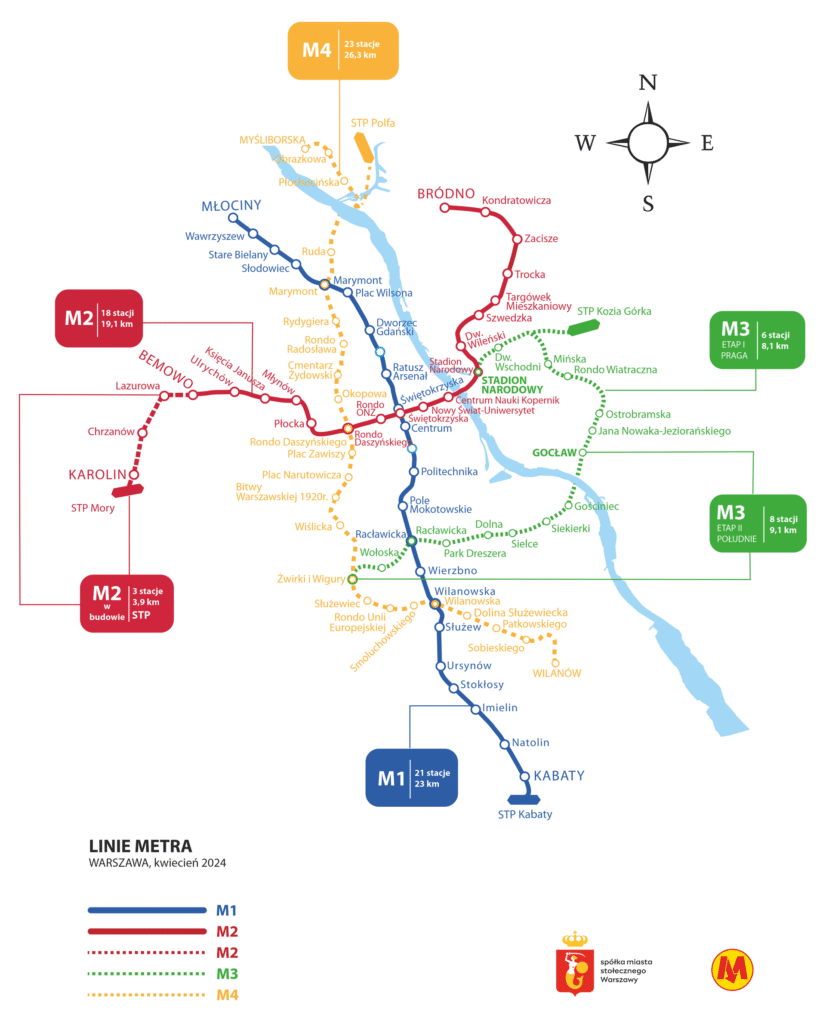
Poland’s capital will receive a 26‑km, 23‑station IV metro line from Tarchomin to Wilanów, with trains slated to operate autonomously by 2027.
Contract Awarded to Metroprojekt
On day signed an agreement for pre‑conceptual works for IV metro line with a technical‑stopping station in Warsaw.
Metroprojekt sp. z o.o., the tender’s winner, will prepare the line’s conceptual design and necessary documents, aiming for completion in 2027.
The full pre‑conceptual work will take 38 months, with the final documentation expected in 2027.
Planned Route, Length and Stations
The M4 line will stretch 26 km between Tarchomin and Wilanów, featuring 23 stations, including two shared with M2 and M3.
Eight stops will host sidings, and a new technical‑stopping station plus a central dispatcher will be added.
The line will connect nine districts—Białołęka, Bielany, Żoliborz, Śródmieście, Wola, Ochota, Mokotów, Włochy and Wilanów—and intersect major rail and road lines, providing key transfer points to M1, M2, M3, M5 and other transport networks.
Project Scope and Deliverables
Deliverables include a Conceptual Project report (initial and final), impact zone assessments, hydrogeological and geotechnical documentation, and detailed station location and tunnel alignment studies.
The works will also address whether the line can operate autonomously and the use of passenger‑door systems.
These studies will inform the subsequent construction tender, establishing precise alignment, station design and operational schemes.
Tender Process and Bids
The procurement opened in March; three firms submitted bids—ILF Consulting Engineers (54.7 M PLN), Voessing (52.3 M PLN) and Metroprojekt (52.2 M PLN).
The city budgeted 50.922 M PLN for the contract; the National Appeal Chamber upheld the selection of Metroprojekt after reviewing appeals.
Autonomous Operations and Environmental Focus
A key question is whether trains will run without conductors, impacting future operation, station layout and connectivity.
The pre‑conceptual study will also investigate eco‑friendly solutions, such as energy supply, heating and rainwater utilisation, aligning with the city’s sustainability goals.