


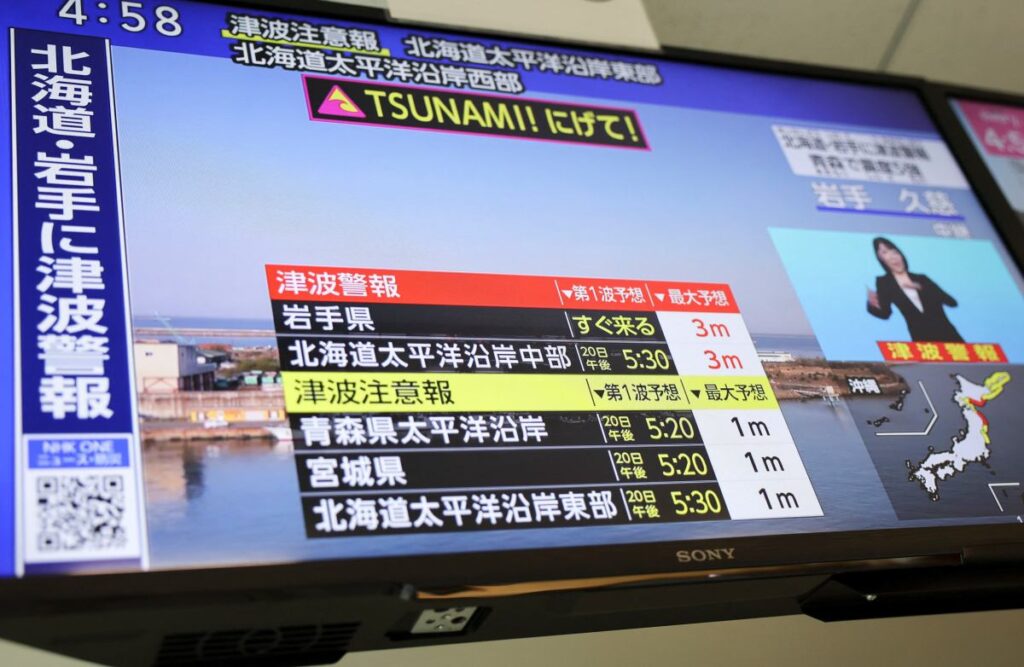
A 7.5 magnitude earthquake struck Japan, triggering tsunami warnings and prompting evacuations along the country’s coastlines on Wednesday.
Earthquake Details
Authorities report the epicenter was approximately 100 km from the Japanese coast, with the quake’s focus located 10 km deep. The Japan Meteorological Agency recorded a seismic intensity of 5+ on the Japanese scale, which ranges from 0 to 7.
Tsunami Observations and Warnings
Initial tsunami waves of 40 and 80 cm reached the coast at 5:34 PM local time (10:34 AM Polish time) at the port of Kuji in Iwate Prefecture. Meteorological agencies warn that higher waves may still reach Japan, necessitating evacuations to higher ground.
Tsunami warnings are currently in effect for Iwate, Aomori, and Hokkaido prefectures. Residents have been urged to evacuate to elevated areas.
Government Response
Japanese Prime Minister Sanae Takaichi has established a task force to address the situation and reiterated the evacuation appeal. She urged residents in warned areas to immediately evacuate to higher ground or designated evacuation buildings.
Nuclear Facility Status
According to the Kyodo news agency, no irregularities have been detected at nuclear power plants in Aomori and Miyagi prefectures. Inspections are ongoing at the Fukushima nuclear power plant, site of the 2011 reactor meltdown.
Japan’s Seismic Activity
Japan is located within the Pacific Ring of Fire and is highly susceptible to earthquakes. Approximately 1,500 earthquakes are detected annually, most of which are imperceptible to humans.
Historical Context: 2011 Earthquake and Fukushima
In March 2011, Japan experienced a magnitude 9.0 earthquake, the strongest in the country’s history, resulting in nearly 20,000 deaths and severe damage to the Fukushima nuclear power plant.
The long-term consequences of the Fukushima disaster extend beyond radiation exposure, encompassing forced evacuations, community disruption, and prolonged uncertainty.