

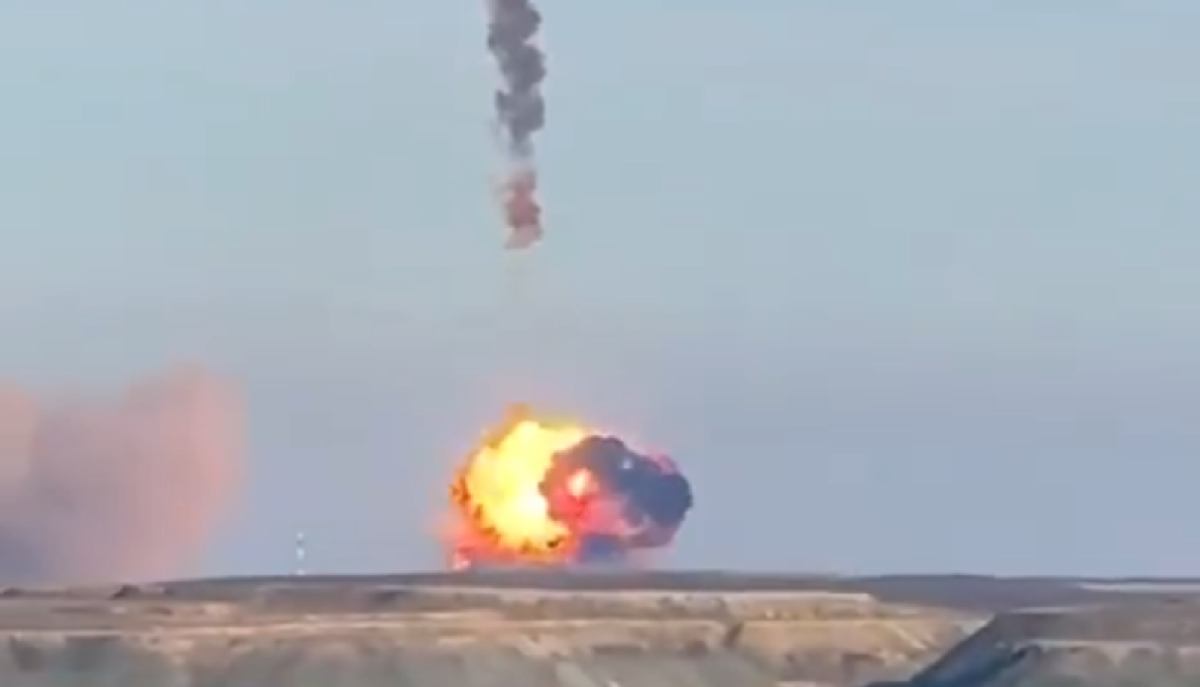
A heavy ballistic missile exploded near Jasnyj, Russia, on November 28 during a test launch that may have involved Russia’s new RS‑28 Sarmat.
Accident near Jasnyj on November 28
A fatal accident occurred on Friday 28 November near the town of Jasnyj, located on the shore of the Sea of Azov and close to the Kazakh border. The site hosts a division of Russia’s strategic missile forces (the 13th), containing 62 Soviet-era silos. Satellite images and footage of the incident suggest that one missile was used in a test launch of the RS‑28 Sarmat, mirroring a disaster in 2024.
The failed launch
The missile failed very early, likely at lift‑off. The footage shows no clear ejection from the silo, but a few seconds later the rocket’s main first‑stage engine appears to activate while the vehicle loses its trajectory and rotates upside down before disintegrating. A separate piece of equipment detached, resembling the booster that normally launches the missile from the silo just before engine ignition. Its premature separation is believed to have caused the runaway motion.
Video confirms liquid fuel use
Recordings indicate the missile used liquid propellant. Soviet ICBMs used dimethylhydrazine and nitrous oxide, highly efficient yet toxic, producing orange‑tinted smoke as seen in the debris cloud. Today’s Russian liquid‑fuel ICBMs include the R‑36M “Wajha” (known in NATO as “Satan”), the UR‑100UTTKh, and the new RS‑28 Sarmat. The footage shows a “cold launch” where the booster pushes the missile out of the silo, ruling out the hot‑launch UR‑100UTTKh which ignites inside the silo.
Possibly the RS‑28 Sarmat
The test was intended for the RS‑28 Sarmat, the successor to the R‑36M/Wajha. The program started in the early 2010s, but progress has been slow owing to a lack of expertise in liquid‑fuel heavy rocket design, which had largely moved to Ukraine’s Donbas plants during the Soviet era. The first Sarmat flight occurred only in 2022, and a spectacular failure in 2024 at Plesetsk destroyed a dedicated test silo. The current failure likely involved the same unfinished vehicle, as the launch silo was recently rebuilt after the 2024 incident.
Implications for Russia’s strategic arsenal
The repeated failures of the heavy missile indicate that the RS‑28 remains far from operational readiness. Russia still possesses about 40–50 R‑36M “Satan” missiles in 13th and 32nd divisions, each capable of carrying up to ten warheads, representing 30–40 % of its land‑based nuclear force. These age‑old warheads, maintained with Ukrainian help until the early 1990s, are expected to last only until the mid‑2020s. Delays in the Sarmat program risk undermining the credibility of Russia’s nuclear deterrent.


