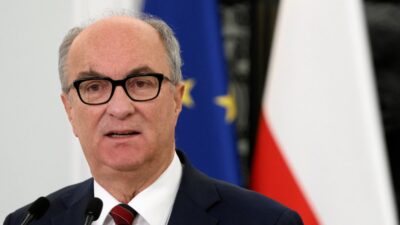
In 2026, President Trump established a Peace Council in Davos, signed by 20 countries, positioning it as an alternative to the United Nations.
Trump’s Peace Council Formation
Donald Trump, the 47th President of the United States, established the Peace Council in Davos in January 2026. The founding document was signed by representatives of 20 countries. The organization is tasked with overseeing the peace process in the Gaza Strip and resolving conflicts worldwide, effectively positioning itself as an alternative to the UN. Notably, most NATO countries, including Poland, are not among the signatories. Russia is also absent. Interested nations seeking permanent seats on the Peace Council must contribute $1 billion for three-year membership, with reduced fees of $200 million available for smaller countries.
UN’s Founding Controversies
The atmosphere surrounding the United Nations has consistently been strained. During the founding conference in San Francisco in 1945, significant divisions emerged between small nations and the “Big Five.” The dispute focused on expanding the powers of the UN General Assembly and questioning the role of major powers in the context of the principle of sovereign equality between large and small states. Consequently, small nations had to comply, and from the 1,200 amendments they proposed to the UN Charter draft, only one was adopted.
Polish Ambassador to the US during World War II Jan Ciechanowski commented: “Poland’s empty chair at the San Francisco conference significantly influenced the character of this assembly. It was strange and incomprehensible that at the end of a victorious world war, by unilateral decision approved by democratic America, Poland—one of the allied states that never ceased its loyalty to the camp and actively supported it in military operations—was excluded from the assembly of nations supposedly convened to incorporate principles of justice and democracy.”
Historical Criticisms of the UN
In Poland, no critical publications about the UN appeared until the 1989 transformation. According to Prof. Jan Sandorski, a renowned international law expert, this was influenced by the position of Polish diplomacy, following the Soviet Union’s example, which deemed discussions about changing the UN Charter undesirable. Since the end of the Cold War, during which the General Assembly was called an “American voting machine,” the organization has been assessed more moderately as a whole, though criticism of certain members continued.
The UN has faced criticism not only from small nations. Some issues were suppressed, and the public was not properly informed about them, such as the case of Kurt Waldheim, who served as UN Secretary-General for two terms (1972-1982) but concealed his membership in the SA (Sturmabteilung), recorded in the Central Register of War Criminals. He misled UN members, including Poland. As late as 1985, the Polish press described him as a politician with clean hands, wounded on the eastern front who returned to Vienna to study and was an unwavering advocate of Austrian neutrality.
UN Ineffectiveness and Calls for Reform
Meanwhile, the Waldheim case cast an unfavorable light on relations within the UN. The natural question arose of how a person whose past decision-makers could not have been unaware of could have reached such a prominent position. According to a CIA report, this “devoted friend of the United States, very willing to cooperate and helpful in promoting US interests” became completely discredited internationally as UN Secretary-General and later as a diplomacy professor at Washington University.
For many years, American society has believed that the UN exists thanks to the generosity of American taxpayers while often acting against US national interests. The American press and even academic studies have called for reducing the privileges of UN diplomats and their families, citing espionage charges and sometimes common criminal offenses. A notable scandal in 1981 involved the 19-year-old son of a Ghanaian attaché at the UN who committed multiple rapes, robberies, and other crimes that could have resulted in several hundred years in prison, but diplomatic immunity resulted in his release 45 minutes after arrest.
The UN’s Current Challenges and Achievements
More than 80 years after the UN’s creation, nothing fundamental has changed in the organization. In the 1980s, Edmund Osmańczyk (author of the “Encyclopedia of the UN and International Relations”) questioned the UN’s relevance given that its most important role—protecting world peace—has been in the hands of great powers for 40 years. Forty-one years after these words were published, it can be stated that the UN remains helpless in the face of the war in Ukraine. As Russia is a permanent member of the Security Council with veto power, the organization has no means of forcing it to stop aggression and is unable to halt the armed conflict.
Fortunately, the political deadlock has not completely eliminated possibilities for providing assistance during the war in Ukraine. One of the UN’s greatest achievements there was the mission conducted with the International Committee of the Red Cross, aimed at ensuring the safe evacuation of civilians from the Azovstal plant in Mariupol. Through its agencies, the UN focuses on delivering food, medical aid, and evacuating from front-line areas. UN peacekeeping missions, of which 79 have been conducted with 11 still active, are undoubtedly a success. These forces received the Nobel Peace Prize in 1988 for their merits.
Critics of the UN’s functioning have emphasized for many years that both the UN and specialized international agencies have proliferated with specialized agencies. Each produces numerous programs and projects, while more and more auxiliary bodies, commissions, subcommittees, etc., are created. Therefore, there is often a lack of funds for specific assistance, as all have been spent on hiring experts to solve problems. The diagnoses of this situation are clear: incorrect assessment of the UN system’s role, lack of development concept for member states, ineffective coordination mechanisms, lack of project classification methodology, and grandiose statements serving the illusion of the UN’s dominant position.
Can the Peace Council established by President Trump meet the challenges of the modern world? The answer can only recall the biblical principle from the Gospel according to St. Matthew: “By their fruits you shall know them.”