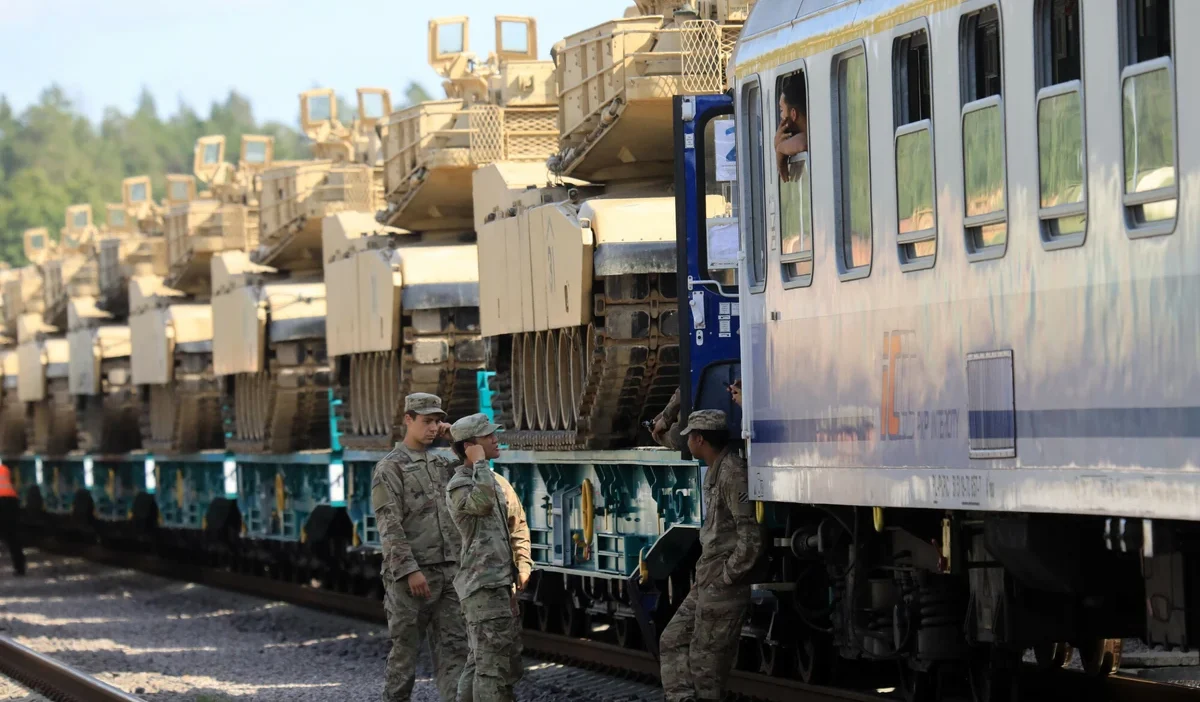
NATO is deploying hundreds of tanks to its eastern flank with Russia, establishing a new permanent military presence in Lithuania.
NATO’s Permanent Deployment in Lithuania
The deployment of troops is part of a broader strategy to strengthen NATO’s eastern flank and deter potential aggression in the Baltic Sea region. Germany is set to play a central role in this system according to operational plans. The first elements of the plan are already being implemented.
By 2027, there will be 4,800 NATO soldiers stationed in Lithuania.
German Brigade’s Operational Plan
The core of Germany’s presence will be the newly formed 45th Lithuanian Panzer Brigade of the Bundeswehr. Its strength is set to increase from approximately 500 to 1,800 soldiers in the near term, reaching full operational readiness with nearly 4,800 military personnel by 2027.
The brigade is stationed at the base in Rudniki, 30 kilometers south of Vilnius. Support units have been deployed in Rokantiszkach and Niemenczyn. With the expansion of the brigade, Germany is taking direct command of the NATO multinational battalion battle group in Lithuania, which has been operational for nearly a decade. Its composition includes soldiers from Germany, the Netherlands, Norway, and Luxembourg.
The backbone of the forces will consist of two German battalions: the 122nd Panzer Grenadier Battalion from Bavaria and the 203rd Panzer Battalion from North Rhine-Westphalia. Together with the existing battle group, they will create an integrated defensive component capable of immediate response.
Lithuania’s Strategic Importance
Lithuania is considered one of the most critical security points in Europe. Located between Belarus and the Russian Kaliningrad Oblast, it is a key area in the context of a potential conflict in the Baltic Sea region. NATO’s shift in strategy—from small rotational contingents to permanent military presence—is part of a broader transformation of the Alliance following Russia’s aggression against Ukraine.
Germany’s Political Shift
For Berlin, this is also a clear political signal. After decades of limited military engagement, Germany is building the image of a state ready for the active defense of NATO’s eastern borders. A permanent armored brigade outside the country marks a significant shift in German security policy and strengthens the role of the Bundeswehr as one of the pillars of the European defense system.
Ukraine’s Elections and Peace Referendum
Parallel to changes on NATO’s eastern flank, information is emerging regarding the political situation in Ukraine. British media, citing Ukrainian and European sources familiar with the plan, reported that Ukraine has begun planning presidential elections that would be held along with a referendum on the peace plan project with Russia.
In December, the Kyiv International Institute of Sociology conducted a public opinion poll showing that only 9% of Ukrainians believe elections should be held before a ceasefire takes effect. 57% of respondents believed that voting should only occur after a peace agreement is reached.
Last week, Reuters reported that during talks between US and Ukrainian negotiators, it was agreed that any peace agreement project would be subject to a referendum, which would be combined with presidential elections. The term of Volodymyr Zelensky expired on May 20, 2024, but due to the state of war, it was not possible to hold elections.
Dispute Over Donbas Territory
President of Ukraine reported a few days ago that the United States expects a peace agreement to be signed between Russia and Ukraine by June. Despite the start of talks in a trilateral Russia-Ukraine-USA format in Abu Dhabi and two rounds of negotiations, serious differences remain between Moscow and Kyiv.
The most serious dispute concerns territorial issues. Russia demands the withdrawal of the Ukrainian army from the still-controlled, heavily fortified part of Donbas—covering several percent of the area of the Donetsk Oblast. Moscow also opposes security guarantees for Ukraine in the form of foreign troops stationed on its territory.
Western countries, in turn, propose that peace be guaranteed by forces provided by European countries—primarily the United Kingdom and France. Poland would provide logistical support for such a mission.
A January poll by the Kyiv International Institute of Sociology shows that 54% of Ukrainians reject the possibility of ceding all of Donbas to Russia, while 39% of respondents declare willingness to make such a concession.