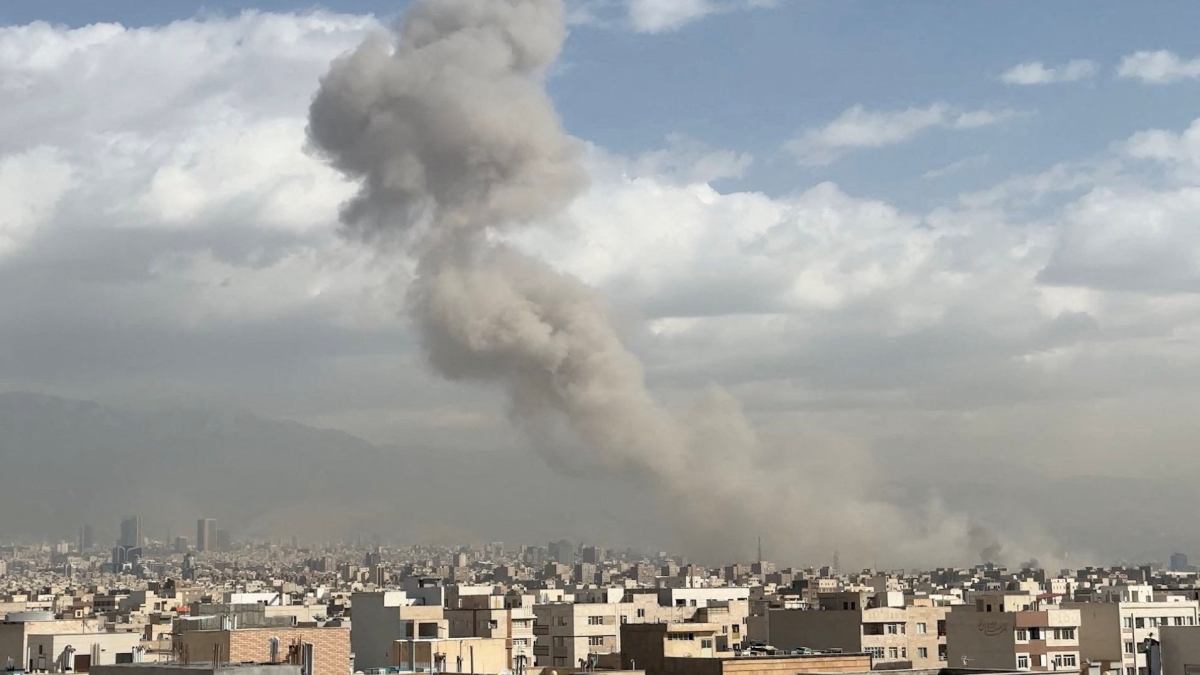
Explosions were heard in Tehran following reported Israeli and US missile attacks targeting Iran’s leadership.
Explosions in Tehran
Iranian media report at least three explosions were heard in Tehran. According to Iran International, the attack targeted the main office of Iran’s Supreme Leader, Ali Khamenei. Reuters reports that Khamenei is not in Tehran and has been transported to a safe location.
Additional Attacks
Fars news agency claims strikes were also conducted in cities including Isfahan, Qom, Karaj, and Kermanshah. Iranian media report that Iran has closed its airspace.
Israel Prepares for Retaliation
Within the last few minutes, air raid sirens have sounded across Israel, and mobile phones issued warnings to stay near protected areas. This is a proactive warning aimed at preparing society for the possibility of missiles being fired at Israel. The Israel Defense Forces emphasized that the public is requested to remain near protected areas.
National Emergency Measures
Israel has decided to move all areas of the country from full activity to essential activity only. Guidelines include bans on education, gatherings, and work, except for essential sectors.
Nuclear Program Talks
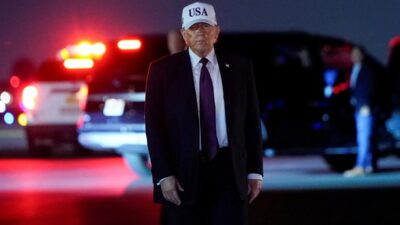
On Thursday, a round of talks between Iran and the United States regarding Iran’s nuclear program concluded in Geneva. US President Donald Trump stated he was “not impressed” with the results of these negotiations. Technical-level talks are scheduled for next week in Vienna.
In recent weeks, Trump has not ruled out attacking Iran. As recently as Friday, the American president indicated he would “very much prefer not to use” US military forces but “sometimes it’s necessary.”
In June of last year, the United States attacked three Iranian nuclear facilities.
Diplomatic Options
Iran is currently insisting on maintaining its ability to produce low-enriched uranium, is willing to suspend parts of its nuclear work for 3-5 years, and is offering cooperation to the US in extracting its oil and minerals.
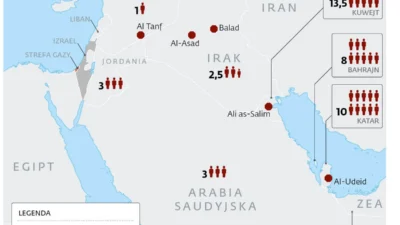
Marcin Andrzej Piotrowski of the Polish Institute of International Affairs noted in Friday’s analysis that diplomatic solutions might be deemed insufficient by Israel and worse for its interests than the 2015 nuclear deal (JCPOA). Such a scenario and the withdrawal of current US military reinforcement in the Middle East would leave Israel facing the threat of Iran’s expanding rocket arsenal, and after 3-5 years, the threat of the country enriching uranium again at higher levels. He assessed that such a development would limit Israel’s options for unilateral strikes against Iran’s rocket arsenal and production facilities.