German Chancellor Merz remained silent as Trump threatened to break trade with Spain over defense spending, later failing to defend the EU partner.
Trump’s Threat Against Spain
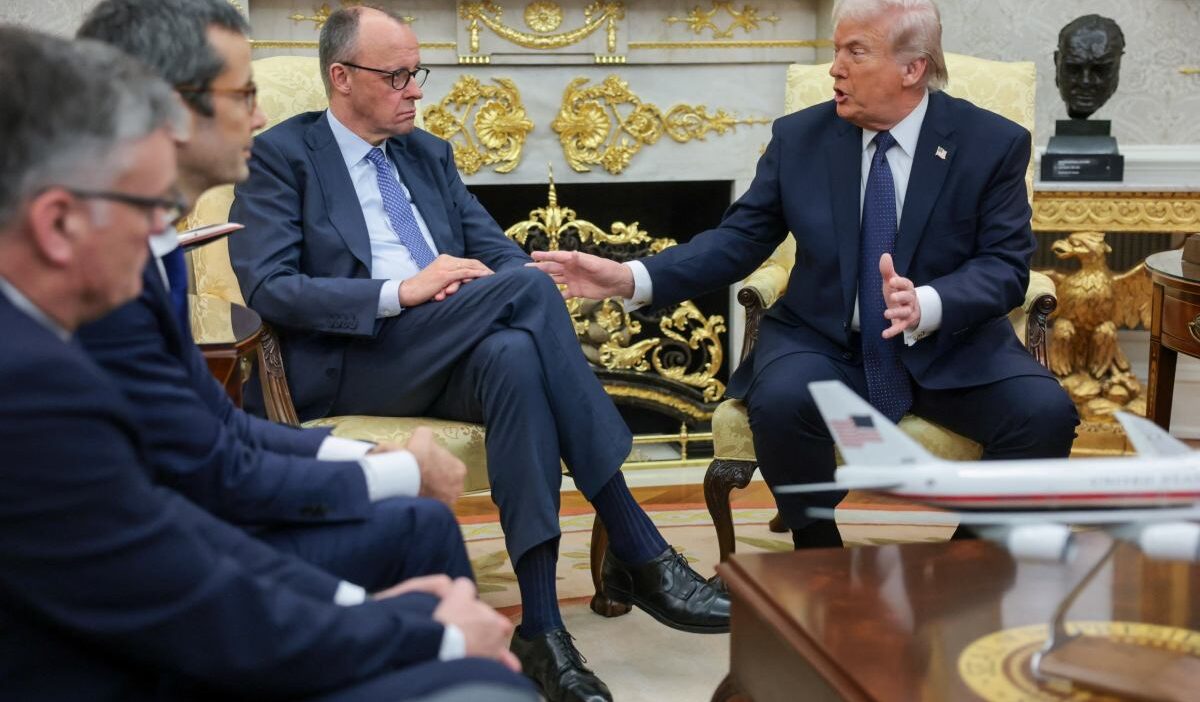
During Tuesday’s meeting at the White House, President Trump announced he might “break all trade with Spain” due to what he considered insufficient Spanish defense spending and Madrid’s refusal to provide military bases for operations against Iran. Spain allocates 2.1% of GDP to defense, while the U.S. demands NATO members increase spending to 5% of GDP.
Merz’s Delayed Response
In response to Trump’s remarks, Chancellor Merz stated that the Madrid government needs “convincing arguments” on this matter. According to “Spiegel,” the Chancellor sat silently in the Oval Office for an extended period, “listening to the tirade of the U.S. president.” The magazine noted, “He went to Washington to please Trump. At least he succeeded in that. Nevertheless, the visit did not end successfully. In the eyes of the world public, the Chancellor failed Spain, an EU partner.”
Criticism of Merz’s Inaction
“Spiegel” criticized Merz for failing to respond to Trump’s threats against Madrid. “Only a question from a German journalist forced him to take a position. Merz should have defended Spain or at least changed the subject. Instead, he joined the complaint,” the magazine wrote.
Merz’s Attempted Damage Control
The magazine suggests Merz later tried to correct his mistake during a lunch with Trump, explaining that any economic war against Spain would be aimed at the entire European Union. “It’s a pity he didn’t say this while the cameras were still filming,” “Spiegel” commented.
Historical Context
According to the magazine, “Merz’s betrayal opens old wounds in Spain.” The publication recalled that during the eurozone crisis, Berlin forced Madrid to implement an austerity program that “deprived an entire generation of future opportunities.” “Since then, many Spaniards have suspected that solidarity in Europe has its limits, especially when German interests are at stake. Merz is fueling these suspicions,” it added.
European Solidarity
In the face of U.S. trade threats, the European Commission declared on Wednesday it is “ready to respond” to defend the interests of EU member states. French President Emmanuel Macron expressed solidarity with Spanish Prime Minister Pedro Sanchez, who “represents a clear political line and sides with international law” on issues including Gaza, Ukraine, and now the conflict with Iran. “Spiegel” noted, “The U.S. president is not only acting without a plan but also violating international law.”