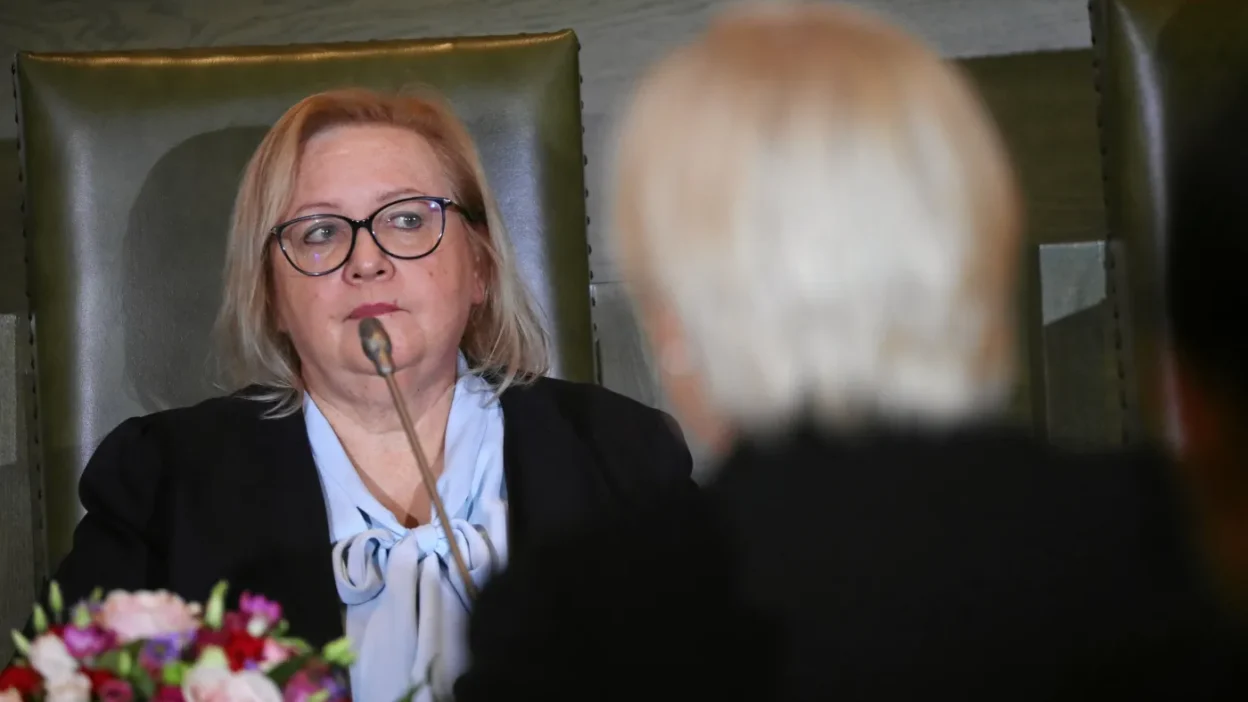
The President of the State Tribunal, Małgorzata Manowska, has criticized a deadline set by tribunal judges for resolving procedural questions, suggesting political motivations.
Dispute Over Tribunal Procedures
The President of the State Tribunal, Małgorzata Manowska, has assessed that expecting a resolution regarding the appointment of adjudicating panels within a month and a half would be naive, were it not for circumstances suggesting politically motivated actions.
Manowska’s statement on Monday responded to a series of questions posed last week by three State Tribunal judges to the full Tribunal.
Questions Regarding Judge Świrski’s Case
The questions were formulated last Wednesday by a panel led by Przemysław Rosati, stemming from a request to recuse Judge Piotr Sak from the case of former KRRiT head Maciej Świrski.
Manowska’s Procedural Directive
The core of the questions centers on evaluating President Manowska’s order from June 13, 2024, concerning procedures for appointing adjudicating panels. This order established that panels in cases brought before the Tribunal would be appointed by the President (who is, by law, also the First President of the Supreme Court) based on a prior lottery.
This system was used last September to form the panel for the case of the former head of KRRiT.
Controversies Surrounding Manowska’s Order
The series of questions concerns the mechanism for forming adjudicating panels, which – according to the justification of the questions – should be defined by statute and related regulations, not by the President’s order.
Deadline and Potential Sanctions
The judges, in posing these questions, obligated President Manowska “to convene a meeting of the full Tribunal within no later than April 4th, under penalty of disciplinary action.” Judge Rosati argued that a prompt resolution of these legal issues is necessary for the efficient handling of the case (of the former head of KRRiT – PAP) and to ensure the Tribunal fulfills its duties while respecting the rights of Maciej Świrski.
Manowska’s Response to the Deadline
In a statement published on the Tribunal’s website, President Manowska emphasized that setting a deadline of April 4th “does not fall within the limits prescribed by law and gives the impression of a solution based more on expediency than on careful normative analysis.”
“Expecting that an issue of this magnitude will be resolved within a month and a half could be considered naive, were it not for the fact that the totality of circumstances indicates that this is rather an action with a clearly political basis, aimed at achieving a predetermined result,” the President of the Tribunal emphasized.
Manowska’s Arguments and Reference to the Wąsacz Case
Manowska assessed that “if one were to accept the logic adopted in the aforementioned ruling, one would have to conclude that any adjudicating panel could, under threat of disciplinary action, force the court’s or other body’s management to take actions that fall within their own organizational competencies.”
“This conclusion is, of course, inadmissible, and at the same time clearly shows to what extent the interpretation adopted in the ruling deviates from elementary systemic assumptions,” reads Manowska’s statement.
Procedural Considerations and Time Requirements
“It should be noted that convening a meeting of the full Tribunal to resolve a legal issue requiring a fundamental interpretation of the statute does not amount to simply sending a copy of the ruling with its justification to Tribunal members. It also requires appointing a rapporteur, preparing a draft resolution, and fundamental theses for discussion, and often also in-depth development of accompanying scientific and constitutional issues. These are activities that, by their very nature, require time,” the President of the Tribunal argues.
Precedent in the Wąsacz Case
Manowska recalled that in the case of a legal issue concerning the statute of limitations in proceedings before the Tribunal against Minister Emil Wąsacz in the AWS government, the legal issue was referred to the full Tribunal in March 2017, and the resolution of the full Tribunal, chaired by then-President Małgorzata Gersdorf, that the case should be statute-barred was issued in May 2019 – more than two years after the issue was presented to the full panel.
“There was no talk then of obstruction or failure to fulfill obligations by the then-President of the Tribunal. It was simply seen as the normal course of proceedings in a matter of appropriate constitutional weight. I intend to maintain the same standard now,” emphasized President Manowska.
Next Steps in the Świrski Case
As reported last week by Judge Rosati, the Tribunal will return to the issue of recusing Judge Sak from the proceedings against Świrski on April 8th.