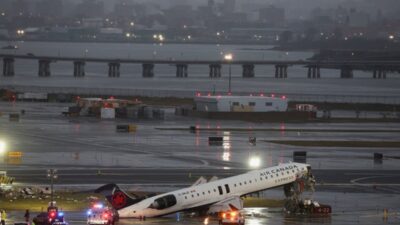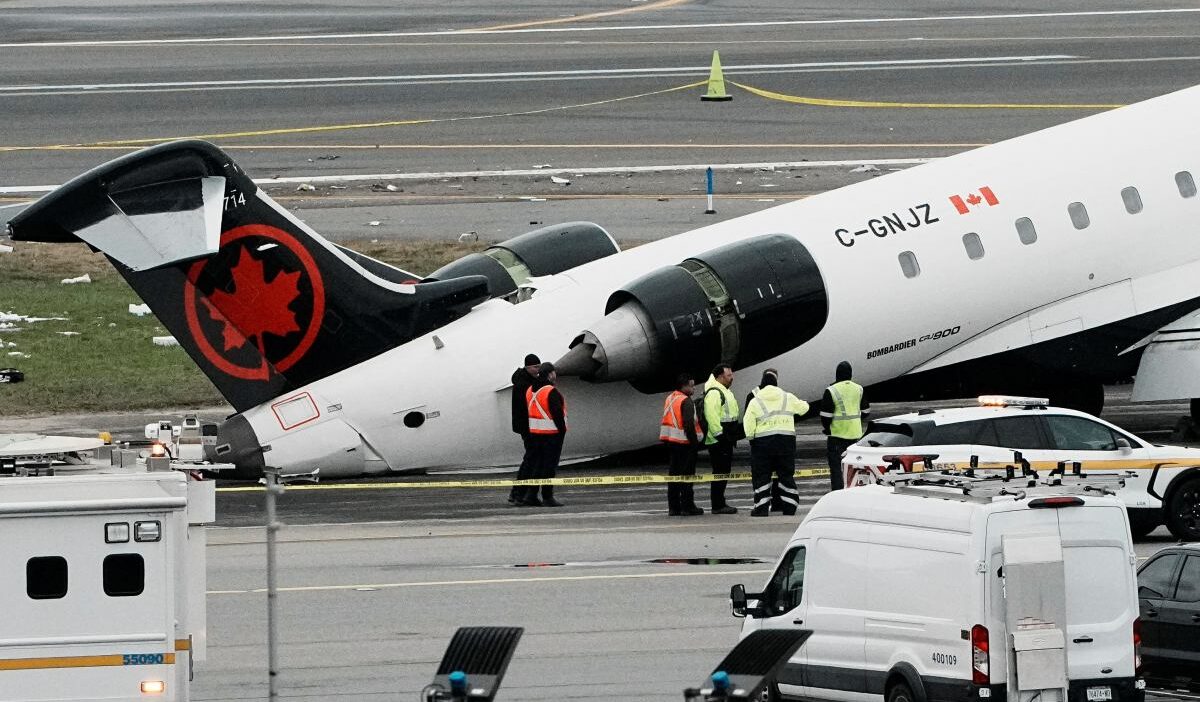
A passenger plane and a fire truck collided at LaGuardia Airport Sunday evening, killing two pilots and sending 41 to hospitals.
Tragic Crash at LaGuardia Airport
The incident occurred Sunday evening around 11:47 PM local time (4:47 AM Polish time). An Air Canada Express passenger plane collided on the runway with a fire and rescue vehicle responding to a separate incident. This marks the first fatal incident at LaGuardia Airport in over three decades.
Authorities identified the two fatalities as the pilots of the jet, described as “young men at the beginning of their aviation careers.”
41 Hospitalized with Injuries
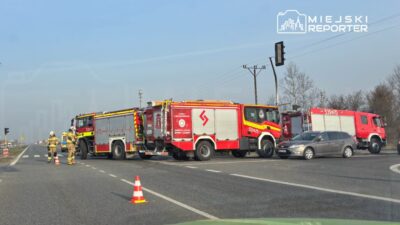
Kathryn Garcia, Executive Director of the Port Authority of New York and New Jersey, stated that 41 people were transported to hospitals, some with serious injuries. The fire truck, carrying two firefighters, was responding to an unrelated issue with a United Airlines aircraft. Both firefighters are in stable condition.
“I Screwed Up” – Controller’s Admission
A recording of air traffic control communications published on LiveATC.com captured the moments before and after the crash. Controllers are responsible for managing aircraft landings, takeoffs, and ground vehicle movement on runways.
According to *The Washington Post*, the air traffic controller asked the fire truck driver to stop seconds before the fatal collision. The controller later admitted, “I screwed up.”
Controller Attempted to Clear Runway
The controller who authorized the landing of Air Canada Flight 8646 was attempting to find a gate for United Airlines Flight, whose pilots declared an emergency due to an unpleasant odor. “Stop, truck one, stop,” the controller said immediately after clearing the runway. “I was trying to reach them… we had a sudden incident earlier and I screwed up.”
Investigation Underway, Safety Concerns Raised
An investigation is underway to determine the details of the accident. Federal aviation officials dismissed theories that the airport was inadequately equipped for air and ground navigation. The Canadian aircraft, a CRJ-900 from Montreal, carried 76 passengers and four crew members and was traveling at approximately 50 km/h at the time of the impact.
Anthony Brickhouse, an aviation safety consultant and professor, explained that normally, fire truck access to an active runway requires controller verification of a safe window for passage.
Increased Runway Incursions and Modernization Needs
Jennifer Homendy, Chair of the National Transportation Safety Board, stated the incident is traumatic for air traffic controllers and that investigators will interview the controller and others who were in the tower. Data from the Federal Aviation Administration shows 80 runway incursions by vehicles or pedestrians in the quarter ending December 31st, compared to 54 in the same period last year.
The incident has raised concerns about staffing shortages in air traffic control at major US airports and the need for increased funding for safety system modernization. Transportation Secretary Sean Duffy reiterated his calls to Congress for an additional $19 billion to complete the air traffic control modernization program.