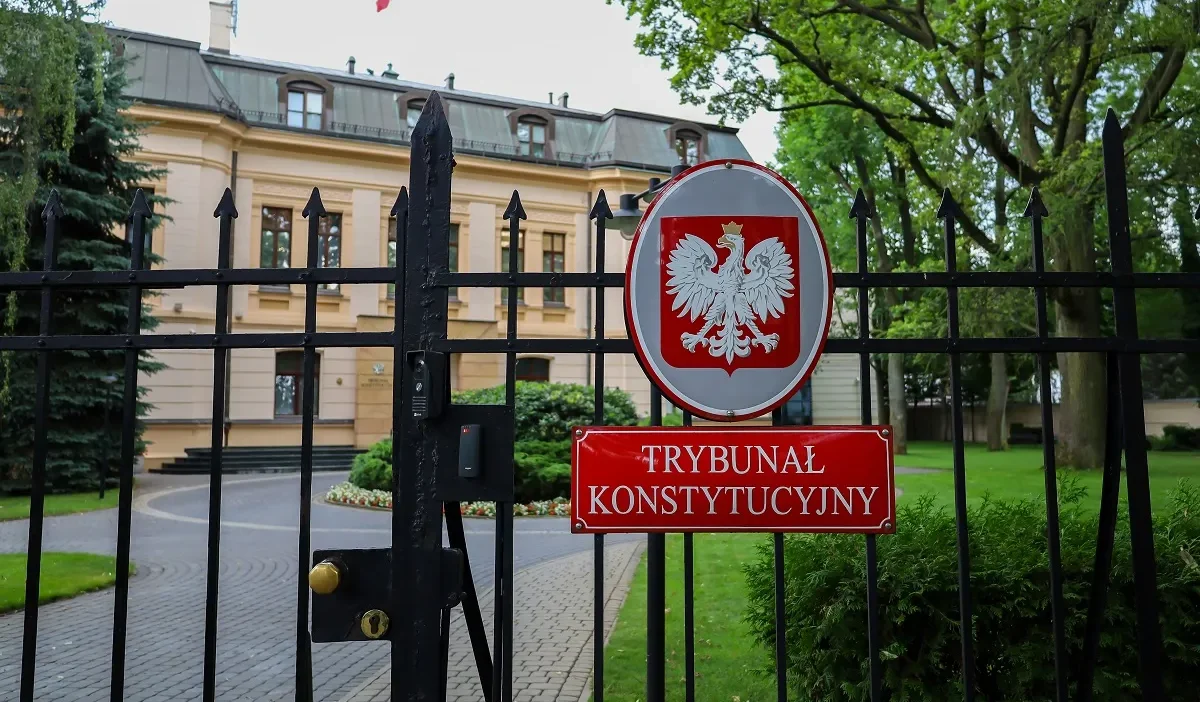
Poland’s Constitutional Tribunal ruled Wednesday that property owners can appeal court decisions impacting them, even if not formally parties to the initial proceedings.
Constitutional Right to Be Heard and Understand Court Rulings
The Constitutional Tribunal determined that provisions of the Code of Civil Procedure preventing appeals by individuals not directly involved in a case, but affected by a court’s security measure decision, are unconstitutional.
Judge Andrzej Zielonacki, explaining the ruling, emphasized that “completely and irrevocably excluding a party from participating in security proceedings and depriving them of the right to understand the court’s reasoning is constitutionally inadmissible.”
Deprivation of Right to Appeal Deemed Unconstitutional
The Tribunal also found it unconstitutional to deny an affected party the right to be heard by the court, through the ability to appeal a security measure. The challenged provisions of the Code of Civil Procedure, according to the Tribunal, do not allow a party – who was not a party in the main proceedings – to understand the reasoning behind the security measure or to appeal that decision.
Background: Property Owner’s Challenge
The case originated in 2019, when the complainant became the owner of a residential property through an enforcement proceeding. The previous owner and tenant filed a lawsuit against the municipality seeking a social housing rental agreement and requested a security measure to suspend the 2019 court decision transferring ownership to the complainant. The court granted this security measure.
Court Refusal to Provide Justification
The court later rejected the complainant’s request for a justification of the decision, arguing that the complainant was not a party to the proceedings and that becoming the property owner did not make them a party to the process – even though the security proceeding obligated them to vacate the property. Consequently, the court ruled the complainant had no right to request justification for the security measure.
Core Issue: Rights of Affected Parties
The complainant’s attorney, Piotr Wiśniewski, argued that the central issue was whether a court can issue a decision directly affecting someone’s rights and then deny that person even the right to understand the reasoning or appeal it, simply because they were not formally named a party in the proceedings.
Wiśniewski stated that the Constitution protects not only formally designated parties but also those whose rights are actually affected by a court’s ruling. He argued that the challenged provisions effectively made the complainant subject to the security measure without providing a means to challenge it.
Impact on Property Rights
According to Wiśniewski, the interpretation of the challenged provision effectively prevents a property owner from using their property – living in it, renting it, or lending it – while simultaneously denying them the right to understand the court’s reasoning.
He further argued that even if the enforcement of the secured claim – potentially leading to eviction – would not result in homelessness or prevent the tenant from pursuing their right to a social housing rental agreement, the complainant was still denied the opportunity to challenge the excessive limitation of their property rights.
Tribunal’s Ruling on Unconstitutionality
The Tribunal found the provisions stemming from the Code of Civil Procedure to be unconstitutional, violating principles such as the right to be heard, the right to enjoy property, and the right to have one’s case heard by an independent and impartial court.
The ruling concerned two specific provisions: Article 357, paragraph 2, index 1, which states that a decision issued on non-public hearing is justified only if it is subject to appeal and only upon request of a party; and Article 741, paragraph 1, which does not provide for the possibility of appeal for an affected party who is not a party or ancillary intervenor in the main proceedings.
Unanimous Decision and Legal Effects
The Tribunal’s decision was unanimous, with President Bogdan Święczkowski presiding and Judge Andrzej Zielonacki as the rapporteur.
Zielonacki emphasized that the legislature, when regulating security proceedings, “cannot lose sight of the constitutional requirements of a fair judicial procedure.” He stated that the challenged provisions fail to meet this requirement, as an affected party learns about the security measure only through an unappealable court decision, effectively depriving them of the ability to defend their rights.
The lack of opportunity to understand the reasoning and appeal the security measure, he argued, is incompatible with the constitutional standard of due process, as it deprives the affected party of the ability to realize their right to be heard.
Distinction Between Parties and Affected Individuals
Zielonacki acknowledged that it is possible to differentiate between the rights of the applicant and the affected party, even “waiving full symmetry and parallelism of the procedural means available to these entities.” However, he stressed that “completely and irrevocably excluding the affected party from participating in the security proceedings and depriving them of the right to understand the court’s reasoning and to be heard through the possibility of appealing the security measure is constitutionally inadmissible.”
Notification vs. Participation
Zielonacki added that the challenged law only notifies the property owner of the security measure in a case where they are not a party. This, in the Tribunal’s view, leads to “an inadmissible restriction of the free exercise of their rights,” without the possibility of presenting arguments that “could at least theoretically influence the assessment of the validity of the court’s interim decision.”
Impact of the Ruling on Courts
Zielonacki clarified that the ruling does not invalidate the provisions of the Code of Civil Procedure in their entirety, but only eliminates the specific sections deemed unconstitutional.
President Święczkowski emphasized that the ruling has legal effect from the moment of its public announcement and binds all public authorities. The Sejm (Polish Parliament) has affirmed that disregarding the Tribunal’s rulings can be considered a violation of the principle of legality. However, rulings of the Constitutional Tribunal are not currently published in the Journal of Laws due to a Sejm resolution questioning the legitimacy of two current Tribunal judges.