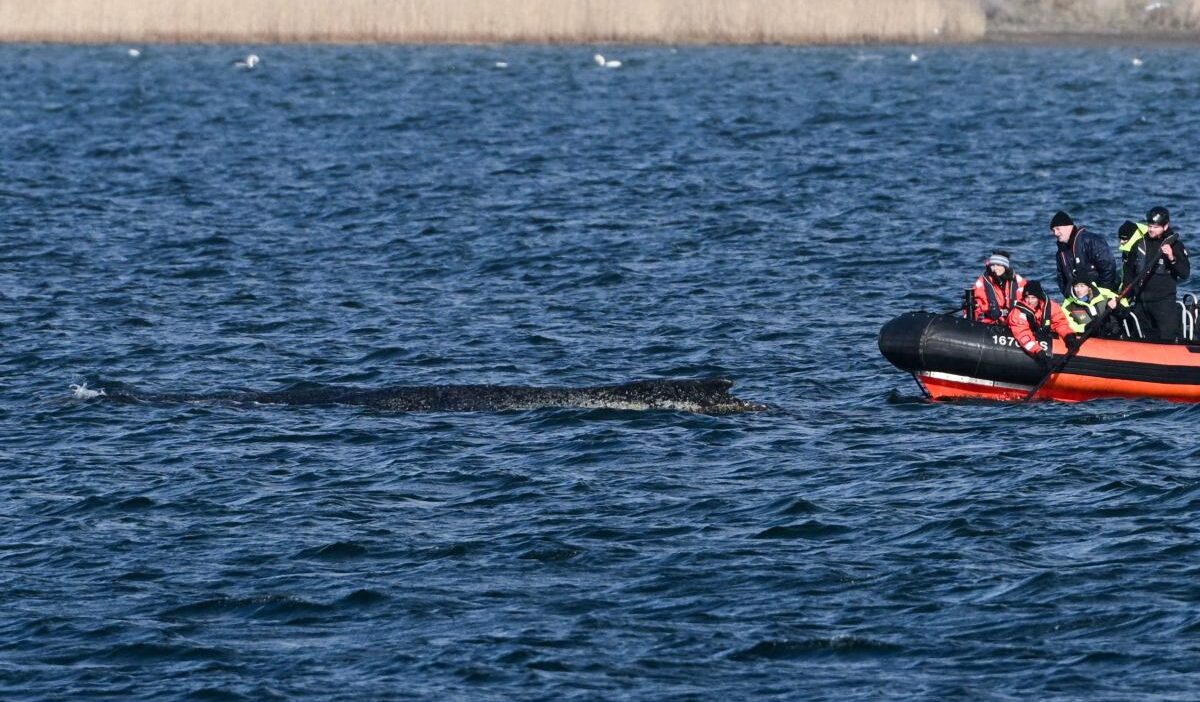
A humpback whale first spotted off the coast of Germany in March is repeatedly stranding and failing to swim away, leading experts to debate intervention.
Initial Strandings and Rescue Attempt
A humpback whale was first observed stranded near Timmendorfer Strand on the night of March 22-23, stuck on a sandbar. On Thursday, it was freed with the aid of excavators creating a channel and returned to the Baltic Sea.
However, the whale re-stranded near Wismar over the weekend, but managed to free itself. It subsequently reappeared in the area, remaining in water approximately two meters deep.
Deteriorating Condition
The whale’s condition has worsened, described as poor. It remained largely motionless, breathing less frequently and making no sounds. Attempts to encourage it to swim with rising water levels on Monday were unsuccessful. Experts tried to stimulate it with noise, striking the water with an oar, but without effect.
“Only Interfering with Dying”
Experts believe the next few hours are critical for the animal. If the whale has space to move, even with minimal effort, but does not swim away, it likely lacks the strength. “We need to consider when to really leave the animal alone so it can die,” said Burkard Baschek, director of the German Maritime Museum in Stralsund.
Expert Opinion on Exhaustion and Stress
Biologist Peter T. Madsen, who has studied humpback whales for years, echoed this assessment. He stated in the “Frankfurter Allgemeine Zeitung” that the whale appears sick and seeks shallow water to avoid drowning due to exhaustion and impending death.
“I completely understand that people are trying to do something. But in my opinion, it’s just interfering with its dying. I think it would be best to let it die peacefully. Pushing it and moving around it creates a lot of noise, and these animals have excellent hearing. It stresses them enormously,” Madsen said.
Baltic Sea Unsuitable Habitat
Experts emphasize that the Baltic Sea is not a suitable environment for humpback whales due to its shallow waters, low salinity, and limited food supply. Human activity in the region also poses a threat.