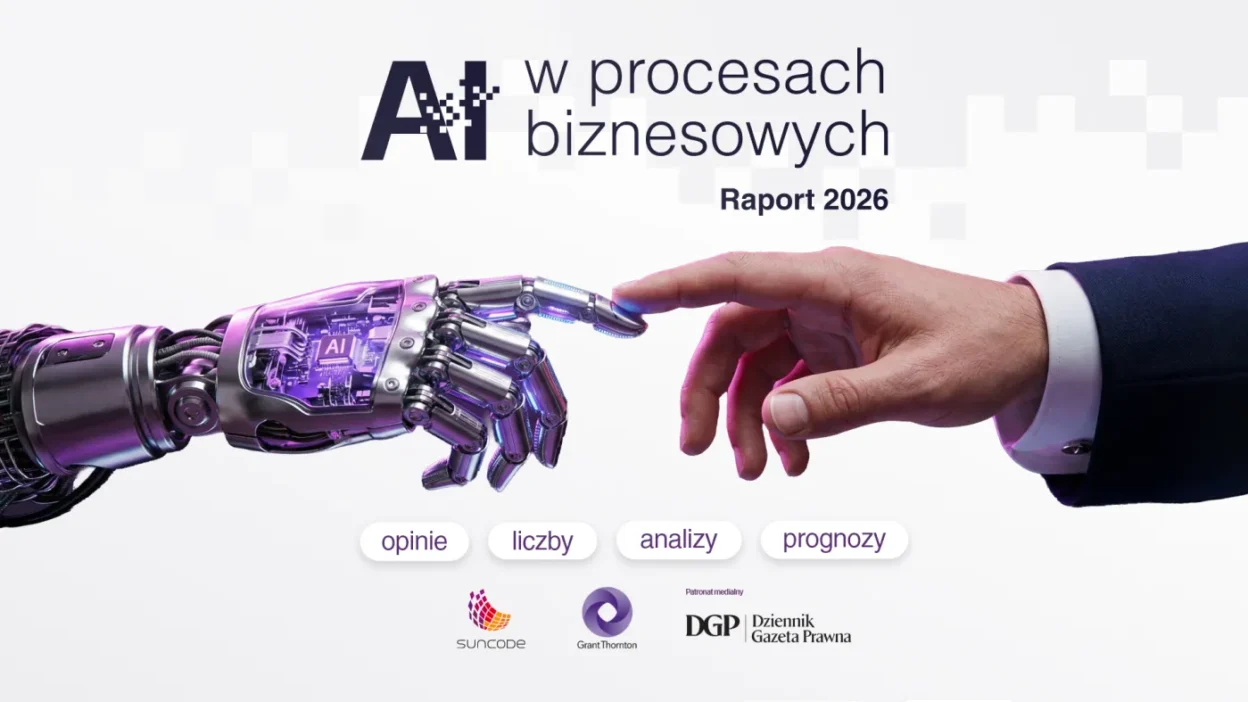
A new report reveals that while nearly all companies discuss AI, only a fraction are systematically implementing it across sectors and departments.
AI Beyond Conceptualization
Artificial intelligence is increasingly moving beyond the presentation of concepts and successfully entering individual departments within companies.
The “2026 Report: AI in Business Processes” examines this phenomenon, created with input from business practitioners, and provides insight into daily work with AI across various industries.
Declarations vs. Reality
Recent data shows a clear disparity between ambition and practice. While awareness of AI’s potential is growing, most organizations remain in the planning stage.
Key to Success: Process Alignment
Experts and AI practitioners emphasize that the technology itself is rarely the problem. The key lies in aligning it with existing processes. Success depends not on the technology itself, but on skillfully adapting it to business processes.
Where this alignment occurs, the effects are clear and measurable – from shortening process times to significantly reducing operating costs.
AI as an Organizational Tool
Artificial intelligence is not a point solution. Its impact encompasses virtually all areas of a company’s activity. Anna Podlewska of Credit Agricole highlights this aspect in the report.
“AI-based solutions affect all positions within the organization and can be helpful for each of them.”
Podlewska does not confirm the scenario of mass job reductions, but rather indicates a shift in the nature of work – from operational to more analytical and supervisory roles.
Areas with High AI Application Potential
AI applications are primarily focused on areas with repetitive processes, data-driven tasks, and the need to process large amounts of information. This is where the technology most often supports daily work and gradually changes how tasks are performed.
Case Studies: AI in Practice
The value of artificial intelligence is best observed in specific implementations – particularly where it directly impacts the daily work of teams. The banking sector provides a good example, where AI is being developed in stages.
Velo Bank has developed a solution enabling loan acquisition based on a product photograph, demonstrating AI’s increasing presence in large-scale, customer-facing processes. Experts also point to broader use of the technology.
“Generative intelligence has firmly established itself in high-volume back-office processes.”
Transforming Business Models
Artificial intelligence is not only streamlining existing processes but is also increasingly changing how entire organizations function.
This is evident in Orange, a leader in the telecommunications industry, where AI solutions are used in many areas, from customer service and employee training to infrastructure management and cybersecurity.
Implementing this technology involves not only optimization but also a deeper change in how work is done, shifting employee roles from repetitive tasks to supervision, interpretation, and decision-making.
Intelligent Document Workflow: A New Standard
The development of intelligent document workflow is a particularly important area for new technologies. Market research indicates that 80-90% of data in organizations is unstructured, with a significant portion consisting of documents – invoices, contracts, applications, and correspondence.
Traditionally, up to 60% of office workers’ time is spent searching for, processing, and entering data. These areas are becoming a natural field for AI application.
Paweł Lizakowski, CTO of Suncode and an expert in electronic document workflow implementations, states: “From a technological perspective, we clearly see that AI-supported electronic document workflow is no longer just an improvement, but is becoming one of the key elements of the process architecture of modern organizations. Traditional approaches, based on manual document processing, are unable to meet the scale and dynamics of business today.”
Modern AI-based systems not only digitize documents but also automate up to 70-90% of document-related operations.
Legal and Ethical Considerations
Implementing artificial intelligence involves not only technological challenges but also the need to consider legal and ethical issues. There is a growing emphasis on responsible AI as an integral part of the entire implementation process, not just an addition.
Wojciech Biernacki, leader of the new technologies law team at Grant Thornton, notes: “The AI Act does not apply only to technology creators. It also includes organizations that use AI systems.”
AI as a Competitive Advantage
The conclusions of the 2026 “AI in Business Processes” report are clear: artificial intelligence is ceasing to be an experiment and is becoming an element of strategy. Organizations that can effectively implement AI and integrate it with processes achieve advantages – operational, cost-related, and qualitative.
The rest of the market is still catching up, and the pace of transition from declarations to implementations may determine companies’ positions in the market in the coming years.