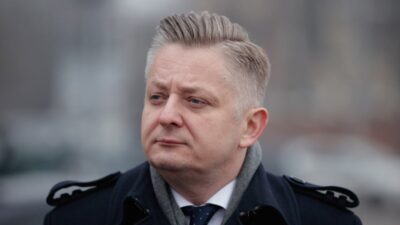
Jarosław Sosnowski, convicted in 2006 of the murder of Małgorzata W., was released from prison on Tuesday after serving 22 years, following a court decision and ten years of probation.
Initial Release and Reaction
The director of the Strzelin Prison submitted a request for Sosnowski’s conditional early release, which was approved by the District Court in Wrocław on April 8th. The prosecution appealed, but the Wrocław Court of Appeal dismissed the appeal on Tuesday and imposed a ten-year period of probation on Sosnowski.
Upon his release, Sosnowski expressed his happiness, stating he would focus on his home, family, and father. His lawyer, Adam Jasinski, indicated the priority would be finding housing and employment for Sosnowski, along with psychological support.
Sosnowski’s Continued Fight for Exoneration
Sosnowski stated to “Wyborcza” that his release was a step towards proving his innocence. He intends to continue fighting to clear his name.
The Case and Initial Conviction
Sosnowski spent 22 years in prison, with approximately three years remaining on his sentence. He was convicted in 2006 for the death of Małgorzata W.
In November 2004, the body of 26-year-old Małgorzata W. was found in a forest near the Faraon disco in Lądek. An expert determined she had been strangled and a sexual assault had been attempted. Initially, 21-year-old Jarosław Sosnowski confessed to the murder.
During the trial, Sosnowski claimed his confession was coerced by police. Both the District Court in Konin and the Appeal Court in Poznań rejected this claim, sentencing him to 25 years in prison for causing the woman’s death through attempted rape.
Renewed Scrutiny and Investigation
The case gained renewed attention in 2020 after reports from Kurier Słupecki and TVP, which received threats from individuals warning them against investigating the case.
Sosnowski’s lawyers attempted to reopen the case, presenting notarized statements from four new witnesses who they believed offered new insights. The Poznań District Prosecutor’s Office reopened the investigation, but it did not lead to a retrial.
Concerns and Support from Senator Fedorowicz
A year and a half ago, Sosnowski’s family contacted Senator Grzegorz Fedorowicz, a former Deputy General of the Prison Service. Fedorowicz expressed his conviction of Sosnowski’s innocence, stating the case “keeps him awake at night.”
Fedorowicz, after reviewing the case files and speaking with Sosnowski, believes there is no forensic evidence linking him to the crime. He noted Sosnowski’s young age at the time, his impoverished background, and the lack of effective representation by his court-appointed lawyer.
Comparisons to the Komenda Case and RPO Involvement
Following Fedorowicz’s intervention, a team from the Ombudsman for Civil Rights (RPO) examined the case, leading to a cassation appeal to the Supreme Court. The RPO noted similarities between this case and the wrongful conviction of Tomasz Komenda.
The RPO questioned the evidentiary value of Sosnowski’s confession, made despite his claims of police coercion and manipulation of interrogation recordings. They also raised doubts about the reliability of a witness identification conducted at a disco changing room.
The RPO highlighted inconsistencies between the witness’s testimony and other evidence, and noted that biological and fingerprint analysis “virtually exclude” Sosnowski’s involvement. Furthermore, the unidentified hair found on the victim’s clothing did not match either Sosnowski or the victim.
Pending Supreme Court Review
The cassation appeal was registered with the Supreme Court. The initial hearing was scheduled for March but did not take place due to a request from Sosnowski’s lawyers to recuse judges who had previously been involved in his case.