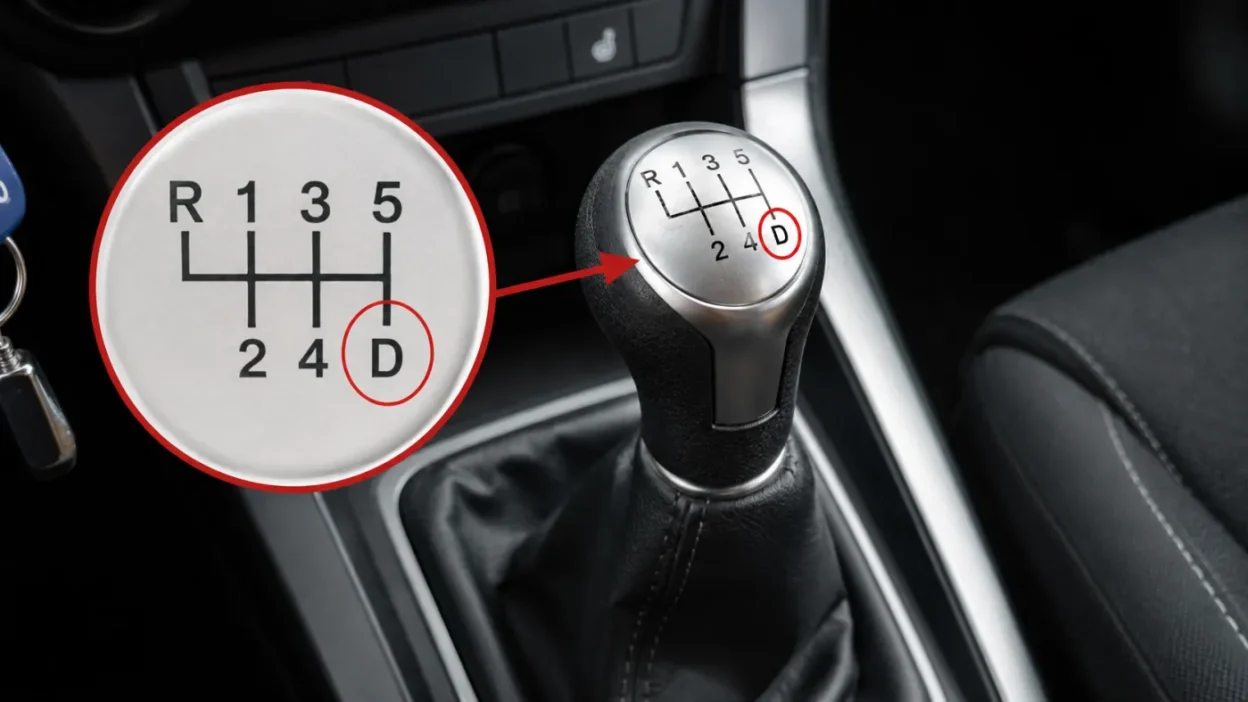
While most drivers associate the “D” symbol with automatic “Drive” mode, in manual transmissions, it actually refers to a specific 1:1 direct gear ratio.
The Distinction Between Drive and Direct Gear
For most drivers, the “D” on a gear lever is synonymous with automatic transmission “Drive” mode. However, the same symbol is found in manual transmissions, where it carries a completely different technical meaning regarding the gearbox construction and power delivery.
In manual gearboxes, this symbol refers to the direct gear. This is a state where the ratio between the engine’s crankshaft and the gearbox output shaft is exactly 1:1.
Efficiency and Fuel Economy
In practice, a 1:1 ratio means the gearbox does not change rotation proportions, allowing the drive shaft to rotate at the same speed as the component driven by the engine. This transfers power with almost no mechanical loss, making it one of the most efficient elements of classic manual designs.
This direct gear allows the engine to operate more stably and quietly at constant speeds, resulting in lower fuel consumption. Consequently, it has long been utilized primarily during highway and rural driving.
Identifying the Direct Gear
In older four-speed manual gearboxes, the fourth gear was most commonly the direct gear. When five-speed transmissions were introduced, the fifth gear usually took over this function, though the fourth sometimes retained it while the final gear became an overdrive.
In modern six-speed constructions, the 1:1 ratio often occurs in the fifth gear, while the sixth gear acts as an overdrive to reduce engine RPM during high-speed travel. An overdrive allows the output shaft to rotate faster than the driving shaft, lowering engine noise and fuel use.
Limitations in Dynamic Driving
While efficient, direct gear has limitations during dynamic maneuvers such as overtaking. At low engine RPMs, the vehicle may lack optimal torque, leading to sluggish acceleration and increased load on the engine even when the gas pedal is pressed firmly.
Experienced drivers often downshift during overtaking to reach higher RPMs and utilize the engine’s full dynamics. Specialists also note that prolonged driving at excessively low RPMs can “strain” modern turbocharged petrol and diesel engines.
The Evolution of Modern Transmissions
Modern manual gearboxes are designed primarily to reduce fuel consumption and emissions, often employing long gear ratios. At highway speeds, this allows engines to operate below 2,000 RPM, though this can affect the comfort of dynamic driving compared to older models.
As manufacturers increasingly move toward automatic, dual-clutch, and CVT transmissions, the use of these specific symbols on gear knobs is becoming less common in modern vehicles.