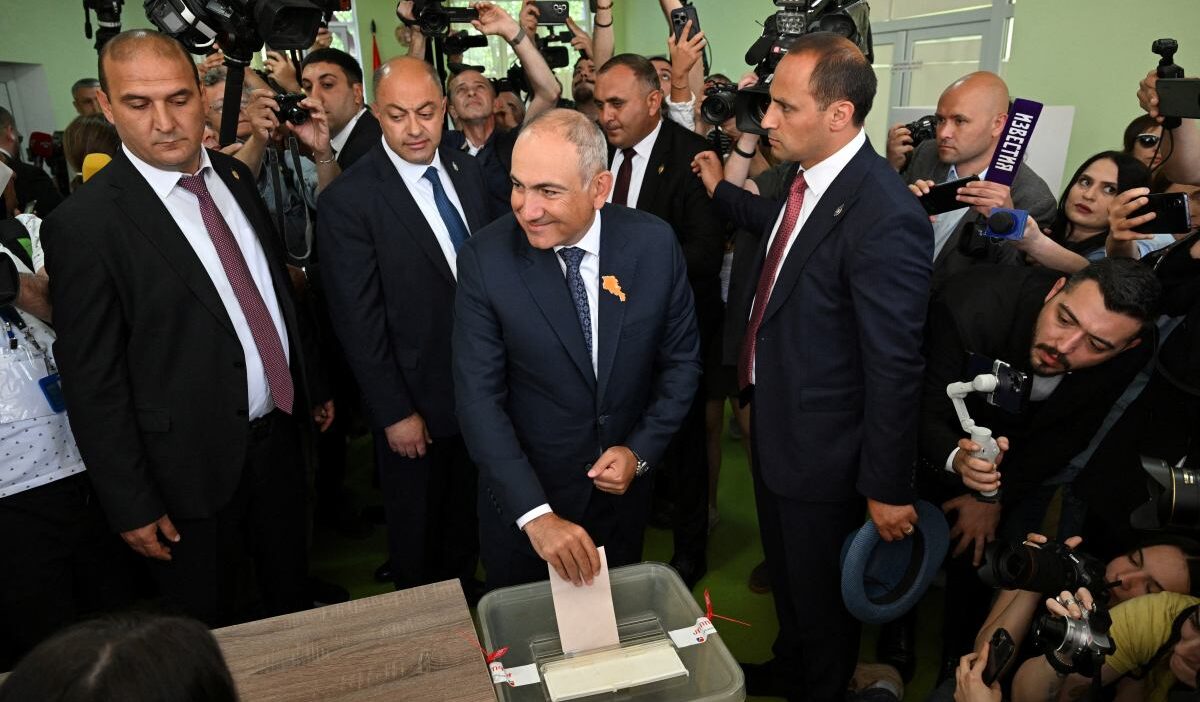
Armenia saw its highest voter turnout in over a decade as Prime Minister Nikol Pashinyan’s Civil Contract party maintained its lead, according to early exit polls from the parliamentary elections.
Election Results and Voter Participation
According to exit polls, Prime Minister Nikol Pashinyan’s Civil Contract party is set to retain power in Armenia. The pro-Russian Strong Armenia alliance, led by oligarch Samvel Karapetian, followed with 17.5 percent of the vote. Results for smaller parties have not yet been released.
Voting concluded at 8:00 PM local time. The election will determine at least 101 members of the unicameral parliament for a five-year term, though the total number of seats may increase due to compensatory mechanisms intended to ensure a stable majority. The Central Election Commission reported a turnout of 58.97 percent, the highest figure in over a decade.
Political Polarization and Allegations of Irregularities
This year’s election is viewed as a test of Pashinyan’s policy of deepening ties with the U.S. and the EU, alongside efforts to secure a lasting peace with Azerbaijan following the loss of Nagorno-Karabakh. The campaign took place in a tense atmosphere marked by claims of Russian disinformation operations.
Authorities have arrested dozens of individuals, including opposition members, on charges of vote-buying, which opponents dismiss as political repression. On election day, seven people linked to the Strong Armenia alliance were detained in Kotayk province for allegedly attempting to bribe 45 voters with a total of 7.5 million drams.
Geopolitical Shifts and Foreign Influence
Since independence in 1991, Russia has been Armenia’s primary ally and trading partner. However, Yerevan has increasingly turned toward the West, driven by disillusionment over Russia’s stance during the Nagorno-Karabakh conflict. While Pashinyan seeks new economic and political partners, he has stated he does not intend to close the Russian military base in Gyumri.
Armenia remains a member of Russia-led organizations, though it suspended participation in the CSTO in 2024. Public opinion shows a shift in perception: recent polling indicates that 75 percent of respondents support Armenia’s potential accession to the EU, while France is now viewed by many as the country’s most important political partner.