


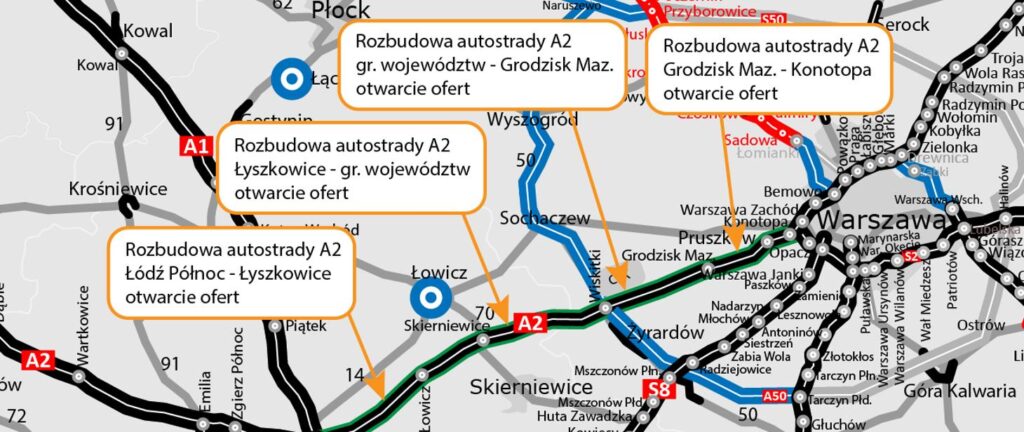
Poland’s A2 motorway between Łódź and Warsaw will gain an additional lane heading both ways, with contractor contracts slated for mid‑2026 after evaluating 18 bids submitted by 2025.
Bid Submissions and Evaluation
In 2025, 18 bids were received to widen the 89‑km section between Łódź and Warsaw and add three kilometres within the Łódź North interchange. Four companies and four consortia submitted proposals.
All but one proposal fit within the allocated budget. The primary selection criterion was price, accounting for 80 % of the score, followed by a 20 % environmental score for efficient reuse of demolition material.
Contracts for each segment are planned to be signed by mid‑2025, with construction expected to begin in the first half of 2026 and finish in the second half of 2027.
Funding and Evaluation Criteria
Funding has been earmarked for each segment, and the evaluation process places 80 % emphasis on price while rewarding the most effective use of recycled demolition waste with the remaining 20 %.
Traffic Demand and Current Capacity
Over its 13‑year history, the A2 has become one of Poland’s busiest corridors, carrying over 50,000 vehicles daily near Łódź and nearly 100,000 near Warsaw. Capacity is reaching saturation, prompting the lane addition.
Project Scope and Lane Addition
The expansion is divided into four phases, covering a total of 92 km: 89 km of new lanes plus an additional 3 km around the Łódź North node where the A1 and A2 intersect.
After completion, the stretch from the Łódź North node to the Pruszków junction will have three lanes in each direction, expanding to four lanes toward the Konotop junction.
Energy Self‑Sufficiency Goal
Renovated sections will use renewable energy to power road lighting and auxiliary systems. The contractor performed an economic analysis covering construction, operation, and energy storage costs.
Construction Complexity and Safety Measures
Work will proceed on a busy motorway, requiring a precise traffic‑management plan. Throughout construction, two lanes per direction will remain open in both directions, and segmental speed monitoring will be implemented to enhance safety.