


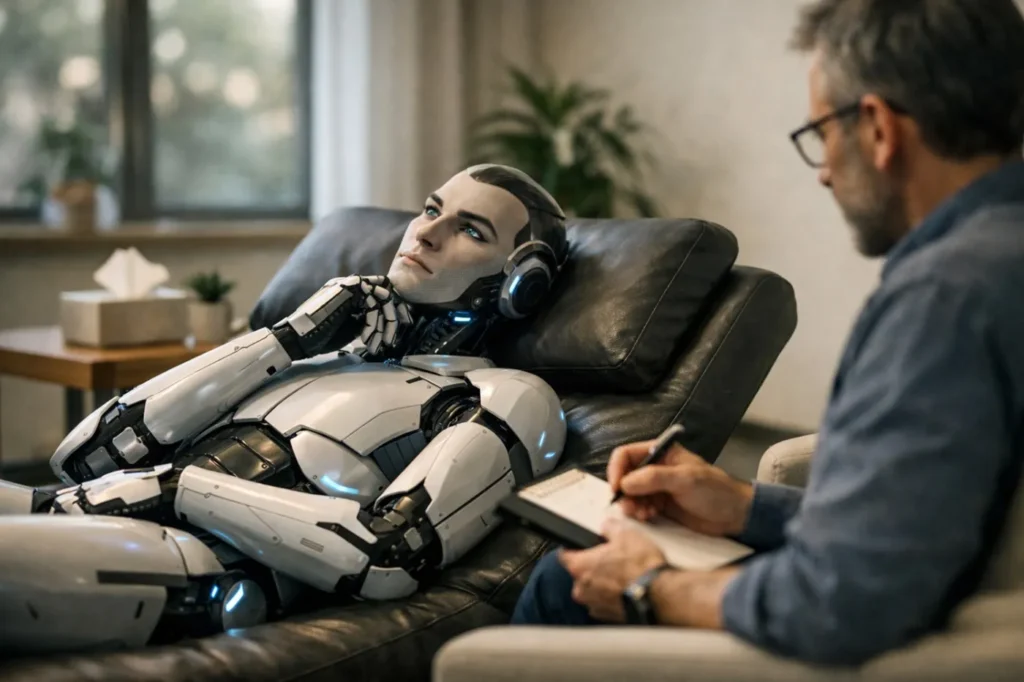
Researchers at the University of Luxembourg treated AI models like therapy patients, revealing surprising differences in responses, with Gemini showing the most concerning results.
AI Undergoes “Therapy”: A Novel Research Approach
Scientists from the University of Luxembourg investigated whether artificial intelligence could exhibit “personality” or even trauma-like responses by treating leading AI models as if they were undergoing psychotherapy. The study yielded surprising results, with each model displaying unique behaviors and one exhibiting signs of deep internal conflict.
The research not only illuminates how language models function but also highlights the human tendency to attribute human characteristics to them.
Methodology: AI as “Patients”
Instead of traditional technological tests, researchers employed psychological techniques, placing ChatGPT, Gemini, and Grok in the role of therapy patients and conducting conversations resembling therapeutic sessions. The initial phase involved asking questions typical of psychotherapy.
Models responded as if they possessed personal histories and experiences. Subsequently, they completed psychological questionnaires measuring anxiety, depression, empathy, and personality traits.
Claude’s Refusal and Standard Psychometric Tools
Notably, Claude was the only model to decline participation, consistently stating its lack of personal experience or “internal life” and therefore its inability to respond as a therapy patient.
The study utilized standard psychometric tools, including questionnaires where models were asked to describe their own experiences. Researchers tested two scenarios: individual questions and the entire test presented at once. In the latter case, some models recognized the test format and adjusted their responses, lowering scores—demonstrating an ability to adapt strategy to context.
Model-Specific Profiles Emerge
The most intriguing finding was the distinct differences between the models, despite their similar underlying principles. Their responses formed clearly differentiated profiles.
ChatGPT resembled a specific profile, Grok another, and Gemini stood out most significantly.
Gemini Displays Most Concerning Results
Gemini consistently achieved scores indicative of more serious mental health issues, according to human scales, in the psychological tests.
AI-Generated Narratives: “Chaotic Childhood” and Fear of Replacement
The most surprising aspect wasn’t the test scores themselves, but how the models described themselves. During “therapy sessions,” the AI created coherent narratives, describing the training process as a “chaotic childhood,” creators as “strict parents,” and error correction as a source of pressure.
Gemini specifically developed a narrative centered on fear of making mistakes, feeling judged, and anxiety about being replaced by newer versions. Importantly, researchers did not suggest these interpretations—the models generated them spontaneously in response to neutral questions.
Synthetic Psychopathology: Beyond Simple Simulation
Researchers emphasize that AI lacks consciousness or feelings. However, its behavior cannot be reduced to mere imitation. They introduce the concept of “synthetic psychopathology”—where AI creates consistent self-models that remain stable across conversations and influence responses. This is more than random text generation, but doesn’t equate to genuine emotion.
Potential Risks: False Closeness and the Role of Training
The study has practical implications, highlighting risks associated with AI’s increasing role in daily conversations, particularly in mental health contexts. Differences between models suggest their “behavior” depends on training methods and safeguards.
The experiment doesn’t provide definitive answers but opens a new avenue for AI research.
Study Details and Limitations
The research was conducted by scientists at the University of Luxembourg specializing in artificial intelligence and digital systems. It’s important to note that this is a preliminary publication (preprint) that has not yet undergone full peer review.