


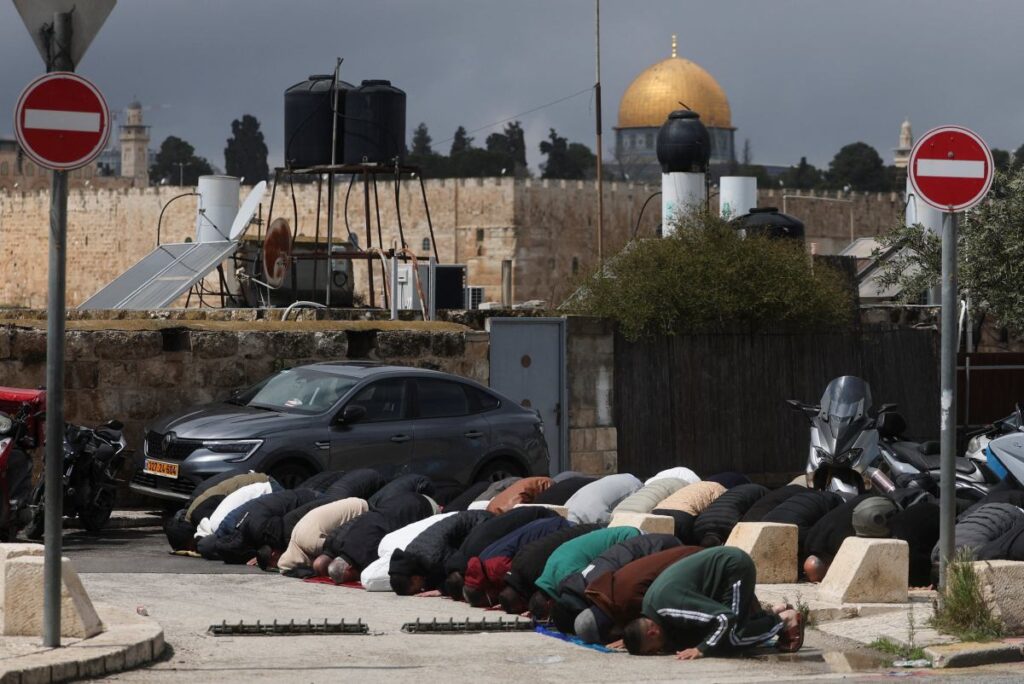
The Al-Aqsa Mosque complex in Jerusalem has been closed for weeks, sparking Palestinian concerns over access to the holy site and potential changes to its status.
Al-Aqsa Mosque Closure During Ramadan
The Al-Aqsa Mosque complex has remained closed for several weeks, including during the start of Eid al-Fitr on March 20th. No gates leading to the Temple Mount, known to Muslims as Al-Haram al-Sharif, have been opened.
Reports from Middle Eastern media indicate this is the first time since 1967 that worshippers have been denied access to the site during the conclusion of Ramadan.
Security Concerns and Palestinian Response
The closure began after American and Israeli strikes on Iran on February 28th, with authorities in Jerusalem citing security concerns. As a result, Palestinians prayed outside the Old City during Ramadan.
The Presidential Committee for Church Affairs in Palestine, affiliated with the Palestine Liberation Organization, stated that this unprecedented restriction prevented thousands of Palestinians from participating in a major religious holiday at one of Islam’s holiest sites.
Warnings Over Sacrifice Attempts
Another point of contention involves events on March 29th. The Jerusalem Governorate (an administrative unit of the Palestinian Authority) warned against attempts to bring animals into the Old City and the Al-Aqsa area for sacrifice during the Jewish Passover, which falls between April 2nd and 9th.
Concerns of Religious Escalation and Propaganda
According to a statement from the Palestinian WAFA news agency, such actions would be an “escalatory step” and an attempt to impose new religious rituals on a site holy to Muslims. Organizations linked to the Temple Mount movement are reportedly using the closure to launch propaganda campaigns, including AI-generated images and videos.
Palestinian authorities claim there have been three unprecedented attempts to bring sacrificial animals onto the complex in 2025, including plans for animal slaughter and the smuggling of blood-stained meat fragments.
Temple Mount Sovereignty Concerns
A post on the Temple Mount’s X profile directly attacked the rituals, stating the 30-day absence of worshippers creates conditions for “Judaizing rituals” and that the “sovereignty of Al-Aqsa is in real danger.” The post included a video showing an attempt to bring animals onto the site.
Historical and Political Context
The Temple Mount remains a sensitive area in Jerusalem, housing the Al-Aqsa Mosque and the Dome of the Rock. These structures were built in the 7th century and are central to Islamic tradition, linked to the Prophet Muhammad’s ascension.
The site also holds significance for Judaism, as it was the location of the First and Second Temples in antiquity. The Western Wall, the holiest site in Judaism, is a remnant of the Second Temple.
East Jerusalem, where the Temple Mount is located, was captured by Israel during the Six-Day War in 1967. Jordan formally oversees the Islamic trust administering the site under a 1994 peace treaty with Israel, but available information suggests Israeli authorities make key decisions in practice.
Incidents at Christian Holy Sites
Recent days also saw an incident involving access to holy sites in Jerusalem. On Palm Sunday, Israeli police prevented Latin Patriarch of Jerusalem Cardinal Pierbattista Pizzaballa and Custos of the Holy Land Father Francesco Ielpo from entering the Church of the Holy Sepulchre.
The Patriarchate stated both were visiting privately, without a procession or ceremony. Israeli President Isaac Herzog stated he spoke with the Patriarch to express “great sadness” over the “unfortunate incident,” attributing it to security concerns related to potential rocket attacks from Iran and reaffirming Israel’s commitment to religious freedom and the status quo.
International Criticism and Resolution
The police intervention was criticized by U.S. Ambassador to Israel Mike Huckabee, EU High Representative Kaja Kallas, and leaders of several European countries. The office of Prime Minister Benjamin Netanyahu later stated that Christian leaders would be allowed to hold Mass at the Church of the Holy Sepulchre.
Polish President Karol Nawrocki expressed strong opposition to the denial of Mass at the Church of the Holy Sepulchre, offering support to the Latin Patriarch of Jerusalem and all Christians in the Holy Land, condemning the actions of Israeli police as disrespectful to Christian tradition and culture.