


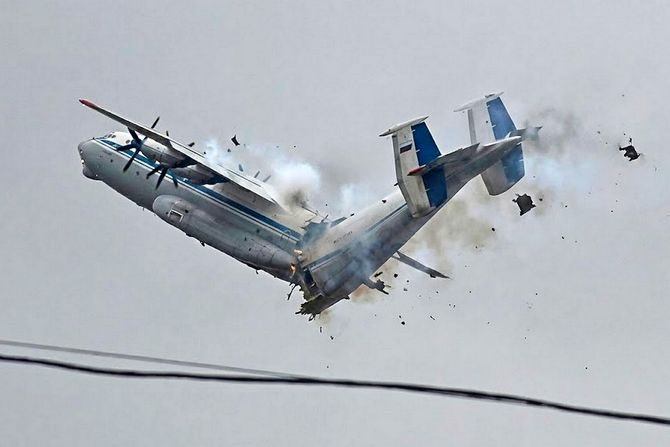
A Russian An‑22 military transport aircraft broke up mid‑flight near Ivanovo on December 9, crashing into a water tank 13 km from airport 308.
Flight and Crash
The incident occurred on December 9 near Ivanovo, about 250 km northeast of Moscow. Here lie the 308 Aviation Works of Aviaremont, which mainly maintain Il‑76 transport aircraft. The An‑22 was scheduled to undergo repairs at 308 and then perform a test flight after the work. Early reports quoted seven or eight victims, meaning everyone on board perished.
Video Evidence
A high‑quality video of the aircraft’s final moments was posted online a few days later, showing the moment before it fell into an artificial water tank near the village Ivankovo—approximately 13 km from the runway where 308 is located. The footage was stitched from several household cameras in the village.
Investigation Findings
The recording reveals that the aircraft, still in the air just behind the wing, broke in half and entered the water in two large pieces. The crew had apparently lost control earlier. The An‑22 descended flat toward the ground with its nose slightly tilted, fractured and gradually disintegrating. The video does not prove whether the catastrophe was caused by hull cracking or by some other loss of control, but an aircraft falling uncontrollably can experience stresses beyond its design limits. If the aircraft is old and poorly maintained, the hull may fail.
Unconfirmed Telegram reports suggest a failure in the hydraulic actuator systems that move the flight surfaces. The malfunction could result from wear, poor servicing, or incorrectly assembled components after repair.
Plant Financial Situation
Official statements also mentioned that 308 is seriously indebted and on the verge of bankruptcy. Workers reportedly did not receive wages in September, with some payments expected only in January 2026. Power suppliers allegedly threatened to cut supply, and a bailiff had seized the plant’s accounts.
Anonymous Commentary
An anonymous reader added a comment: “Regarding the Antieja (the Russian term for An‑22) it was actually not repaired at our plant. Yes, it arrived for repairs, but for some reason it was not entered into the maintenance hangar. They extended its service life by 100 hours. It lay on the deck for several months; its crew did something with it, but our technicians did not approach it.”
Aircraft Background
This particular An‑22 was one of the last built in 1975 at Soviet‑era Tashkent (now Uzbekistan). Sixty‑eight were produced in total. The aircraft were the heaviest transports of their time, designed mainly for moving airborne assault troops (up to 80 t of cargo). At their introduction they were the largest transport aircraft in the world and set numerous records in the mid‑1960s. Their design came from the Antonov bureau in Kyiv. The four Kuznetsov NK‑12 turboprop engines each drive a pair of counter‑rotating propellers, among the most powerful ever built. The An‑22 remains in service mainly in the Russian military, with a plan to retire the fleet by the end of 2024.