Poland’s Supreme Court faces contentious battle over legal status of judges appointed under controversial judicial reforms.
Controversial Judicial Appointments
The dispute concerns judges appointed after 2018 with the involvement of a newly formed National Council of the Judiciary (KRS), which was established after legislative changes by the previous parliamentary majority. The EU Court of Justice and European Court of Human Rights have ruled in several judgments that the method of forming the new KRS violates independence standards, and consequently, judges nominated with its participation cannot guarantee impartiality and judicial independence.
In a July 15, 2021 ruling, the EU Court of Justice determined that Poland’s system of judicial responsibility does not meet EU law requirements. Meanwhile, the European Court of Human Rights in cases “Reczkowicz v. Poland,” “Dolińska-Ficek and Ozimek v. Poland,” and “Advance Pharma v. Poland” held that the participation of persons appointed with recommendations from the new KRS in judicial panels violates the right to a fair trial established by law. These decisions have become the basis for challenging the status of neo-judges in domestic proceedings.
Supreme Court Resolution Attempt
In 2020, the combined chambers of the Supreme Court – Civil, Criminal, and Labor – issued a resolution stating that a judge appointed with a recommendation from the new KRS could lead to an improper composition of the court. This position was later confirmed in the case law of some “old” Supreme Court judges.
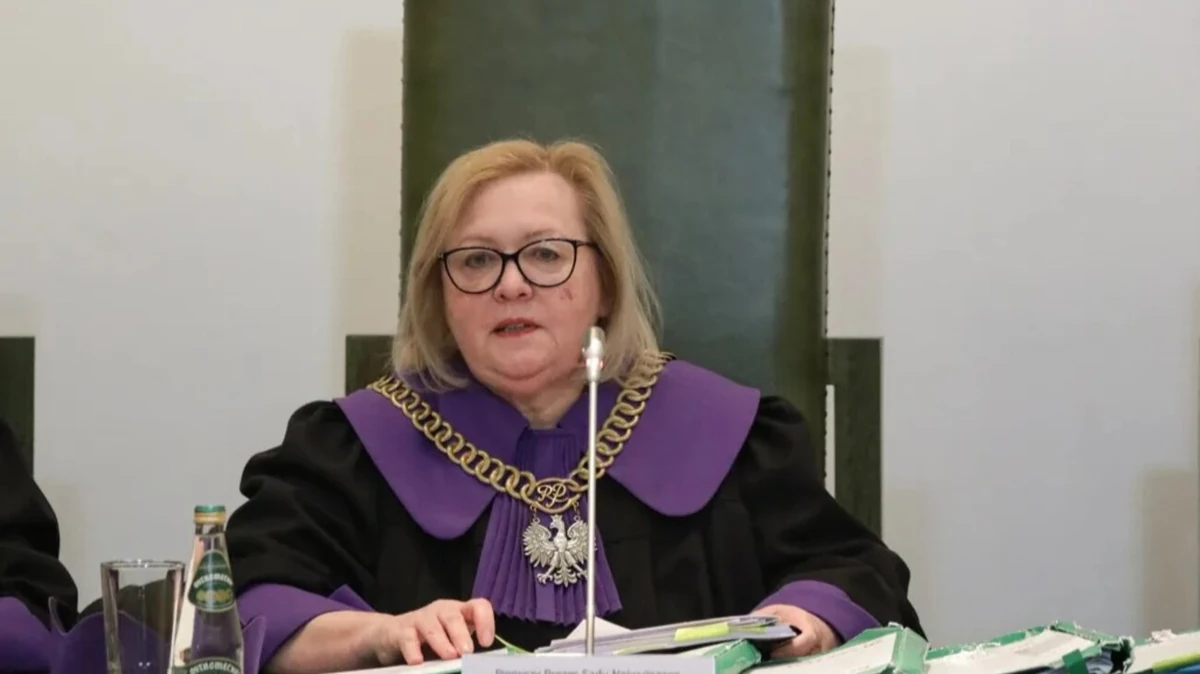
Małgorzata Manowska aims to achieve a situation where the full Supreme Court issues a legal principle recognizing that panels with neo-judges are legal. A legal principle has special force – it binds all Supreme Court panels and sets the direction for case law.
Composition Controversy and Minister’s Response
The composition of the panel that would make such a resolution is controversial. Panels are designated by the presidents of the Supreme Court chambers, and some of them are persons already appointed after changes to the KRS. This means that neo-judges whose status would be evaluated could also sit on the full panel. Critics point out that this leads to a situation where judges would be deciding on their own legitimacy.
In Waldemar Żurk’s assessment, the attempt to oppose a resolution by “legal” Supreme Court judges to a new resolution of the full chamber will not change the situation in light of European law. “This move will not succeed, and Ms. Manowska will one day be held accountable for her actions,” he announced.
Government Plans and Financial Implications
The Ministry of Justice announces actions aimed at regularizing the status of judges appointed with the involvement of the new KRS. Among the solutions being considered are legislative changes and verification of judgments issued with the participation of neo-judges. The government emphasizes that one of the key conditions for unblocking funds from the National Recovery Plan was the restoration of the rule of law standards and implementation of EU Court of Justice rulings.
The dispute also has financial dimensions. In 2021, the EU Court of Justice imposed a daily fine of 1 million euros on Poland for failing to implement a provisional measure concerning the Disciplinary Chamber of the Supreme Court. The total amount of deductions from EU funds reached several hundred million euros before the European Commission decided to stop calculating the penalty after legislative changes.
Leadership Transition and Future Uncertainty
On Tuesday, the General Assembly of Supreme Court judges was held to elect candidates for the new First President of the Supreme Court. The meeting, however, ended in failure due to lack of quorum. According to the constitution, the final selection is made by the president from the presented candidates.
Małgorzata Manowska’s term is ending, and she has announced that she will not seek a second term. The request to issue a legal principle on the status of neo-judges is perceived as one of Manowska’s last significant actions before leaving office. If the resolution were adopted as a legal principle, it would directly affect all future Supreme Court judgments and indirectly also proceedings before ordinary courts.
Meanwhile, some judicial circles point out that even adopting such a resolution will not close the path to challenging judgments before European courts. The EU Court of Justice and European Court of Human Rights have repeatedly emphasized that the assessment of court independence must be made with regard to real institutional guarantees, not only formal resolutions of domestic bodies.