


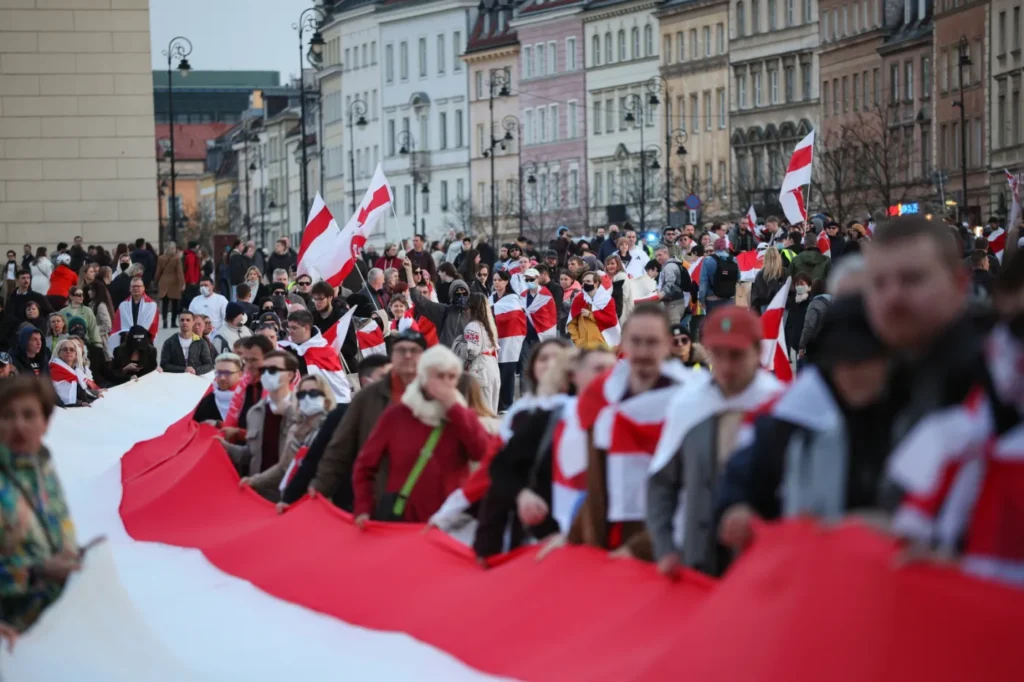
In Warsaw, Belarusians celebrated Freedom Day, commemorating the Belarusian People’s Republic, while expressing fears of KGB monitoring and repercussions for family back home.
Forbidden Independence Day in Belarus
Freedom Day – commemorating the establishment of the Belarusian People’s Republic in 1918 – has long served as a symbol of independence and resistance against the regime. Authorities in Minsk have banned its observance, replacing it with a state holiday on July 3rd, referencing Soviet history.
As a result, Belarusians can only celebrate outside their own country.
A Turning Point – The 2020 Elections
The Warsaw march directly stems from the events of 2020. The presidential elections on August 9th, officially resulting in over 80% of the vote for Alexander Lukashenko, were widely considered fraudulent. Protocols from many polling stations indicated a victory for Sviatlana Tsikhanouskaya.
In the following weeks, hundreds of thousands of people took to the streets in Minsk and other cities. The state’s response was brutal – mass arrests, violence, and torture in detention.
“It’s Not Paranoia” – Fears of KGB Presence
“It’s not paranoia. People are covering their faces because they have to,” Belarusian President-elect Sviatlana Tsikhanouskaya told DGP. She confirmed her belief that Belarusian security services are present in Warsaw, among the crowd celebrating the banned Freedom Day. “I know it. The KGB is here and observing,” she stated without hesitation.
Anonymity in Warsaw
The square is filled with white-red-white Belarusian flags. Some carry photos of political prisoners, others wave small flags bearing the Belarusian coat of arms, and children in traditional costumes run among the adults. However, faces are concealed by balaclavas, masks, and scarves. Even in Warsaw, Belarusians must celebrate their national holiday anonymously.
Collective Responsibility and Repression
The regime employs collective responsibility. If someone participates in demonstrations or publicly criticizes Lukashenko abroad, their relatives in Belarus face consequences. “They check. Internet, photos,” explained one man.
Personal Stories of Fear and Resilience
Many in the crowd have left Belarus since the 2020 events and have not returned. Nikita, who has lived in Poland for six years and works as a cashier, stated he cannot even visit his family for fear of arrest. Alek, an IT specialist arrested during the 2020 protests, shared that the KGB visited his parents, warning them about his activities.
Natalia, arrested during a Minsk protest in 2020, spent nearly two months in prison and now works in a beauty salon in Poland. She stated that freedom is everything – the only thing a person truly possesses.
“We Are Free… Almost”
After a speech by Tsikhanouskaya, she was surrounded by a masked crowd. When asked if she believes Belarusian security services are present in Warsaw, Tsikhanouskaya responded, “It’s not paranoia. The mechanisms of the dictatorship extend beyond the borders of Belarus.”
She added, “People in free Poland are hiding their faces because they are intimidated. They are afraid for their loved ones. The KGB is here and observing. I know it.”