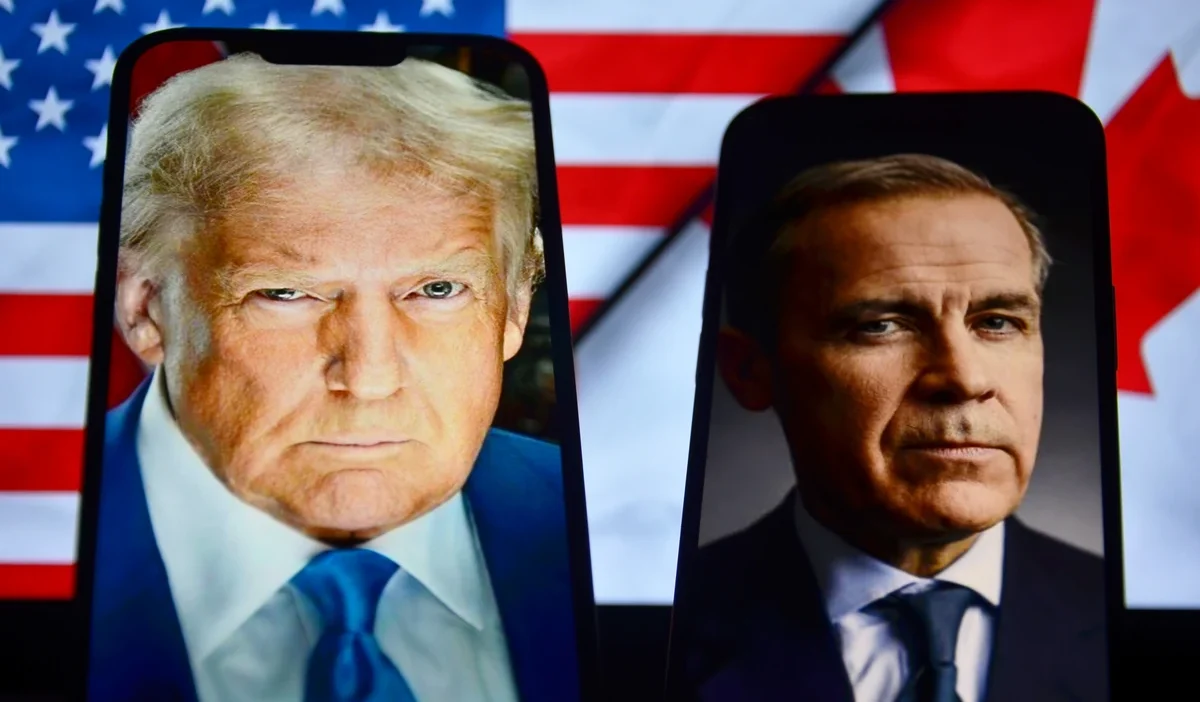
Mark Carney and Donald Trump present competing visions for Europe’s path in the emerging global order.
Contrasting Styles and Messages
Mark Carney delivered a well-organized, rhetorically suggestive speech, while Donald Trump spoke at length with countless digressions, though his core message was condensed into a few short sentences. Carney spoke like a disciplined intellectual leader of a financial organization, as he had been for years (Governor of the Bank of Canada). Trump spoke like a salesman seeking to lull his audience, overwhelm with arguments from various fields, and draw them into his world to ultimately close the deal.
Carney’s “Freedom” Vision
In the battle to make a good impression on listeners, Carney left his rival far behind. His statement “We can no longer rely solely on the strength of our values. We must also see the value of our strength” was quoted by the German Chancellor and immediately spread through the media. The Canadian Prime Minister also stated that “subordination will not ensure security” and it’s time to stop indulging in the pleasant fiction that we live in a world governed by rules. The old order has been broken.
The Principle of Equal Distance
This means that smaller and medium-sized countries should take advantage of their freedom to form agreements and alliances consistent with their values, based on equal distance from allies and adversaries. Each time, an individual assessment should decide. Allies should not be treated better just because they are allies. We must apply “the same standards to allies and opponents.”
Implications for Canada
During his recent visit to Beijing, when Carney and Xi Jinping reached a series of trade agreements, the Canadian Prime Minister made remarkable words about building a new world order together with China. This caused anxious comments. It is more than likely that the Canadian meant exactly what he has now laid out in Davos: his country will apply the principle of equal distance and enter into relations with others in such a way as it deems appropriate, without regard to which camp its partner previously belonged to.
Trump’s Vision of Camps
Among the sea of words spoken by the President of the United States, which served as “masa tabulettae” for his main thoughts, the following message can be read: we want a strong and united West, we want strong allies, we want Europe to be strong. Then, in the part referring to Greenland, Trump added a significant sentence that if Europeans refuse to meet demands, then “we will remember this.” He thus proposed strengthening and consolidating the Western camp under the absolute and unquestioned leadership of America.
The Reality of Both Visions
Carney’s vision is seemingly “libertarian” and was even constructed using Václav Havel’s famous essay “The Power of the Powerless” from nearly half a century ago, suggesting some connection between the world concreted by the Soviet Union and the current one dominated by the United States. This is by the way a completely false and unrealistic comparison presented by Havel, but one can bet that few in the conference hall in Davos have read Havel, and even if they did, they were too fascinated by the anti-American vision to delve into details.
The Dilemma for Europe
Carney’s leader vision is tempting. It fits perfectly with the way of thinking the Western world has become accustomed to, dominated by liberal elites. It gives the appearance of cultivating common values and the illusion of one’s own strength. This was shown by Chancellor Friedrich Merz, who at the same Davos said that “We are not at the mercy of this world,” and a few hours later, the heads of government gathered in Brussels decided to jointly manifest their strength and independence.
The Paradoxical Choice
Only paradoxically following Carney’s vision may mean plunging into a pleasant dream that will end when the Sino-Russian colossus decides it’s time to subjugate the fragmented Western world camp. Then it will turn out that America, which will build along the way a powerful defense system called the “Golden Dome,” will be safe, while countries that have decided to apply the principle of equal distance towards China, Russia, and the US will remain isolated. Following Trump’s vision, on the other hand, means strengthening the freedom camp, where although one is the largest and demands the most rights for itself, in principle one can talk and negotiate.