


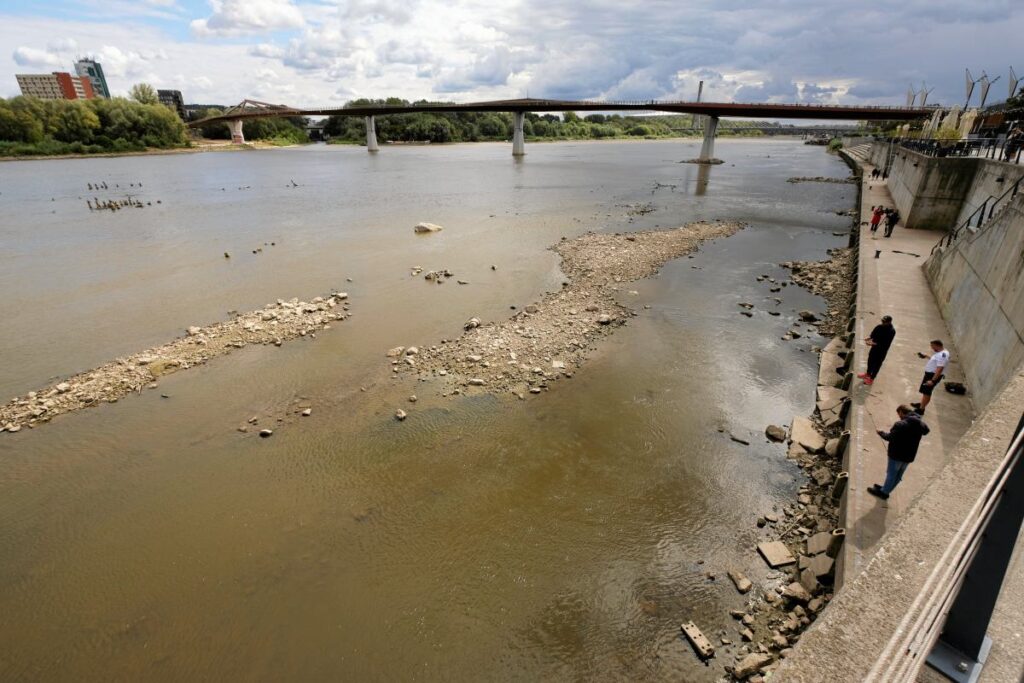
Poland’s Central Institute of Meteorology and Water Management changed the zero reference on Warsaw’s Vistula gauge in early November, bringing a record‑low water level of 6 cm into focus.
Zero‑point shift creates gauge confusion
Early in November, the Polish Institute of Meteorology and Water Management (IMGW) altered the zero‑point on two Vistula gauge stations—Bulwar Wiślany in Warsaw and in Gusinie—defining the measured water level rather than the riverbed, which can shift due to natural and human factors.
Industrial sand extraction lowers the riverbed
The Warsaw stretch of the Vistula hosts three industrial sand mines that remove more sand than the river deposits. This activity accelerates the subsidence of the riverbed, causing the zero‑point to migrate higher relative to the bed over time.
Record‑low water level is misleading
During the August‑September drought, the gauge registered only a few centimetres of water. Yet scientists measured maximum depths of up to 3.5 m at the same gauge time, showing that the 6 cm reading can be dangerously deceptive if taken at face value.
Rapid subsidence threatens future conditions
In the 20th century the Warsaw Vistula bed sank by two metres, and recent rates can reach 15 cm per year, according to hydrologist Piotr Bednarek. A continued drop could drive gauge readings below zero, leading to further confusion and ecological harm.
Calls to halt sand mining and dam construction
Environmental NGOs and Warsaw councilors have urged President Rafał Trzaskowski to stop Orlen’s planned water‑levelling barrier and further sand extraction, arguing the projects would damage the river’s ecosystem and water‑use services, such as tourism, municipal supply and cooling of the Siekierki thermal power plant. Jan Mencwel, a city councilor, noted that scientific studies confirm sand mining exacerbates erosion and subsidence.