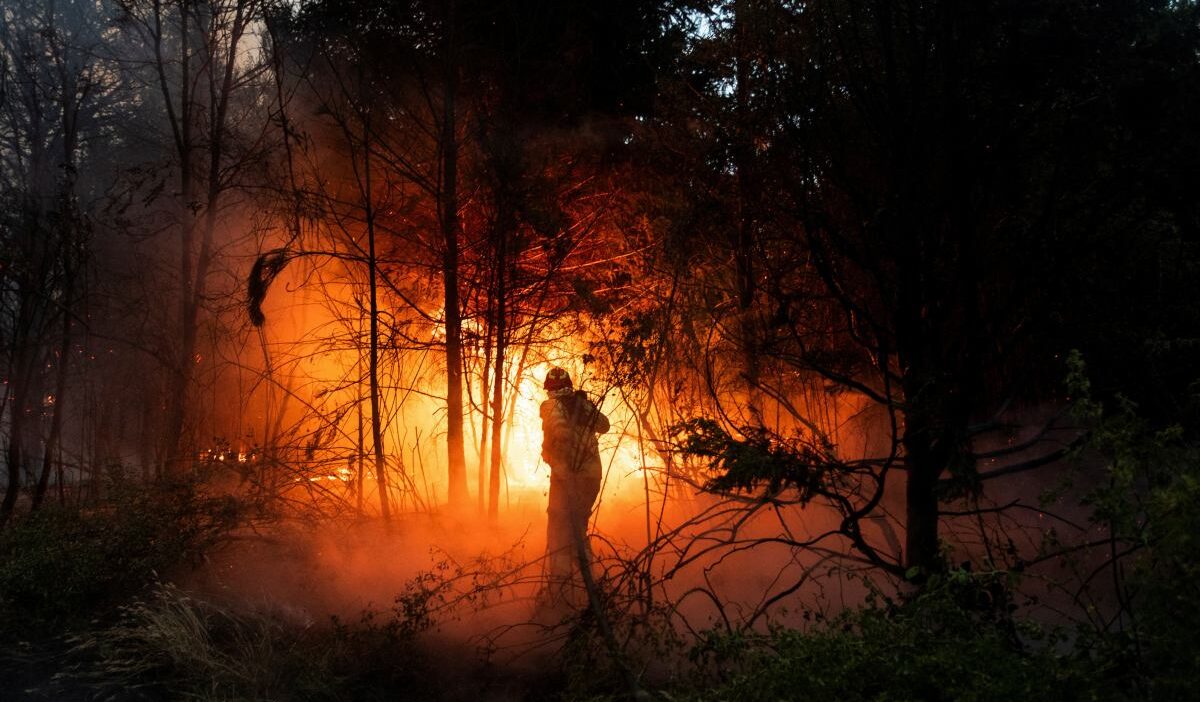
At least 19 people have died and entire neighborhoods destroyed in Chilean wildfires that have burned over 35,000 hectares amid a decade-long drought.
Devastation in Chile and Argentina
At least 19 people have died and entire neighborhoods have been completely burned in Chile. The country’s government has declared a state of emergency in several regions. The scale of fires is also significant in neighboring Argentina.
Residents of Penco, a city located about 500 kilometers south of Santiago, Chile, began the week searching through the massive fire site after the blaze destroyed entire neighborhoods. According to Reuters, residents initially tried to fight the fire themselves or at least protect their homes by watering them. However, the strength of the inferno was such that these attempts were futile.
At least 325 homes have been completely destroyed, while damage assessment continues for another 1,100 properties.
Extensive Damage
The fires in Chile have burned more than 35,000 hectares in total – an area larger than Krakow. Meanwhile, approximately 15,000 hectares have burned in Argentina’s Patagonia.
Satellite images show smoke from the Chilean fires stretching hundreds of kilometers over the Pacific Ocean.
Long-term Drought and Weather Conditions
The beginning of the year brought a heat wave to Chile with temperatures reaching 37°C in some areas, according to Reuters. Professor Miguel Castillo, a fire specialist from the University of Chile, told the agency that high temperature is one of the factors driving the fires. In the Concepcion region, where some of the largest fires appeared, temperatures significantly exceeded 30°C for several consecutive days.
“One or two days of such heat are normal, but not four or five,” Castillo emphasized. The problem is also the size of the fires – the larger they are, the harder they are to extinguish. For this reason, he described the situation as “critical” – while the number of fires does not significantly deviate from typical values for the season, their scope is several times larger.
Drought and Climate Change
Another factor contributing to the fires is the drought that has lasted in Chile for 10 years. Dried vegetation becomes “fuel” for the fires.
These factors are exacerbated by climate change, which disrupts water relations and increases the probability and intensity of heat waves. Previous seasons with extensive fires – in 2023 and 2017 – were characterized by high temperatures and below-average rainfall. Experts expect that as climate change progresses, these conditions will become even more intense.
Plantation Problem
The problem is also exacerbated by tree plantations grown for timber. Popular species – eucalyptus and pine – are highly flammable. In such artificial forests, trees have similar age and size, and without active management, lower branches become a “ladder” for the fire, explains Alejandro Miranda from the Chilean Center for Climate and Resilience Studies. Natural forests where native species grow are usually more diverse and better retain moisture, making them more fire-resistant than tree plantations.
Unfortunately, fires can create a negative spiral of risk because invasive species, such as pine, regenerate more quickly on burned areas. When they replace native species and natural forests, they create an environment even more susceptible to subsequent fires.
Extreme Heat in Australia
Not only South America is struggling with the effects of extreme summer in the Southern Hemisphere. January is also the height of summer in Australia, and this year has brought the worst heat since the “black summer” at the turn of 2019 and 2020, when the country was ravaged by record-breaking fires.
Now in many regions – including the largest cities of Melbourne and Sydney – temperatures exceed 40°C, reaching 45°C in the continent’s center. Australian media report that the heat is seriously affecting residents. At the beginning of January, one hospital in Melbourne recorded a sudden 25% increase in admissions of patients with heat-related symptoms.
Patients were appearing mainly at night, when – as doctors explained – the heat is particularly noticeable. Very high nighttime temperatures don’t allow for sleep, and the body cannot recover from the heat experienced during the day.
Climate Change Connection
An analysis by an international group of climatologists showed that climate change has intensified the current heat wave in Australia. The temperature was higher than what could occur in a world without global warming, and the probability of such a heat wave has increased fivefold. If we do not more quickly limit and halt climate change, such heat waves will become even more frequent and intense. Meanwhile, as experts emphasize, we must adapt to more dangerous conditions resulting from current climate change – including protecting particularly vulnerable people from heat.