


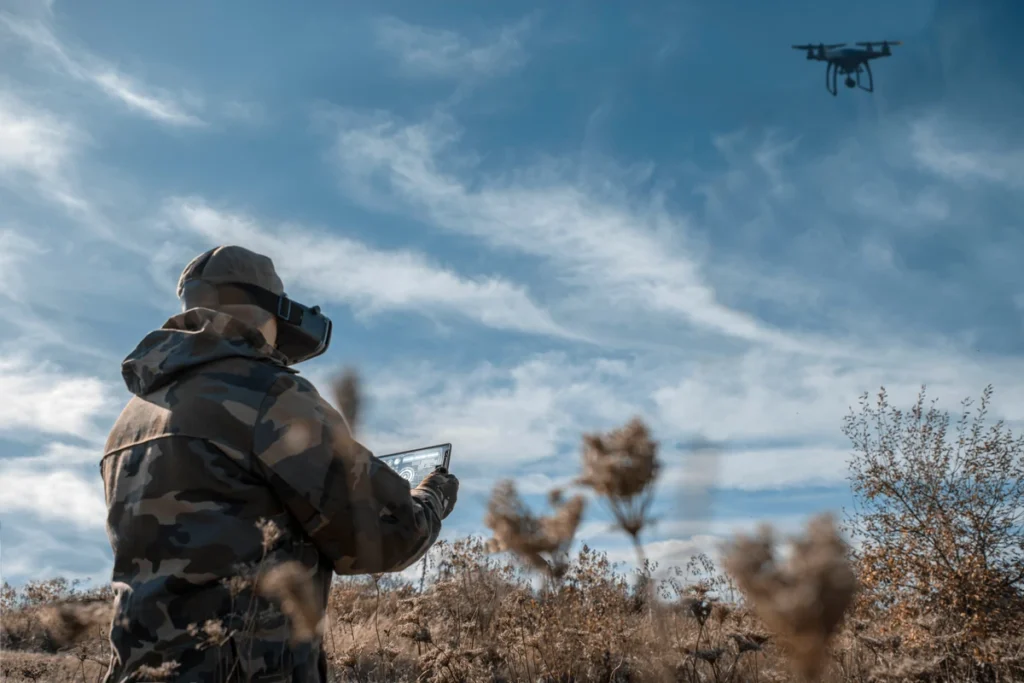
Four years into Ukraine war, battlefield technology evolves with China’s anti-tank dog drones and Russia’s new AI drone being shot down by Ukrainian counterpart.
Drones Dominate Ukrainian Battlefield
Four years of war in Ukraine have seen the battlefield dominated by various drone variants. Recent military technology developments suggest this is just the beginning, with new inventions continuing to surprise observers.
Chinese Dog Drone: Tank Destroyer
The World Defence Show 2026 in Saudi Arabia showcased numerous military innovations, with a Chinese invention drawing particular attention—a new approach to using dog drones. These four-legged machines have previously appeared on the Ukrainian front, mainly for transporting ammunition and supplies to the front lines. However, the Chinese have advanced further, transforming the dog drone into a tank killer.
The new four-legged robotic combat system is equipped with four compact launchers for guided anti-tank missiles. According to the manufacturer, a state-owned Chinese defense firm, the effective range of the missiles is 2-4 km. The remotely operated machine is designed to support infantry in urban and hard-to-reach terrain. The dog’s head features an electro-optical targeting system with day and thermal sensors plus a laser rangefinder. The design also includes a stabilization system, allowing the machine to attack targets even while moving. A single such dog could halt the advance of an entire tank platoon, experts note.
China’s Stealth Drone and American Response
China is not only showcasing technical innovations but also testing more powerful drones. An example is the GJ-21 machine, detected in January on the Sichuan vessel. This powerful drone is adapted to carry rockets and bombs for tactical maritime strikes. Characteristic of the GJ-21 is its stealth technology and compatibility with China’s undetectable J-20 fighter jet, also under testing.
While some work on increasingly advanced drones, Americans have tested another system designed to quickly bring such machines down. In early February, Raytheon announced its invention, the non-kinetic version of the anti-drone “Coyote Block 3NK” system, passed initial tests. This machine is equipped with jamming systems and, reaching enemy drones, doesn’t destroy them but causes them to lose their target and fall to the ground. According to the manufacturer, this system will be suitable not only for protecting critical infrastructure but also for military use.
“Coyote provides soldiers with cost-effective defense against single drones and swarms. We continue to invest in battle-proven Coyote capabilities, providing allies worldwide with affordable operational advantage over advanced and evolving drone threats,” said Tom Laliberty, president of Raytheon’s Land and Air Defense Systems.
Russian Drone Intercepted by Ukrainian Forces
Russians didn’t want to fall behind in the technology race and recently boasted about their latest achievement—the “Klin” drone. They assured that this unmanned aerial vehicle would use Artificial Intelligence to independently detect targets. Flying at speeds up to 300 km per hour, it carries a 5 kg warhead, and its speed of movement was supposed to guarantee it would be difficult to shoot down using standard air defense elements.
In early February, Moscow attacked Ukrainian positions with the “Klin,” but the machine’s debut didn’t go as planned for the manufacturer. The machine encountered the 118th Independent Mechanized Brigade of the Ukrainian Armed Forces. The defenders sent their own invention to meet it—the intercepting drone “General Cherenzhaya AIR,” which easily handled the Russian threat. The wreckage of the “Klin” was handed over for research.