


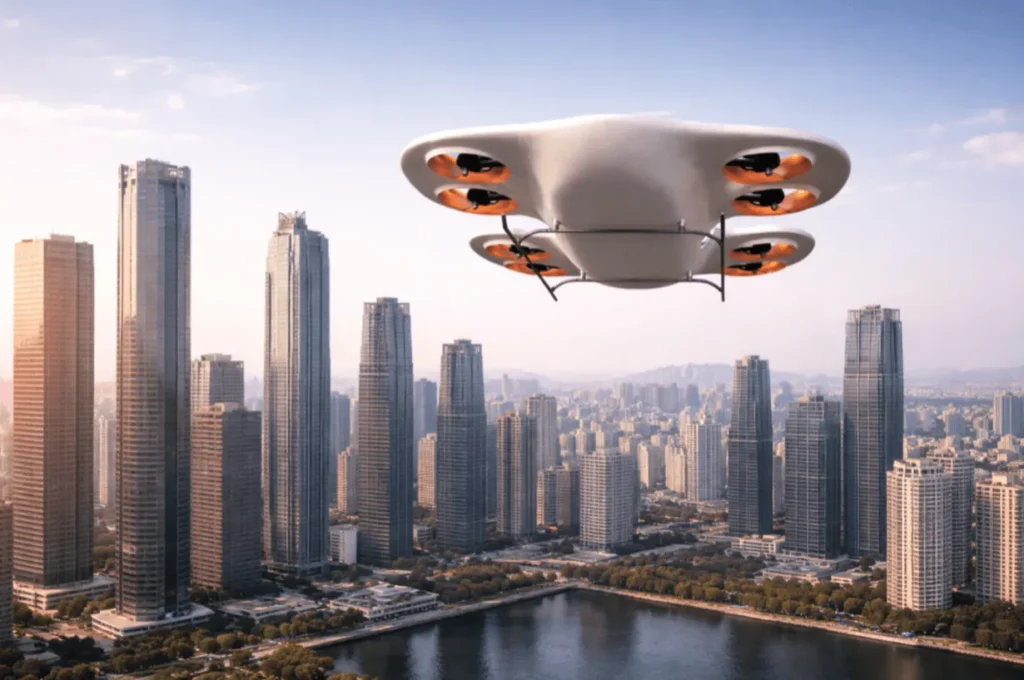
A flying taxi prototype resembling a UFO has completed test flights in Wuhan, China, showcasing potential for passenger and emergency services.
Chinese eVTOL Prototype Airborne
A Chinese company, E-Hawk Technology, has successfully tested an experimental eVTOL (electric vertical takeoff and landing) vehicle in Wuhan, Hubei province. The aircraft’s unusual disc-shaped design has drawn comparisons to a UFO.
The demonstration at Optics Valley Low-altitude Economy Park included a full operational cycle: vertical takeoff, hovering, lateral movement, and precise landing – maneuvers crucial for urban environments.
Low-Altitude Economy Gains Traction
E-Hawk Technology is active in China’s burgeoning “low-altitude economy” sector, which is gaining strategic importance. Chinese authorities forecast this segment—including drones and autonomous air taxis—could reach hundreds of billions of dollars in the coming years.
Design and Engineering Features
The vehicle’s design, described as “breakthrough” by company founder Cai Xiaodong, features a 5.6-meter fuselage housing ducted fan propulsion. This “invisible wings” approach enhances safety and reduces mechanical damage risk.
The aerodynamic shape contributes to stability during hovering and low-altitude maneuvers. The aircraft has a maximum takeoff weight of 1.2 tons and is designed to carry four passengers.
Urban Applications and Emergency Response
The eVTOL is optimized for operation in confined spaces, making it suitable for congested cities where traditional aviation infrastructure is limited. Over 140 test flights have been completed.
One test simulated a rescue operation from a third-story balcony, demonstrating potential for medical transport, emergency services, and bypassing traffic congestion.
Interior Comfort and Autonomous Potential
The vehicle’s interior eschews traditional flight controls in favor of a simplified interface with a large screen. A journalist described the cabin as surprisingly spacious and comfortable.
The digital control system suggests the possibility of full or partial autonomy, aligning with broader industry trends to increase accessibility of air transport.
China’s Investment in Air Mobility
The development of eVTOL technology aligns with China’s broader strategy to modernize transport and utilize low-altitude airspace. Beijing is investing heavily in drone infrastructure and air traffic management systems.
Key challenges remain, including legal regulations and integration with existing air traffic. Work continues on improving battery range and efficiency.
Despite these challenges, commercial air transport services are already being tested in China, with more cities preparing to implement supporting infrastructure.