


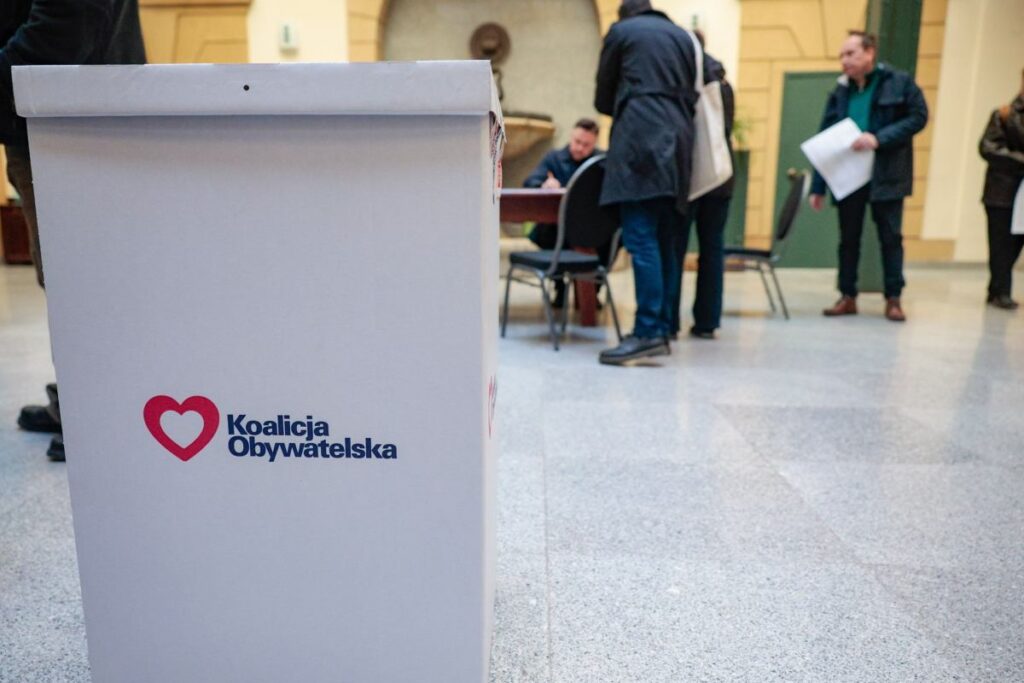
Following internal elections within Poland’s Civic Coalition (KO), multiple protests have emerged over disputed results in several regional contests.
Civic Coalition Holds Internal Elections
Internal elections began in mid-January within the Civic Coalition (KO), the first since the merger of Platforma Obywatelska, Nowoczesna, and Inicjatywa Polska last October. The first phase focused on electing new leadership at the local level.
In March, members re-elected the current leader, Donald Tusk, who ran unopposed and received 97% of the vote. Elections were also held for county and regional leaders.
Protests Emerge Over Regional Results
Controversies arose after the announcement of regional election results. Joanna Frydrych, a member of parliament, filed an election protest after losing to Paweł Kowal, chairman of the Sejm Foreign Affairs Committee. Frydrych alleged irregularities but declined to provide details, stating it was an internal matter.
Monika Wielichowska, a Deputy Speaker of the Sejm, also filed a protest in the Lower Silesia region, claiming she received six fewer votes than the incumbent regional head, Deputy Minister of Development Michał Jaros. She alleged a lack of voting secrecy, specifically regarding individual ballot casting.
Further Protests and Disputed Votes
Additional protests were reported in Kraśnik, Lublin Voivodeship, where the presence of an allegedly unqualified individual on the election commission was challenged. In Lublin Voivodeship, Marta Wcisło was elected regional head with 663 votes, defeating Michał Krawczyk, who received 30 less.
A KO activist in Kraśnik County claimed that Wcisło received 49 votes compared to Krawczyk’s 13, a difference of 36 votes—more than the overall margin. If those votes were invalidated, Krawczyk would have won.
National Review of Protests
Reports indicate a total of around a dozen election protests nationwide, primarily in the Lower Silesian, Subcarpathian, and Lublin Voivodeships. Most protests have been dismissed by the national election commission, often concerning minor issues.
Dorota Niedziela, head of the KO National Election Commission, stated that one case involved an individual simultaneously serving on the commission and running in the election, but the commission granted permission after a request. The commission is systematically reviewing all protests, including the one from Lower Silesia.
Leadership Changes Anticipated
The next step involves electing members to the National Council, national collegiate court, and audit commission, as well as regional audit commissions and collegiate courts. A meeting of the National Council will follow, potentially before Easter.
The National Council will elect new vice-chairpersons, subject to approval by the Prime Minister. Former leaders of Inicjatywa Polska and Nowoczesna, Barbara Nowacka and Adam Szłapka, are expected to be included in the leadership. The Council will also elect a secretary-general and treasurer, with Donald Tusk expected to nominate the candidates.
The position of secretary-general is considered crucial, especially with parliamentary elections scheduled for 2027. Current secretary-general Marcin Kierwiński, who also heads the Ministry of Interior and Administration, is not expected to continue in the role. Sources suggest the change was discussed previously when Kierwiński became a Member of the European Parliament.