


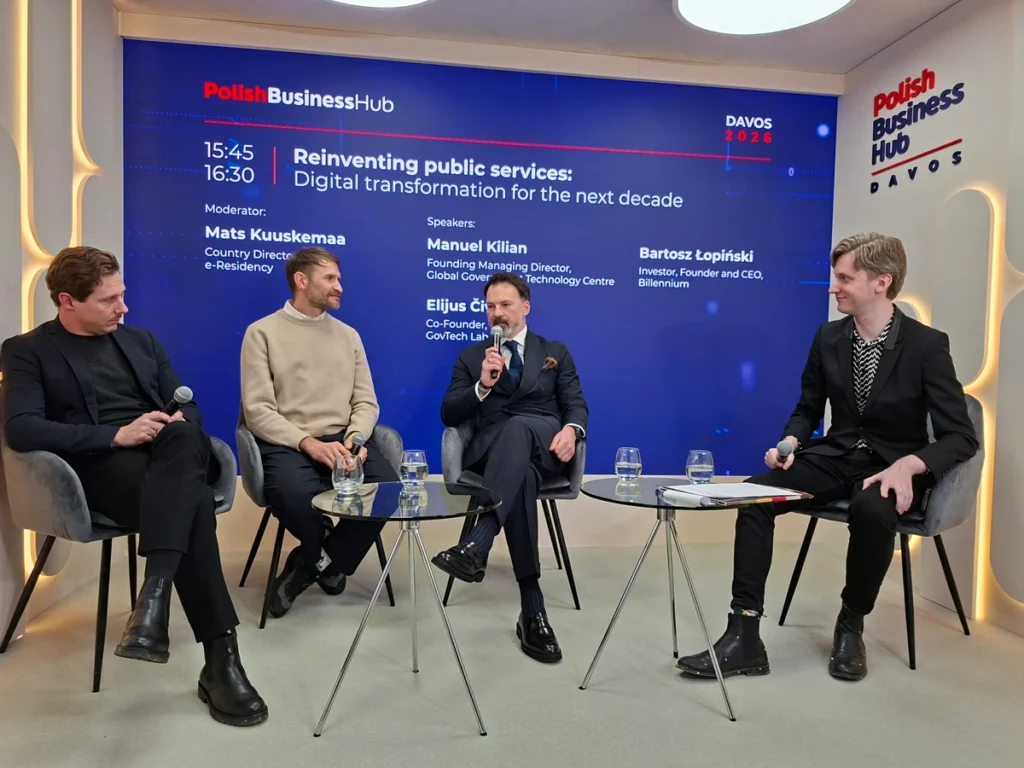
Panelists at Davos 2026 explored how digital transformation and artificial intelligence can reform government and drive innovation through public-private cooperation.
Panel Discussion at Davos 2026
On January 19, a panel discussion featured Bartosz Łopiński, creator and CEO of Billennium; Manuel Kilian, Founding Managing Director of Global Government Technology Centre; and Elijus Čivilis, Co-Founder of GovTech Lab Lithuania. The discussion was moderated by Mats Kuuskemaa, Country Director of e-Residency.
AI Creating New Opportunities
During the discussion focused on digital transformation in public services, themes of competitiveness and the need for a strong digital economy in Europe emerged clearly. Participants mentioned the famous Mario Draghi report. When asked about governments’ role, Elijus Čivilis stated, “I think the government should fundamentally provide infrastructure. It must set the rules of the game, but services should be provided by private companies, in my opinion.”
Need for Public-Private Cooperation
Panelists largely agreed on lost opportunities, as Europe’s position on the global innovation map is not impressive. Bartosz Łopiński noted that a new opportunity (possibly the last) has emerged to change this situation, with AI development opening a new chapter. As defined by the Billennium CEO, a joint effort by the private sector, governments, and external financing is necessary to leverage potential and achieve goals (including achieving digital sovereignty). “This is a necessary condition,” emphasized Bartosz Łopiński.
Transformation of Citizen-State Relationships
As the discussion showed, cooperation should have different dimensions between sectors but also across borders in Europe. Panelists pointed out that digital transformation simultaneously changes the relationship between citizens and the state—a dynamic process whose best examples are successive solutions based on AI. Another issue is that involving AI agents in processes related to governance, such as public procurement or crisis response, may raise questions and challenges.
Digital Transformation Beyond Paper Processes
During the discussion, the essence of digital transformation was also addressed, which should not merely mean transferring processes from the paper world. It is worth focusing on remodeling them, considering user experience, and appropriately shaping regulations. From the participants’ statements, it appeared that technological change can lead to a profound transformation in citizen-state relationships and to remodeling the latter in the context of its role. At stake is increased efficiency, performance, and strengthened European competitiveness.
Estonia as a Success Story
The discussion included Estonia as an example of a country that has decisively embraced digitalization, creating an environment conducive to entrepreneurial development through this approach. Examples of AI applications worldwide were also presented, which can shorten administrative formalities such as issuing building permits. Bartosz Łopiński evaluated the situation from the perspective of an IT service provider with subsidiaries in different countries on three continents (Europe, North America, Asia). He pointed out the regulations distinguishing the Old Continent but added that he is optimistic.
“I sincerely believe that creating a truly reliable, sustainable ecosystem will make Europe a potentially wonderful place to live because ultimately it’s about creating a competitive environment where people can develop,” said the Billennium CEO, also mentioning cooperation with the public, private, and academic sectors.
Cross-Sector Cooperation for Innovation
The need for cooperation, including between public and private sectors, supporting development based on innovation, was also recurring in other panels at Polish Business House in Davos—for example, in the context of dual-use, civil, and military solutions.