


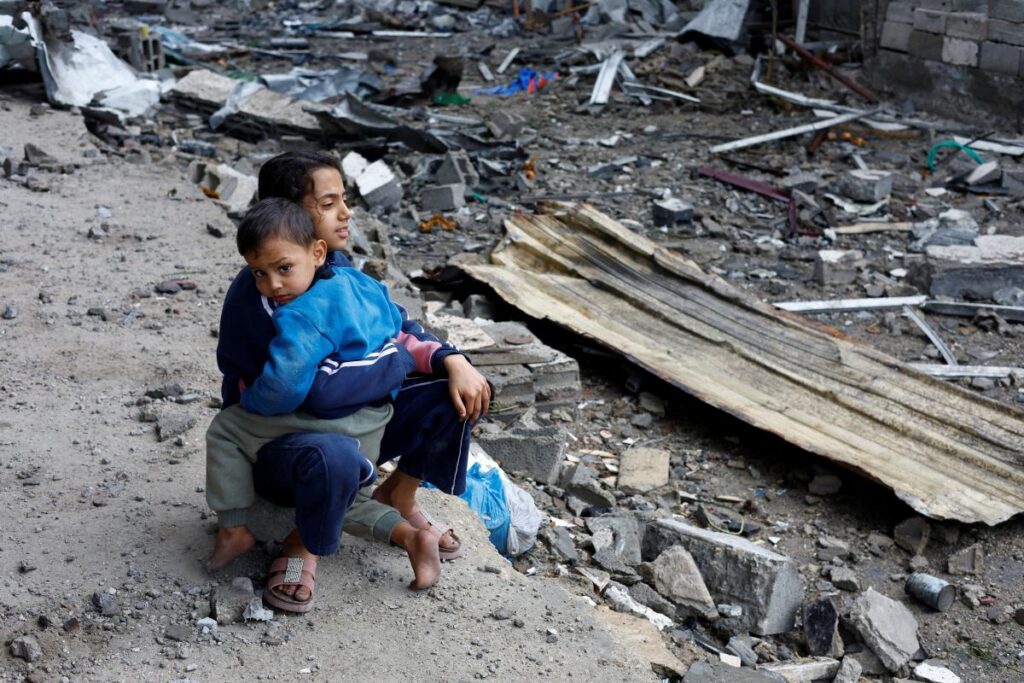
Doctors working in Gaza report that despite a ceasefire in place since October, Israeli bombings and attacks continue in the Palestinian enclave.
Continued Violence Despite Ceasefire
Since October last year, a ceasefire has been in effect in the Gaza Strip aimed at ending the conflict. However, it does not mean that Israeli bombings and attacks have ceased in the Palestinian enclave – specifically in its smaller part, beyond what is known as the “yellow line.” The humanitarian situation remains dire, though aid deliveries have slightly increased compared to the period before the ceasefire.
International Medical Aid
Food and medical aid deliveries are very limited, but foreign doctors can still enter Gaza. Among them were Kasem Wreikat and Adib Halasa, Jordanian surgeons whose mission was possible thanks to cooperation with the international organization Project Hope, the Polish Medical Mission, and the Jordanian organization JHASi.
Hospital in the Epicenter
The Jordanian doctors completed their 30-day mission at the Martyrs Al-Aqsa Hospital in Deir al-Balah, in central Gaza. Although they arrived at the end of October – several weeks after the ceasefire took effect – they saw many injured in new Israeli attacks.
“From reports, we know that since the ceasefire took effect, attacks have definitely eased, but have not disappeared. Instead of several dozen, sometimes 100 people dying daily, several are dying. The time of fighting in the descriptions sounded like hell,” said Adib Halasa.
The “Yellow Line” as New Border
According to Adib Halasa, since the ceasefire took effect, the “yellow line” has become the new de facto border of Gaza. Palestinians are now confined to territory constituting less than 50% of Gaza’s pre-war area. “The yellow line is tightening more and more, and anyone who approaches it can be killed. Children searching through ruins to find firewood died this way,” the doctor reported.
Medical Challenges
Like other foreign doctors, the Jordanians performed four to six operations daily. “On one hand, there were patients with chronic problems: after two years of war, there are many people with serious burns or injuries whose treatment needs to be completed. Lack of drugs, clean bandages, and water often leads to complications,” Halasa emphasized.
After their shifts, the Jordanians conducted training for residents and young doctors whose education had been interrupted by the war. “We met people who had unimaginable experience in emergencies, treating gunshot wounds, but sometimes didn’t know some simpler or basic procedures because all their practice was war medicine,” he noted.
Heartbreaking Cases
“The most difficult case I encountered was a 35-year-old woman. A bomb fell near her house when she was looking in the mirror. Pieces of the mirror shattered in her face and all over her body. We tried to remove them and dress the wounds,” described one doctor.
“I never in my life thought I would wish death on another human being, but in her case I couldn’t stop the thought: death would be a mercy for her. What would her life be like? Without eyes, destroyed by pieces of mirror. Without a piece of face that wouldn’t be wounded. With a body full of shrapnel. Without close ones who died a year earlier. Fortunately – I consider it fortunate – she died. Actually, she didn’t ‘die’. She fell,” the doctor recalled.
Kasem Wreikat recalled a seven-year-old girl whose house was bombed, and her entire family died. “She had second and third-degree burns on 70% of her body. Second-degree burns require intensive and long treatment. Third-degree burns on most of the body – that’s a death sentence, even if the patient survives the first hours and days. She also had open fractures and a large, open wound across her entire perineum,” Wreikat remembered.
Aid Restrictions
Despite restrictions on aid deliveries and the activities of non-governmental organizations in Gaza, Israeli authorities continue to allow foreign doctors to work in hospitals. However, their missions are also subject to numerous restrictions – starting with the verification of each person traveling to the enclave.
“After declaring my desire to travel to Gaza, I learned that I would be informed the evening before whether I was going to go,” said Kasem Wreikat.
Although the Jordanian capital is a little over 200 km from the Gaza border, the doctors’ journey takes a full day. First to the Jordanian-Israeli border, then to a checkpoint on the Gaza border. Doctors can bring personal items and some food and medicine for their own needs, but not larger quantities of medicines and medical equipment.
“I asked the organization if I could bring at least burn ointment. They told me not to take more than one tube for my personal use, because Israeli soldiers would confiscate them during inspection,” the surgeon reported.
Arrival in Gaza
Adib Halasa recalled the first images he remembered from Gaza. “Beyond the yellow line, at a UN field facility, we boarded buses that were to take us to the hospital itself. The road goes along the coast, so we first saw the beach, and then the first tents of displaced Gaza residents. They quickly became more numerous and that was our view for the next two hours of driving: a sea of tents and people who had lost their homes,” he recounted.
Winter Challenges
Despite increased humanitarian convoys and commercial food deliveries, food is still scarce in Gaza. The result is widespread malnutrition and extremely high prices – both doctors described the war-torn city as “the most expensive they have ever visited in their lives.”
“A chocolate bar can cost 10 dollars (about 35 zł). In Jordan, a 10-kilogram gas cylinder costs less than 40 zł. In Gaza, one kilogram costs 250 zł,” they compared.
The ongoing winter means new dangers – in Gaza, nighttime temperatures can drop to just a few degrees. There have been downpours that flood displaced persons’ camps. Tents sometimes collapse during rain, and all the small belongings get soaked. Palestinian media report of children dying from hypothermia and people dying in collapsing buildings.
What Gaza Needs Most
When asked what is most needed in Gaza, the doctors don’t have one answer because everything is needed. “Every wounded and sick person should be evacuated from Gaza for treatment abroad. In Gaza, the chances of survival are very small,” said the surgeon.
“When I talked to children, they asked me: ‘in Jordan, how many hours a day do you have electricity? How often do bombs fall where you live?’ They couldn’t even imagine that somewhere you can have electricity all the time, that you don’t hear the buzzing of drones all day, that bombings don’t happen on a daily basis. I didn’t know what to answer them,” recounted Kasem Wreikat.