Poland’s Climate Ministry will decide in June whether multi-material beverage containers will be included in the deposit system, following an evaluation.
Deposit System Evaluation Scheduled for June
The Ministry of Climate and Environment (MKiŚ) will decide in June whether multi-material packaging, such as beverage cartons, will be included in the deposit system. Deputy Minister Anita Sowińska assured that manufacturers avoiding the system is a marginal phenomenon, despite previous lobbying from the multi-material industry for inclusion.
Concerns Over Manufacturers Circumventing the System
Multi-material packaging – beverage and liquid food cartons – currently remain outside the deposit system. Recently, PiS MP Grzegorz Matusiak raised concerns that producers might intentionally switch to multi-material packaging to avoid deposit system obligations.
Sowińska responded that this appears to be a marginal trend, adding that beverage cartons are generally not included in deposit systems in other EU countries, though Poland may still consider it in the future.
Evaluation Criteria and Timeline
The decision, according to Sowińska, will not be made before June – following at least six months of system evaluation. The Ministry intends to assess recycling rates and the extent of environmental litter from different packaging fractions. The Deputy Minister acknowledged that cartons are less likely to end up in the natural environment than, for example, single-use glass.
Industry’s Previous Interest in Inclusion
During the legislative work on the deposit system law, multi-material packaging producers themselves lobbied for inclusion. Sowińska stated she is currently unsure if this remains the case, and no further consultations have been held.
Deposit System Statistics: Half a Billion Packages Monthly
Approximately 520 million packages have entered the deposit system since the beginning of the year, with a 60% increase in the last two weeks of March compared to the same period last year, indicating system acceleration. The Ministry estimates a stable monthly collection rate of around half a billion units.
Overall System Growth and Participation
A total of 1.8 billion packaged items subject to the deposit have been introduced to the market since the beginning of the year, a number that continues to grow rapidly. Approximately 70% of packaging available on the market is now deposit-based.
Collection Network and Incentives for Retailers
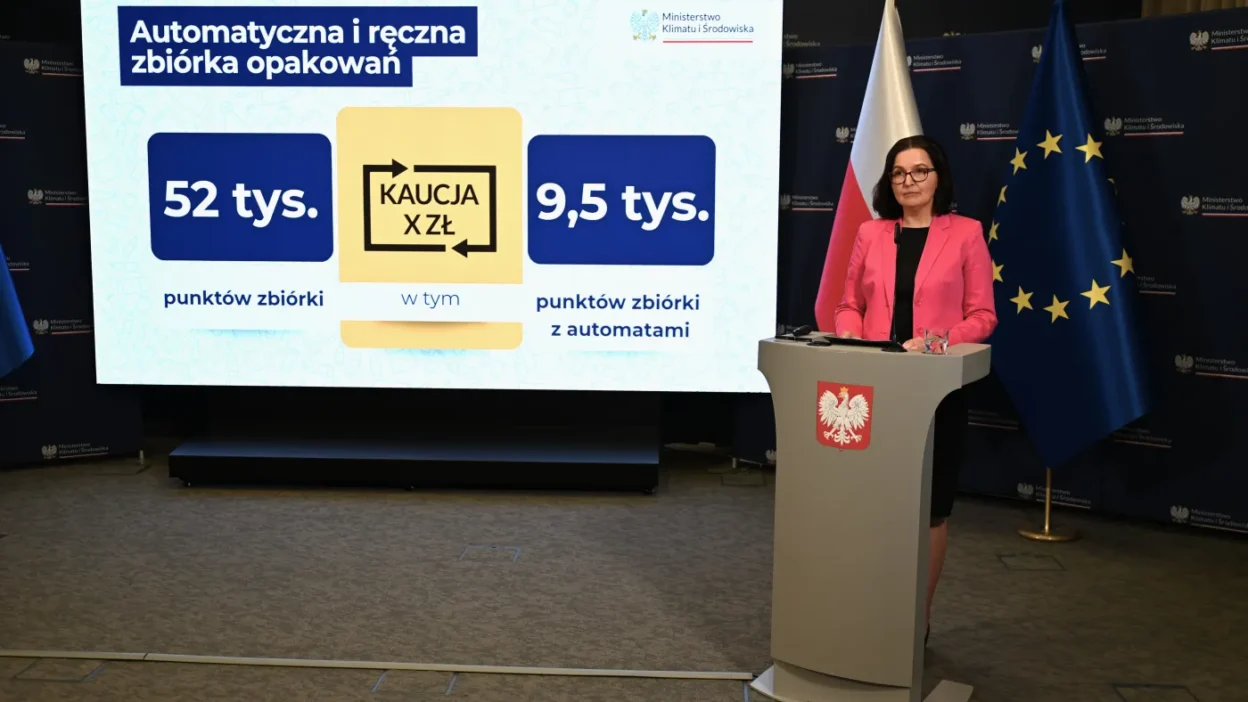
The collection network currently includes 52,000 points, with 9,500 being automatic return machines. A significant 24,000 points – 46% of the total – are operated by small stores voluntarily participating in the system. Sowińska highlighted the dual motivation: receiving a handling fee from operators and attracting customers.
Collection Methods and Consumer Rights
Around 78% of packaging is returned through automatic machines (404 million units). However, manual collection is considered equally valid – stores cannot refuse to accept packaging for beverages they do not sell and must provide a cash or card refund upon request. Purchases in the store cannot be a condition for receiving the deposit.
Operator Stability and Oversight
The system operates with multiple operators. The Ministry revoked the permit for EKO-Operator, which itself requested the cancellation before planned launch in August 2026. Ecokaucja received approval from MKiŚ to operate the deposit system starting in June, despite its president facing charges related to the “waste mafia.”
Sowińska assured that the situation is being closely monitored and the former president is no longer in that role.
Potential for Umbrella Organization and Future Expansion
The Ministry is also considering establishing an umbrella organization for system participants, dependent on consensus among business sectors – operators and retail chains.
Unclaimed Deposits and System Funding
Journalists inquired about the fate of unclaimed deposits. Sowińska explained that these funds finance the system, reducing costs for beverage producers and indirectly protecting consumers from price increases. The system is primarily funded by producers, with revenue from material sales or unclaimed deposits offsetting costs.
Expansion Plans: Single-Use Glass Under Consideration
Regarding system expansion, the Ministry confirmed it is first analyzing the inclusion of single-use glass, including small bottles (“małpki”), which contribute to public space litter. Any legislative changes would require approximately two years of *vacatio legis* due to necessary logistical investments.
Response to Criticism of the System
Sowińska addressed accusations that the system “made Poles fools” or “garbage collectors” – referencing online publications. She stated she does not feel that way and regularly cleans forests, adding that it insults those who volunteer. She also responded to Konfederacja, whose members demonstratively brought bottle crates to their offices: “If you throw away a bottle, you finance this system. So better return it.”
Interpretive Issues for Businesses
Sowińska was asked about interpretive issues raised in DGP regarding free beverages or those for internal producer use. Packaging law does not specify what businesses should do in such cases, and regional authorities issue conflicting interpretations. The Deputy Minister did not provide a direct answer, stating that the Ministry would consider the issue if necessary.
Deposit System – Key Figures
520 million – number of packages collected since the beginning of the year (data as of April 13, 2026)
1.8 billion – deposit-based packages introduced to the market since the beginning of the year
52,000 – collection points in Poland (including 9,500 automatic machines)
78% – packaging returned through automatic machines (approx. 404 million units)
Approx. 70% – estimated share of deposit-based packaging among all packaging available on the market
Copyright © INFOR PL S.A.