


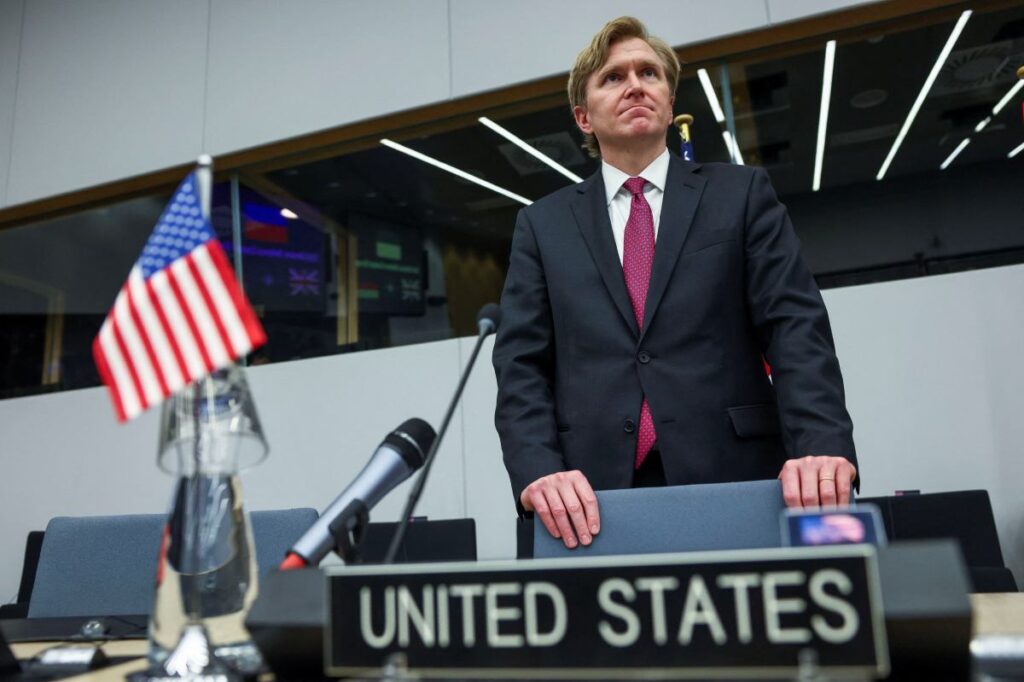
Deputy Secretary of Defense Elbridge Colby stated that Iran is prepared to strike various countries, not only in the Middle East but potentially NATO members as well.
Iran’s Global Threat
Deputy Secretary of Defense Elbridge Colby stated on Wednesday that “Iran is ready to strike various countries, not only in the Middle East.” Colby, speaking at a Council on Foreign Relations think tank, was responding to questions about U.S.-Israeli attacks on Iran.
Regarding a NATO-intercepted missile over Turkey, Colby said, “I don’t know the details, so I don’t want to get ahead of myself.” However, he added, “But I think we see clearly that the Islamic Republic is ready to strike a wide range of countries, not only in the Middle East, but potentially NATO as well.” He noted, “We are observing movements by many NATO countries to take action (in this matter).”
U.S. Defense Strategy Priorities
When asked how operations against Iran fit into priorities of the U.S. National Defense Strategy, Colby responded that “the strategy clearly states that Iran, the Islamic Republic, poses a threat to the U.S., our allies and partners in the Gulf, to Israel, to Europe.”
“The strategy emphasizes that it is the duty and necessity of the department to provide the president with credible and rational military options that will enable him to achieve his goals worldwide, and especially will allow him to utilize our aviation and maritime programs. Therefore, I believe it is incredibly important that the United States, and in particular the armed forces of the United States, can take decisive actions worldwide,” he added.
Poland as a Model Partner
“Secondly, the strategy emphasizes how important it is to share burdens,” the Deputy Minister noted. In this context, he mentioned Israel, South Korea, and Poland as model partners for the U.S. He acknowledged that “Germany is also making progress” in terms of defense spending.
“We also see this to a large extent in the Middle East. And the strategy is designed to allow the president (Donald Trump – ed.) to carry out such operations,” he listed.
Pentagon Stance on European Nuclear Capabilities
In response to a PAP question about whether there are plans to change the number or deployment of American soldiers and equipment in Europe in light of operations against Iran, the Pentagon responded that “today they have no changes to announce regarding force deployment.”
When asked about his opinion on ongoing discussions among European countries regarding obtaining nuclear weapons or extending French or British nuclear umbrellas to other countries on the continent, Colby answered, “I have not heard credible information that European governments are seriously considering independently acquiring (nuclear weapons) and breaking their obligations under the Nuclear Non-Proliferation Treaty.”
“From the Ministry of Defense’s perspective, it is entirely appropriate and reasonable for the European contribution to NATO’s nuclear deterrence to be greater,” he added. “The independent nuclear deterrence of the United Kingdom or France contributes to NATO’s deterrence and defense. So that’s a good thing,” he emphasized.
Opposition to European Nuclear Programs
“As I understand it, there are currently talks about how this exactly fits into NATO planning (…) I know that the United Kingdom has decided to increase its commitment to NATO nuclear deterrence. I think there is also other potential. I think everything in this spirit is positive. And by the way, Europeans usually tell us: hey, we’re talking to the French, but don’t misinterpret it – the Deputy Secretary conveyed.
When asked whether, if German, Polish, or Scandinavian authorities approached the U.S. about developing their own nuclear capabilities, Washington would try to dissuade them, Colby answered, “Yes, I think we would try to dissuade them. I think that, of course, we would at least firmly oppose it.” He added, “This is hypothetical, but we are opposed to such a possibility.”
France’s New Nuclear Vision
On Monday, Emmanuel Macron presented a vision for a new French nuclear deterrence, proposing cooperation with other European countries, including Poland, and announced an increase in the number of French warheads. He emphasized that advanced nuclear deterrence will give European allies of France the opportunity to participate in deterrence-related exercises.