


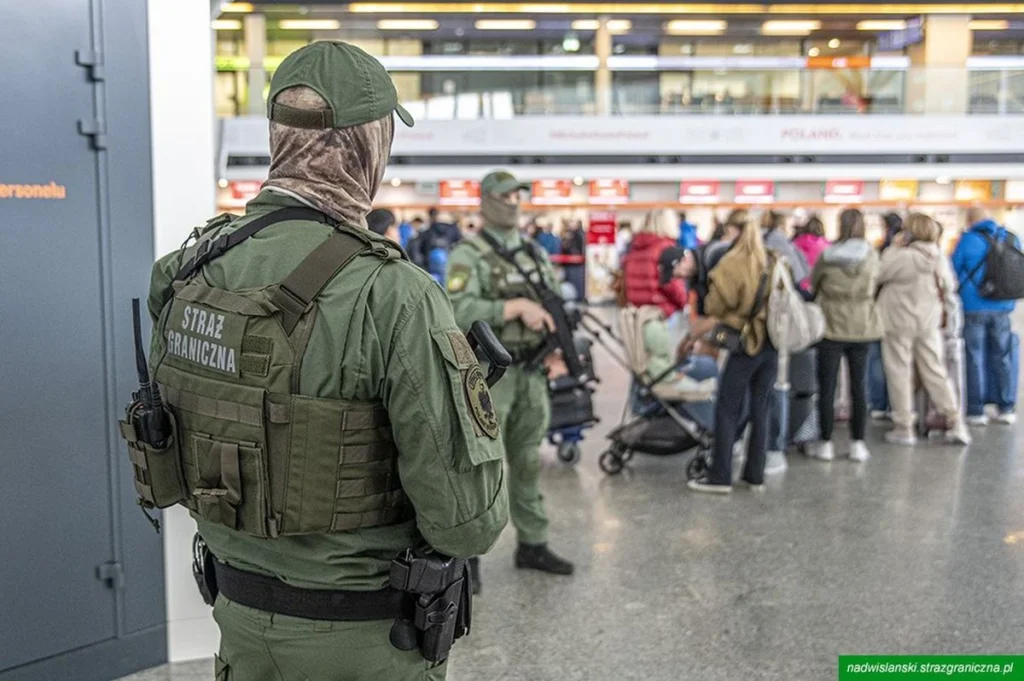
Ukrainian national Illia S. detained at Warsaw Chopin Airport with suspected jamming device after spending weeks behaving suspiciously.
Initial Encounter and Suspicions
Initial signals did not raise alarm. Airport Protection Service officers accepted the man’s explanation about a delayed flight to Canada, especially as his behavior and appearance inspired trust. Only later, after his arrest, did a service note describe earlier conversations.
According to authorities, the Ukrainian citizen arrived in Poland on December 9, landing at Modlin Airport near Warsaw. Shortly thereafter, he began regularly appearing at Chopin Airport. He always sat in a café, set up his computer, and spent many hours there, sometimes until late at night. For a long time, no one had grounds to intervene.
Suspect’s Background and Travel History
On December 25, around midnight, the same patrol of the Airport Protection Service that had spoken with the man earlier again noticed him. Officers asked why he was still at the airport and why he had not flown to Canada. This time, the answers were inconsistent. The man could not logically explain the change in plans, refused to show a valid air ticket, and also a document of identity.
From the passport, it emerged that the man is 26-year-old Ukrainian citizen Illia S., born in Kyiv. Importantly, since 2021, that is, even before Russia’s full-scale invasion of Ukraine, he had not been in his country. Officials who saw his documents noted numerous entry stamps from Middle Eastern countries cooperating with Russia – including Syria and Lebanon.
Suspicious Items Found in Luggage
Other sources confirm that Illia S. also frequently traveled to Arab countries such as the United Arab Emirates. He had also been to Canada, the United Kingdom, and Cyprus. He had a valid Polish and Canadian visa, as well as an expired British visa. The scale and frequency of his travels aroused additional interest from the services.
Real surprise came during the search of baggage. In the suitcase, officials found about five kilograms of oatmeal, onions, and a portable electric kettle. The Ukrainian could not sensibly explain why he was transporting such items.
In addition, the bag contained a large amount of electronic equipment: headphones, microphone, numerous chargers, a splitter, and two spools of network cable. Officials were also puzzled by the noise-canceling headphones, typically used to protect hearing during shooting.
The Jamming Device and Its Potential Impact
In the suitcase, car keys were also found, most likely for a Land Rover vehicle. When asked about the vehicle, Illia S. tangled in his testimony: once he claimed the car was in Ukraine, at other times that it was in Canada.
However, the greatest interest was aroused by a metal device the size of a pocket book, to which a large number of antennas were connected. Officials had seen such equipment for the first time. Analysis using AI-based tools indicated that it was a jamming device.
Experts have no doubt that such a jammer could cause serious disruptions at the airport. “Many airport systems use hidden WiFi networks, like cameras or gates with QR code readers. If monitors communicate via WiFi, they may lose connection and not update data for passengers. Such a jammer can also disrupt walkie-talkies, communication between ground staff and the aircraft cabin, the work of the border guard service, and GSM telephone passengers,” an expert added.
System Failures and Arrest Delays
According to airport sources, in the two weeks before the arrest, there were several failures of information systems, including arrival and departure boards. A working hypothesis emerged that the Ukrainian might have been testing the capabilities of the jammer in real conditions.
This possibility is indicated by the account of a woman sitting at a neighboring table. She noticed the man’s nervous behavior and saw that for about half an hour he was conducting a video conference during which he was sending something to his interlocutors, which she read as GPS coordinates. When he realized someone was watching him, he closed his laptop and quickly moved away.
After midnight on December 26, officials concluded that there was a need for a formal arrest of Illia S. However, police officers waited for a decision from their superiors. For the next hours, there was a jurisdictional tug-of-war between the services. The case was reported to the antiterrorist center of the Internal Security Agency, but formal arrest decision only came after about five hours.
Legal Proceedings and Security Concerns
The case is being handled by the Warsaw-Ochota District Prosecutor’s Office. The Regional Court applied a one-month arrest to Illia S.; unofficially, its extension is being considered. Investigators point to the man’s intensive travels and lack of credible explanations regarding the sources of financing such a lifestyle.
Sources at the airport indicate that the problem is not only procedures but also lack of training in electronic warfare and drone-related threats. They recall the incident of May 14, 2023, when a drone with a wingspan of about 2.5 m appeared in the approach area. Polish Airports confirm that effective anti-drone systems are difficult to implement and must take into account the presence of the military and the Polish Air Navigation Agency.