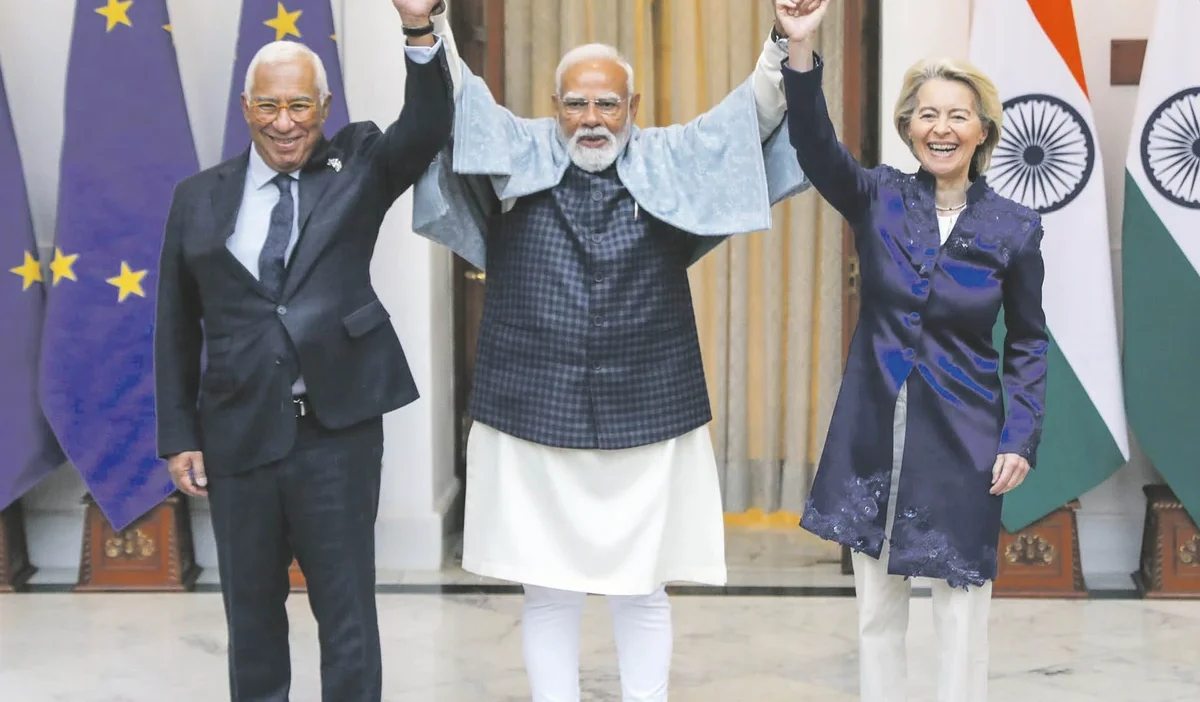
European Union and India are developing strategies to navigate between China and United States in a newly complex global landscape.
A Shifting Global Order
Until recently, the world appeared organized in a relatively simple manner, roughly reflecting the old blocks of the 20th century, centered around common interests and similar values. The economically liberal, democratically governed West respected human rights, while on the other side stood statist and authoritarian states (to varying degrees), with China increasingly serving as the brain, heart, and stomach of this bloc, and Russia, Iran, and North Korea in the role of a threatening fist.
India’s Balancing Act
Several countries existed “in between,” such as the wealthy, Sunni monarchies of the Persian Gulf and India. In the face of China’s increasingly sharp game, India tried to politically balance, business-wise open to cooperation with everyone, but in the sphere of hard security, it clearly leaned toward the United States and its allies.
The Trump Disruption
This clear and logical picture has been destroyed over the past year by the Trump administration, which did so intentionally. A significant portion of American business elites, followed by political ones, had deemed the previous model dysfunctional. They adopted the view that a multi-polar world, ostentatiously devoid of universal rules and permanent alliances, would be better for them—one in which the US, objectively the strongest economically and militarily, would gain the most benefits through its advantage and ability to brutally use it.