


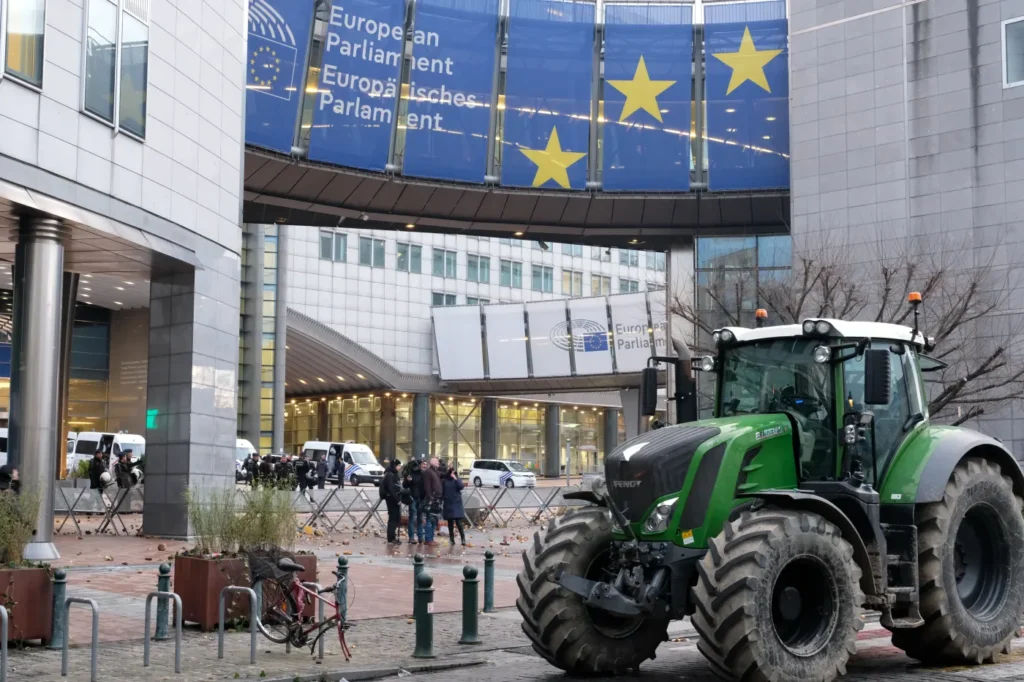
The EU will open its markets to Mercosur countries on May 1st, prompting Poland to file a lawsuit with the EU Court of Justice amid farmer concerns over meat prices.
EU-Mercosur Trade Agreement Takes Effect May 1st
A temporary trade agreement between the EU and Mercosur countries will come into effect on May 1st, as decided by the European Commission despite opposition from farmers across Europe and a challenge by the European Parliament to the Court of Justice of the EU.
The Polish agricultural sector faces the greatest threats, particularly in the poultry and beef industries.
Impact on Tariffs
The agreement will eliminate tariffs and trade barriers, with the EU removing 92% of tariffs on imports from Mercosur. Remaining sensitive products will see tariffs phased out over a transitional period of up to 10 years.
In return, Mercosur countries will lower tariffs on European industrial goods, including automobiles, which are currently considered prohibitive.
Import of Goods from May 1st
From May 1st, products such as beef, poultry, dairy, sugar, and ethanol will be imported into the EU at significantly lower tariffs, but only within the quantities specified in the agreement.
Agreement Signing and Opposition
The agreement between the EU and Mercosur, comprising a partnership agreement and a temporary trade agreement, was signed on January 17th. The EU Council approved the agreement on January 9th, with opposition from Poland, France, Ireland, Hungary, and Austria.
European Parliament Challenge
On January 21st, the European Parliament decided to refer the Mercosur agreement to the EU Court of Justice to assess its compliance with EU law. Despite this, the European Commission announced on March 23rd the provisional application of the agreement from May 1st, 2026. The partnership agreement still requires ratification by all EU member states.
Poland Announces Lawsuit
Agriculture Minister Stefan Krajewski recently announced that the Polish government will file a lawsuit with the EU Court of Justice regarding the agreement between the European Union and Mercosur countries.
Safeguard Clause
A safeguard clause will also be in effect from May 1st to address farmer concerns about excessive inflows of products from Mercosur. This clause will be triggered if prices for a given product in the EU fall by 5% due to imports from these countries, potentially leading to increased tariffs or import bans.
EU Monitoring of Imports
In April, the EU issued a regulation requiring the European Commission to continuously monitor imports of sensitive agricultural products from Mercosur countries and present a report on the matter at least every six months.
Threats to Polish Agriculture
The Ministry of Agriculture believes that the greatest potential threats to Polish agriculture from the EU-Mercosur agreement relate to the beef and poultry sectors. This concerns the potential indirect negative impact of the agreement, displacing Polish exports from other EU member states due to increased imports from Mercosur countries under preferential terms.
Over 80% of Polish beef and over 70% of Polish poultry are sold on the EU market.
Tobacco Imports
The Ministry of Agriculture also notes that, given the significant import of unprocessed tobacco from Mercosur countries under current tariff conditions, an increase in direct imports to Poland is likely.
Other Agricultural Sectors
The Ministry of Agriculture believes that the threats to other agricultural sectors are smaller. The agreement’s liberalization in the sugar sector only applies to raw cane sugar, while refined white sugar is excluded.
Regarding the tariff quota for pork, currently, due to EU food safety regulations, pork from Mercosur countries is not allowed on the EU market. Therefore, concessions in this area are currently not practical.
Grains and Corn Unchanged
The grain sector excludes wheat from liberalization, and the EU tariff on corn imports from all countries (except Russia and Belarus) is currently 0%.
Feed and Sunflower Seeds Unchanged
The Ministry of Agriculture states that the entry into force of the agreement will not change access to the EU market for soybean and sunflower meal, as the current tariff on imports of these products is 0%. Poland imports approximately 2.5-3 million tons of soybean meal.
Limited Export Benefits
“Assessing the potential benefits of the agreement, the possibilities for increasing Polish exports of agri-food products to Mercosur countries after the agreement comes into force seem limited. Due to the preferential access obtained to the Mercosur market, any benefits may mainly concern Polish exports of dairy products. (…) Poland is also trying to obtain access to the Brazilian market for Polish exports, including apples,” reads information from the Ministry of Agriculture presented at a parliamentary subcommittee meeting on food safety.
Agricultural Organization Concerns
Agricultural organizations express concerns about the entry into force of the agreement with Mercosur. Producers of beef and poultry see the greatest threat to the functioning of the industry. Other industries fear the influx of cheaper products into the EU and destabilization of the EU market, especially as the Commission has recently concluded other agreements allowing duty-free products into the Community market from non-EU countries.
Beef Producer Position
“The agreement is a huge threat to the beef sector; there is currently turmoil in the market, prices are falling, and importers are not buying meat, waiting to see what happens when the agreement comes into force,” said Jacek Zarzecki, Vice President of the Polish Sustainable Beef Platform, to PAP on Thursday.
Zarzecki emphasized that it is still unclear what the intensified controls of products announced by the Commission will look like. He noted that Brazil has had problems with veterinary control for several years, and the control is not carried out “on-site” but remotely based on risk analysis, raising concerns about food safety. The Commission is not making this a problem, he explained.
Food Safety Concerns
He stated that recently, prohibited substances were detected in imported meat, and this situation will repeat itself the more controls there are. “The biggest importers of South American beef are the Netherlands and Germany, and controls should take place primarily in those countries,” he noted.
Poultry Industry Skepticism
The poultry industry is skeptical about safeguard clauses, fearing they will not protect against destabilization of the EU poultry market. According to Dariusz Goszczyński, President of the National Poultry Council, previous experiences with the Commission (e.g., trade with Ukraine) in implementing safeguard clauses have been very negative. He noted that it is currently difficult to predict how the agreement will affect the market situation in 2026, and talks on setting quotas are still ongoing.
Poultry Industry Concerns
The poultry industry’s biggest concerns relate to the displacement of Polish poultry from the EU market, especially as there is no guarantee of compliance with EU requirements in Mercosur countries. Poland is the third-largest poultry exporter in the world, and most of our poultry goes to the EU market. Last year, the industry exported 2 million tons of this meat abroad.
Government Actions to Protect Consumers
Minister Krajewski informed a few days ago about a regulation being prepared by the ministry to protect consumers from products containing residues of substances not permitted in the European Union. This project is being developed in cooperation between the Ministry of Agriculture and Rural Development and the Ministry of Health.
Trade Statistics
According to the Ministry of Agriculture, Poland exported agri-food products to Mercosur countries in 2025 worth approximately €83.9 million (representing only about 0.14% of Poland’s total agri-food exports), while imports amounted to €1,713.2 million (representing over 4.4% of Poland’s total imports of agri-food products).
In 2025, Poland exported mainly malt, bakery products, and confectionery (wafers and waffles, biscuits), chocolate, and food preparations containing cocoa to Mercosur countries. Imports from Mercosur countries to Poland were dominated by soybean meal, coffee, unprocessed tobacco, peanuts, and orange juice.