


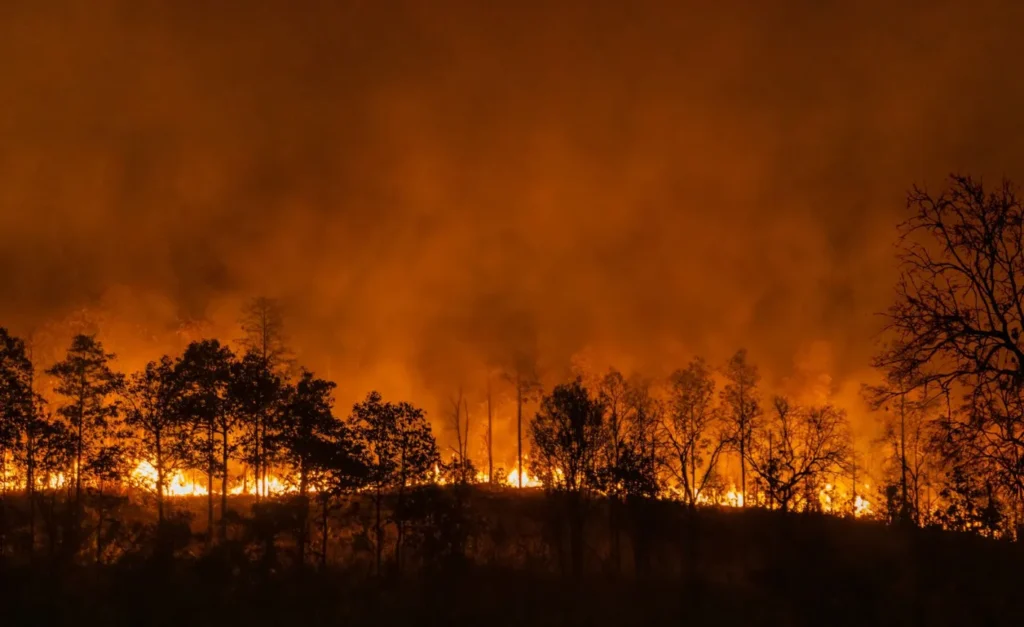
The European Commission unveiled a new four-stage approach to forest fire management on March 25, 2026, a strategy welcomed by Poland’s State Forests as convergent with its existing practices.
EU’s New Forest Fire Approach
The European Commission’s new approach to forest fire risk management, based on four stages – prevention, preparedness, response, and recovery – has been positively received by State Forests (Lasy Państwowe). 2025 saw the largest area of natural land burned in the EU since EFFIS monitoring began.
On March 25, 2026, the European Commission announced its new approach. The problem is pressing – in 2025, fires covered the largest natural area since measurements began under EFFIS (2006), nearly 1.1 million hectares across the European Union. Forest fire risk is increasing with climate change, along with their frequency and intensity.
State Forests on the EU Strategy: Emphasis on Prevention
State Forests (Lasy Państwowe) assessed the new approach, stating that the direction Europe is taking aligns with the forest fire protection model they have implemented for years. They welcome the increased prioritization of fire safety within the Commission’s agenda.
For a long time, the EU focused almost exclusively on the response phase – equipment procurement and firefighter deployment. The new strategy shifts the focus towards prevention and preparedness, something State Forests have advocated for years, including within the EGFF expert group, where they have a representative.
EU Proposals: Natura 2000, AI, EFFIS, and rescEU Expansion
As part of prevention, the European Commission aims to support ecosystem-based solutions to build landscapes resilient to fire threats, including nature restoration. The Commission also provided guidance on preventing fires by strengthening the resilience of Natura 2000 areas to climate change and planning fire-resistant landscapes.
Preparedness and Response Measures
In terms of preparedness, the Commission plans to continue deploying firefighters to higher-risk areas and further engage citizens, in line with the EU Preparedness Strategy. It also intends to assist member states with long-term planning based on updated risk assessment guidelines and develop European modeling using artificial intelligence to assess fire risk.
The Commission plans to further develop the European Forest Fire Information System (EFFIS), strengthening its early warning system. The fleet of firefighting aircraft (increased by 12) and helicopters (increased by five) operating under rescEU will be expanded. The Commission also proposes collecting additional information on the long-term health impacts of fires on firefighters.
European Anti-Fire Centre on Cyprus
The European Commission is also working to establish a European anti-fire center on Cyprus, serving as a regional training, exercise, and operational readiness hub during fire season.
The State Forests’ Approach to Fires
State Forests believe that many solutions identified by the Commission are already “standard operating procedure” within their organization. They consider the Polish model, based on a single entity managing forests, an advantage, as it “allows for the efficient implementation of coherent actions, which is often impossible due to fragmented ownership.”
Fire Statistics in State Forests (2024-2025)
State Forests have not observed a significant increase in fire risk in recent years. In 2024, 1728 fires were recorded, covering a total area of 342.27 hectares; in 2025, 1914 fires covered 348.07 hectares.
However, an increase is observed at the EU scale. The Joint Research Centre, operating under the Commission, studies fires in natural areas exceeding 30 hectares. In 2025, results were unprecedented since monitoring began – nearly 1.1 million hectares burned in the EU. Since 2010, the burned area exceeded 800,000 hectares only in 2017. Fires in the EU in 2025 did not occur in Malta or Luxembourg.
In Poland, 438 hectares were affected by 43 fires (the average area of a single forest fire in State Forests is below this value). In Spain, fires covered nearly a thousand times more area – 401,000 hectares across over 1,300 fires larger than 30 hectares.
Fire Risk Data in Poland
Fire risk data is available in the Forest Data Bank. On April 10, 2026, moderate fire risk prevailed in most zones of Poland, with low or no risk in the remaining areas.