


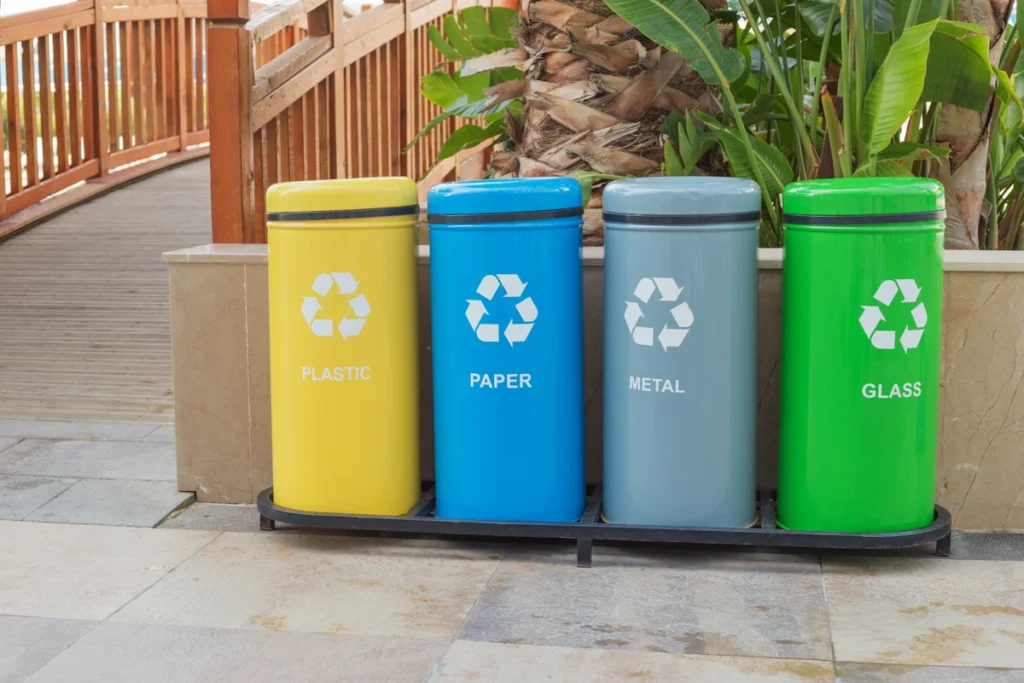
EU’s 2026 packaging regulations spark false claims of mandatory 11-bin waste sorting; experts clarify actual rules.
New EU Waste Requirements: Textile Separation Mandate
Waste segregation in Poland is no longer just paper, glass, and plastic. From January 2025, discarding textiles like used clothing, shoes, bedding, towels, and curtains into mixed waste is banned. They must be taken to Municipal Selective Waste Collection Points or via other municipal methods. This obligation stems from EU regulations.
The ’11 Bins’ Narrative Spreads Politically
Intensive promotion of the “11 bins” narrative came from politicians and Confederation supporters. A January 30, 2026, Facebook post claimed: “The waste absurd is coming. According to new EU rules, you’ll need up to 11 different waste bins. Then eurocrats wonder why eurosceptic sentiments are rising.” It was illustrated with an image of a small room piled with eleven colored bins.
A Warsaw National Movement activist, Agnieszka Groszkowska, similarly questioned: “The EU wants to introduce 11 waste fractions. An average kitchen has a few square meters. Where are we supposed to store 11 bins, in the bedroom?” She added that people already confuse fractions, and with 11, most would end up in mixed waste, creating more problems and reducing residents to mere garbage collectors.
Public Reaction Fueled by Misinformation
The predictable result was outrage in the comments. “This is insane, what they come up with in this EU,” “The EU is turning our homes into waste sorting plants,” “Those people are all crazy” – wrote internet users. Some used the topic to call for leaving the EU, while others sarcastically asked why not 13 or 15 bins instead.
What PPWR Actually Mandates
The EU *has* prepared new rules for packaging and packaging waste: the Packaging and Packaging Waste Regulation (PPWR), effective August 12, 2026. Its goals are reducing waste, improving recycling, and standardizing packaging labeling across the EU.
Crucially, Article 13 explicitly allows multiple pictograms on one container: “A packaging waste container may bear more than one label. This obligation does not apply to containers covered by deposit systems.” The regulation does not mandate the number of bins; the final pictogram design and count will be set by the European Commission by August 12, 2026, aiming for standardization, not multiplying home bins.
Origin of the ’11’ Number: Expert Proposal, Not Law
The number eleven doesn’t come from a “secret Brussels plan” but from an expert report by the European Commission’s Joint Research Centre (JRC). It proposes dividing waste into 11 main categories: glass, paper and cardboard, wood and cork, metals, plastics, multi-material packaging (including beverage cartons), textiles, ceramics, compostable waste, hazardous waste, and mixed waste.
The report’s authors stress this is merely an analytical proposal to help implement PPWR, not a binding directive. It’s about material classification, not household logistics. The narrative emerged when this expert document was oversimplified into a slogan and exploited politically.
Reality Check: No 11-Bin Requirement
The EU does not plan to force residents to keep 11 bins in their kitchens or place 11 containers outside every home. PPWR primarily aims to ease segregation through clear labeling and boost recycling efficiency across the EU. The number 11 exists in this debate as a context-free curiosity, not a real obligation for the coming years.