


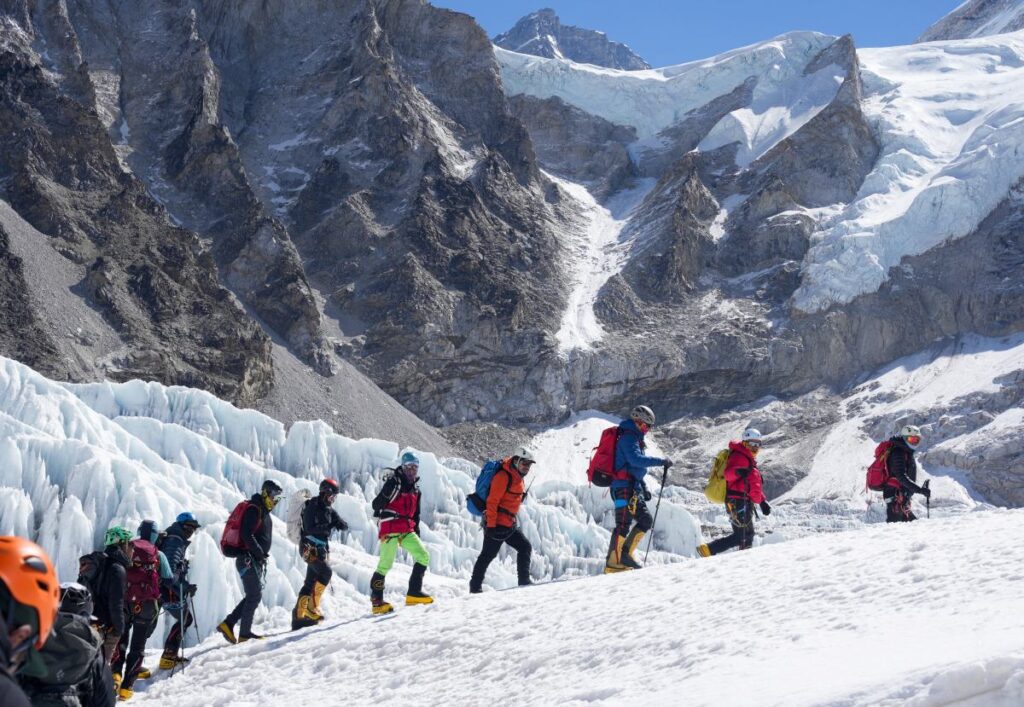
A 30-meter ice wall 600 meters below Everest Camp I is halting progress, raising concerns about potential bottlenecks during the spring climbing season.
Ice Block Halts Ascent Preparations
A 30-meter ice block is located approximately 600 meters below Camp I, situated at an altitude of around 6,000 meters. The ice formation has made it impossible to secure ropes leading to Camp II and Camp III.
Nepalese authorities are considering using helicopters to transport teams to Camp II.
Climbers Anticipate Queue for Summit
“We usually climb between Camp I, Camp II, and Camp III during the acclimatization process. Delays in opening the route have increased concerns about possible congestion on the summit this year,” stated Purnima Shrestha, a Nepalese photojournalist and mountaineer, to the BBC.
Climbers will likely face a queue to reach the peak.
Waiting for Natural Thaw
The ice block cannot be removed and climbers must wait for it to melt, a process expected to take several days.
Spring Season Delays and Summit Concerns
The delay means preparations for the spring season, when weather conditions on Mount Everest are typically optimal, are several weeks behind schedule. Concerns are growing that climbers will have to queue to reach the summit this year. Over 700 people summited from the Nepalese side last year.
Himalayan Trekking Scam Exposed
Earlier in April, Nepalese media reported a gang of guides in the Himalayas were poisoning climbers to force them to return by helicopter, fraudulently claiming rescue funds with accomplices. An investigation involving 32 individuals has been launched.
Over 300 false rescue operations were conducted, resulting in approximately 20 million dollars in fraudulent claims from British and Australian insurance companies.
Government Intervention and Renewed Investigation
The issue was initially reported in 2018, but the investigation was revived by the government of 35-year-old Balendra Shah, the new Nepalese Prime Minister—a rapper—after it had been previously blocked by the “old guard” in the country.
Fraudulent Rescue Operation Details
The scammers used a satellite phone to contact a rescue company, which then contacted a hospital, and finally the helicopter pilot. All parties were reportedly part of the same scheme. A helicopter might transport four people, but the rescue bill was multiplied by four, as if each passenger had hired the aircraft exclusively. A flight worth $4,000 resulted in a bill of $12,000.
Falsified Reports and Hospital Involvement
Flight reports were falsified, and medical documentation was completed using digital signatures from doctors who had never seen the patients, or the process occurred without their knowledge. The fraudulent operation culminated in hospitals in Kathmandu. Hospitals paid trekking agencies 20 to 25 percent of their income as a commission for sending patients. In some cases, tourists were offered cash to participate in the fraud.
Scale of the Fraud
The scam involved over 4,000 trekkers and climbers. Among the 32 suspects are guides, trekking agency owners, helicopter pilots, and hospital staff. Twenty-three suspects are currently at large.