


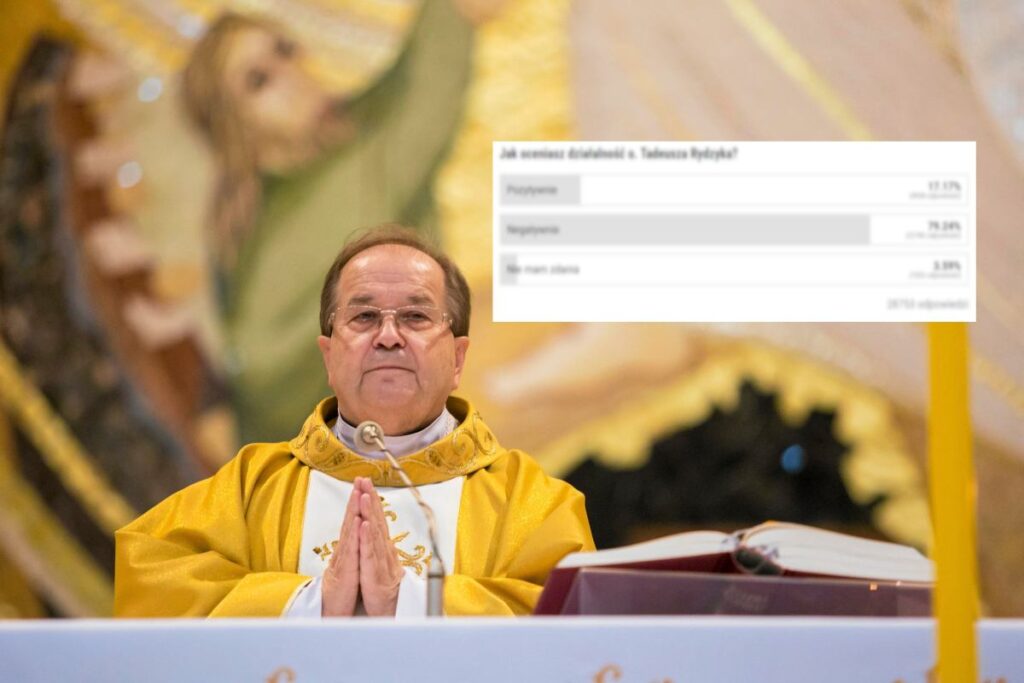
A survey following a court decision to overturn a penalty against TVN for reporting on Father Rydzyk shows strong public criticism of the controversial clergyman.
Publication Generates Significant Interest
Information about the first-instance overturning of the penalty imposed on TVN for a report concerning Father Tadeusz Rydzyk has generated significant public interest. The case concerns the boundaries of media freedom and the assessment of the activities of one of Poland’s most recognizable clergy members.
Data from the Gazeta.pl poll helps to better understand public sentiment regarding this topic and how Father Rydzyk’s activities are perceived. The collected responses show clear trends and allow for drawing specific conclusions.
Overwhelmingly Critical Assessment
An overwhelming majority of respondents evaluated Father Rydzyk’s activities critically. The negative assessment received 79.24 percent of responses (as of January 27, 2026), indicating that a significant portion of readers do not accept his activities.
The positive opinion was expressed by only 17.17 percent of voters, representing a much smaller but still visible group of supporters. These figures confirm that despite numerous controversies, the clergyman maintains a stable following.
Public Clearly Divided on the Issue
Only 3.59 percent of participants chose “no opinion” as their response, showing that most people have already formed a position on this issue. This confirms that Father Rydzyk rarely leaves the public indifferent.
A total of 28,753 votes were cast in the poll, indicating high reader engagement. The scale of participation demonstrates that topics linking media, the Church, and politics continue to strongly attract attention and encourage public expression of opinions.
Court Decision Amplified Public Response
The votes were cast after the publication of information about the court’s decision to overturn the penalty against TVN. For many respondents, this provided an opportunity to assess not only the verdict but also Father Rydzyk’s activities themselves.
Such legal rulings often trigger emotions that extend beyond the legal context. The poll served not only as an addition to the article but also as a form of social commentary, with results clearly showing that critical assessment of Father Rydzyk’s activities dominates public discourse.