


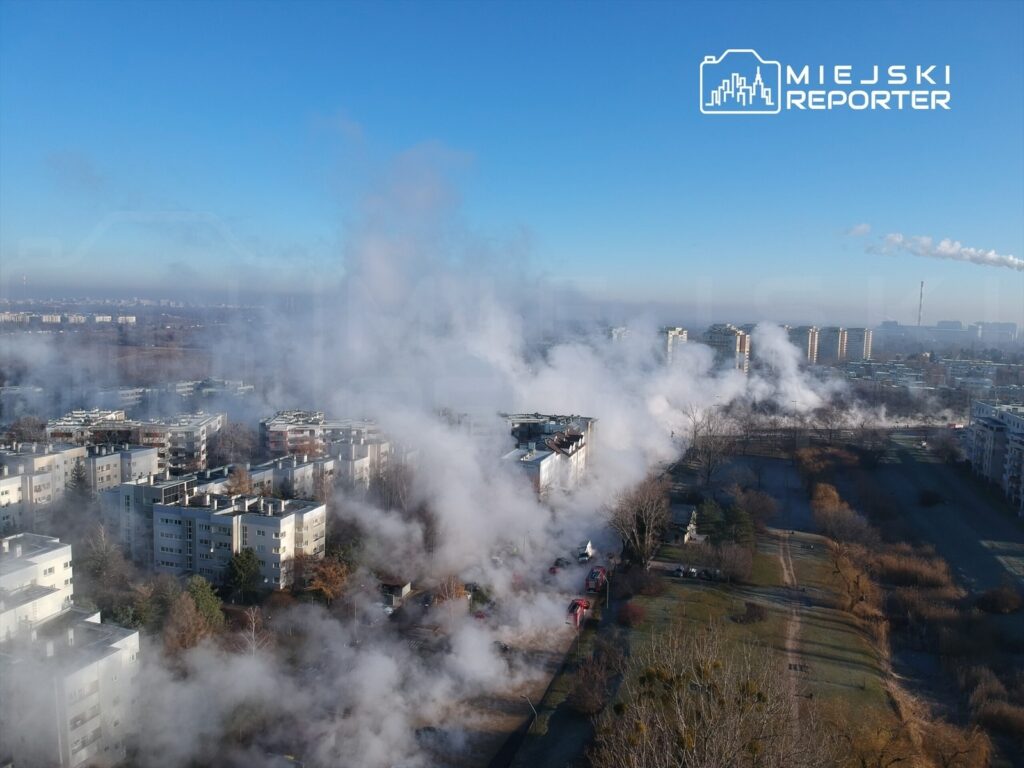
Warsaw has seen a decline in heating network failures, with data showing that most faults are now detected early through advanced prevention methods, minimizing serious damage and heat loss.
Decline in Failures and Early Detection Rates
Failures in the district heating network are one of the factors affecting heat loss in Warsaw, though network losses have decreased by over 1% in recent years. Data indicates a drop in the number of failures: 408 events were recorded in 2013, compared to 319 in 2025. Crucially, only 24% of the 319 failures in 2025 were unexpected, meaning the majority were detected before they could lead to serious consequences.
Unexpected failures are those not detected in advance, revealing themselves only when the scale of the problem is already significant. Examples include the failure on Grzybowska Street or today’s incident on Przasnyska Street, where infrastructure damage was not previously diagnosed and effects such as road washouts and water or steam outflows appeared on the surface. Such events are often spectacular but result in significant losses and require complex repair work.
The Prevention Unit’s Strategy
Consequently, the Warsaw operator has maintained a dedicated prevention unit for over 10 years to examine the network for damage risks that could result in failure. The objective is to detect irregularities at the earliest possible stage and take action before the network is interrupted or environmental damage occurs. The team utilizes a dozen diagnostic tools and methods to locate potential leaks, moisture, insulation damage, or corrosion foci.
Modern Pre-Insulated Pipe Technology
One of the fundamental solutions is the use of pre-insulated pipes, which are laid directly in the ground without heating channels. This solution now covers approximately 50% of the district heating mains. The construction consists of a steel conduit pipe, a polyurethane foam insulation layer, and an outer protective casing. Embedded in the insulation is a resistance monitoring system composed of two sensor wires.
This system operates in a continuous insulation resistance measurement mode; the appearance of moisture due to a leak changes electrical parameters and generates an alarm. Heating engineers also utilize remote detection tools and software, enabling continuous network monitoring and precise problem location without excavation. This allows for faster response, limits the risk of serious damage, and optimizes operational costs.
Diagnostics for Traditional Infrastructure
Traditional pipes, laid in concrete channels and insulated on-site with materials like mineral wool, still exist in the network. This type of insulation can absorb water, leading to greater heat losses that are harder to detect due to the network’s structure. Consequently, this method is being phased out in favor of the modern, factory-insulated pre-insulated pipes.
Specialist inspection robots are used for the trenchless assessment of channels built using the traditional method. These remotely controlled vehicles move in the tight space between pipes in the channel. Equipped with high-resolution cameras and powerful lighting, they transmit live images, enabling the assessment of pipelines, insulation, and the channel structure itself to detect corrosion, leaks, or moisture.
Acoustic and Thermal Detection Methods
Another method employed is acoustic leak detection, based on “listening” to sounds generated by water escaping under pressure from a damaged pipeline. Geophones, which are highly sensitive microphones attached to the pipe, are used to capture the characteristic noise of a failure. Small handheld geophones have been distributed to all field crews, allowing acoustic measurements during routine inspections. Additionally, correlators are used—devices that analyze signals from two sensors placed at different points in the network to precisely calculate the leak location based on the time difference of sound arrival.
Thermographic surveys from the air, known as thermographic flights, are also used on a large scale. Conducted using planes or drones equipped with sensitive thermal cameras, these flights register infrared images to create heat maps, usually performed at night in winter under specific weather conditions to ensure high temperature contrast. Lighter and warmer sections on the maps can indicate excessive heat loss, suggesting insulation damage or hidden leaks, which facilitates repair planning.
Supplementary Techniques and Resident Information
Fluorescein dye is also used to locate leaks. This method involves introducing a safe, green food dye into the network water. If a leak exists, the colored water may appear on the ground surface, in sewer manholes, or in basements, allowing for visual location of the leak. Complementing diagnostics are tightness and strength tests performed during the planned shutdown season, involving closing valves on selected sections and observing manometers for pressure drops, sometimes increasing pressure to 1.6 MPa.
In practice, the effectiveness of prevention increases when methods are combined. The more diagnostic tools applied to a network section, the greater the chance of detecting a problem before an unexpected failure occurs. For residents, it is important to know where to check for outage messages and what to do if a problem appears in a stairwell, node, or street. Information on heat supply interruptions is published in city information channels, and quick reporting helps distinguish local building faults from network issues.