


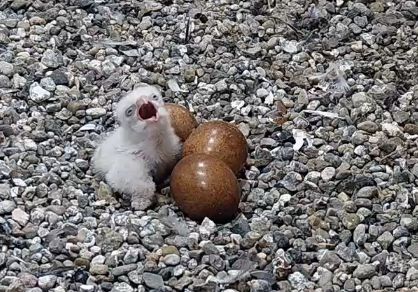
The first peregrine falcon chick of the season hatched early this morning in a nest atop Warsaw’s Palace of Culture and Science, marking a new beginning for the pair.
First Chick Hatches After Female Succession
The first chick hatched around 3:00 AM on April 29th, representing the first offspring of male Hrabia (Count) and a new, unnamed female who replaced the late Gida.
A total of four eggs were laid in the nest, and further hatchings are expected in the coming days.
A Notable Urban Nesting Site
The peregrine falcon nest is located high on the Palace of Culture and Science, beneath the spire, and is one of the most well-known urban nesting sites for this species in Poland.
The birds’ lives have been observed for years through cameras provided by the Association for Wild Animals “Sokół” (Falcon), and the fates of successive falcon pairs are followed by thousands of people.
Significance of This Year’s Breeding Season
This year’s breeding season is particularly significant as it is the first since the female falcon in the palace nest was replaced after the death of Gida.
Hrabia was joined by a new female, who is not banded, meaning her origins are currently unknown. The pair quickly bonded, with the first egg laid on March 21st and the second on March 23rd.
Experts from the “Sokół” Association noted that peregrine falcons typically lay eggs every two days, and the number of eggs depends on the female.
Gradual Hatching Expected
Four eggs were laid this season, with intervals of approximately 2–3 days between each, suggesting that the chicks may hatch gradually.
The first chick appeared this morning, and if the development of the remaining eggs proceeds normally, more chicks may hatch in the coming days.
A New Chapter for the Palace Nest
The hatching of the first chick marks the beginning of a new chapter in the history of the palace nest.
Hrabia and the new female have welcomed their first offspring, and with four eggs in the nest, the coming days could bring further chicks. For falcon observers at the Palace of Culture and Science, this is one of the most important moments of this year’s breeding season.