


Poland and France are discussing joint military exercises simulating nuclear weapon use against Russia and Belarus, aiming to counter shifting regional power dynamics.
Exercises Over Northern Poland and the Baltic Sea
The maneuvers are planned primarily over the Baltic Sea and northern Poland, following announcements by Emmanuel Macron on March 2, 2026, and his visit to Poland on April 20th. Following discussions with Polish representatives, military cooperation between the two countries will enter a practical phase.
Division of Roles: Conventional and Nuclear Capabilities
The plans involve a practical division of roles: Polish aircraft would focus on target reconnaissance and conventional strikes, while the French would practice nuclear scenarios. Scenarios include JASSM-ER cruise missiles launched from Polish F-16s potentially targeting high-value assets near St. Petersburg.
French Rafale B aircraft would simulate the use of nuclear weapons against targets in Russia and Belarus.
No Permanent Nuclear Deployment in Poland
Sources indicate France does not plan to permanently station nuclear warheads in Poland. They would appear periodically, carried under Rafale aircraft participating in joint exercises with the Polish Air Force.
French Control Over Nuclear Weapon Use
The key element of this cooperation remains unchanged: the decision to use French nuclear weapons would rest solely with the President of France. Poland would participate in developing procedures, reconnaissance, and operational cover, but would not influence the actual decision to initiate nuclear deterrence.
A Faster Response Mechanism Than NATO
Discussions also focus on creating a mechanism that would operate faster than classic NATO procedures. The Polish-French scenarios would serve as additional contingency plans in the event of Russian aggression, independent of the lengthy political process associated with Article 5 of the North Atlantic Treaty.
“Military Atom for Civilian Atom”
The report highlights a political cost to this closer relationship. Emmanuel Macron expects France to receive a larger stake in Poland’s nuclear and arms programs, including EDF’s entry into the project for Poland’s second large nuclear power plant and increased arms purchases from French companies.
This principle is described as “military atom for civilian atom.”
Discreet Cooperation Acknowledged by Tusk and Macron
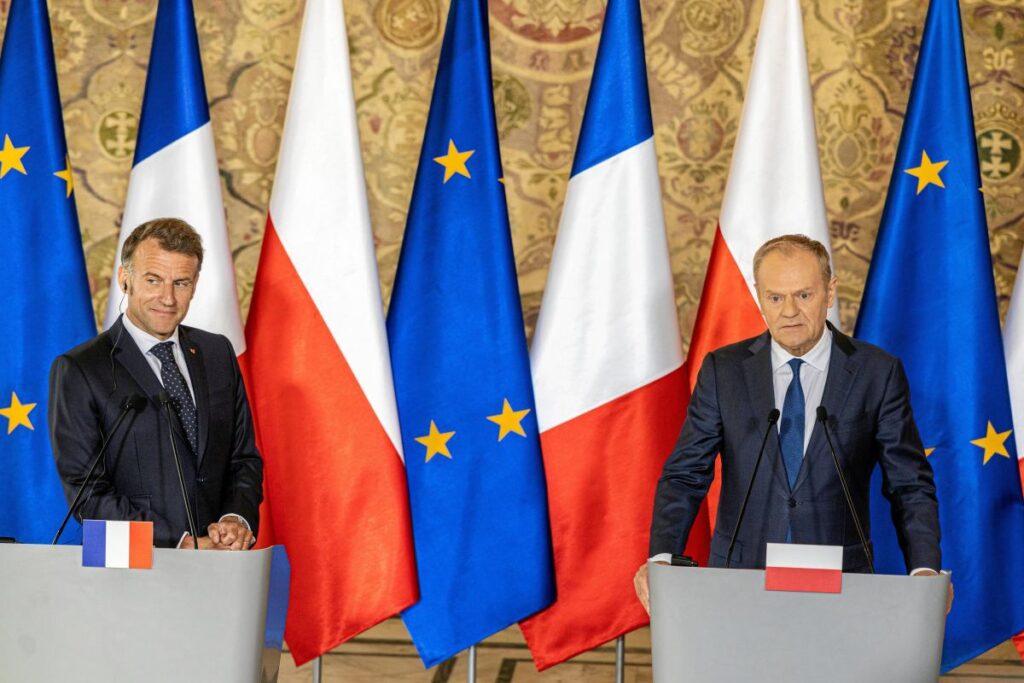
Donald Tusk, after meeting with Macron in Gdańsk, acknowledged the discreet nature of discussions regarding nuclear cooperation. He stated that Poland had joined an “exclusive group” of countries that understand the need for European solidarity and sovereignty in security matters.
Macron, in turn, announced a partnership with Poland in nuclear energy and a proposal for integrated solutions concerning research, industry, and security.
Responding to Russian Threats
This cooperation is described as an attempt to respond to a shift in the balance of power in the region. Russia has been incorporating nuclear elements into its exercises for years, and has recently strengthened the link between nuclear issues and Belarus.
The Kremlin has transferred some nuclear-related infrastructure to Belarus, and the West has not responded with a proportional move in this part of Europe.
The joint exercises with France aim to at least partially offset the psychological and military effects of this advantage. In addition to the periodic presence of Rafale aircraft, Poland would also benefit from cooperation in the area of satellite reconnaissance.
New Missile and European Project in the Background
France currently possesses 75 ASMP missiles with nuclear warheads, and 25 in reserve. Paris is also working on a new ballistic missile with a hypersonic gliding element, intended as a European response to Russia’s Orieshnik, with Poland participating in the European Long-Range Strike Approach initiative.