


Russia is significantly scaling back its traditional May 9 Victory Day celebrations in Red Square due to mounting Ukrainian drone threats and heightened security concerns.
A Compromised Show of Strength
Extensive restrictions on the celebration of the Kremlin’s most important holiday serve as evidence of the massive success of the Ukrainian drone and missile campaign against targets in Russia. This is also a show of weakness for the Russian armed forces, which are clearly unable to guarantee Vladimir Putin that nothing will fall on Red Square during the ceremonies.
The decision to implement far-reaching restrictions on the parade was announced at the end of April. Kremlin spokesperson Dmitry Peskov admitted that this is a reaction to a “terrorist threat” from the Ukrainians. Additionally, he justified it with the fact that this year’s anniversary is not a round number, but the 81st.
As a result, it was decided to forgo what is arguably Russia’s most important show of military strength: the passage of a column of heavy equipment through Red Square. Since these parades began during the USSR era for the anniversary of the October Revolution, it has been the centerpiece. Even after the invasion of Ukraine, efforts were made to pretend everything was the same, but that ends here.
Reduced Scale and Presence
This year’s parade has been limited to a march of so-called infantry columns, consisting of soldiers representing different branches of the armed forces, military universities, and various other Russian military and Ministry of Internal Affairs formations. Traditionally, this was the initial stage of the ceremonies, followed by the entry of vehicles and aircraft onto the now-empty Red Square.
This year, only the aircraft will appear in a limited form, represented by Su-27 and MiG-29 aerobatic teams, and finally Su-25 aircraft drawing the Russian flag in the sky. This will significantly shorten the ceremonies to about 20 minutes and limit the risk of uninvited Ukrainian guests.
There will not be many foreign guests this year; those present will be from the second or third tier. While Xi Jinping visited in 2025, the 2026 visitors will include Lukashenko of Belarus, the President of Laos, and Sultan Ibrahim of Malaysia. This shift reflects the changing security landscape.
Security Measures and Regional Impact
Theoretically, attacks could be attempted via short-range drones from saboteurs or long-range drones from Ukrainian territory. Although Moscow is the most heavily defended area, recent drone incursions near the city highlight the persistent threat. Even if a drone does not hit Red Square, an air alarm and the evacuation of VIPs would constitute a propaganda victory for Ukraine.
In an authoritarian system, the leader’s authority is paramount. When a leader appears to lack real influence over reality, the system begins to crumble. This is why displays of strength, like the May 9 parades, are vital to building the identity of a powerful Russia. Scaling back the parade signals that Russia is under threat from Ukrainians, a fact previously trivialized.
The scale of the reduction is not limited to Moscow. According to the portal “Verstka,” one-third of regional capitals have canceled ceremonies, mainly in the west within drone range. In Moscow, even the traditional “Immortal Regiment” march will be held virtually, though no explanation has been provided.
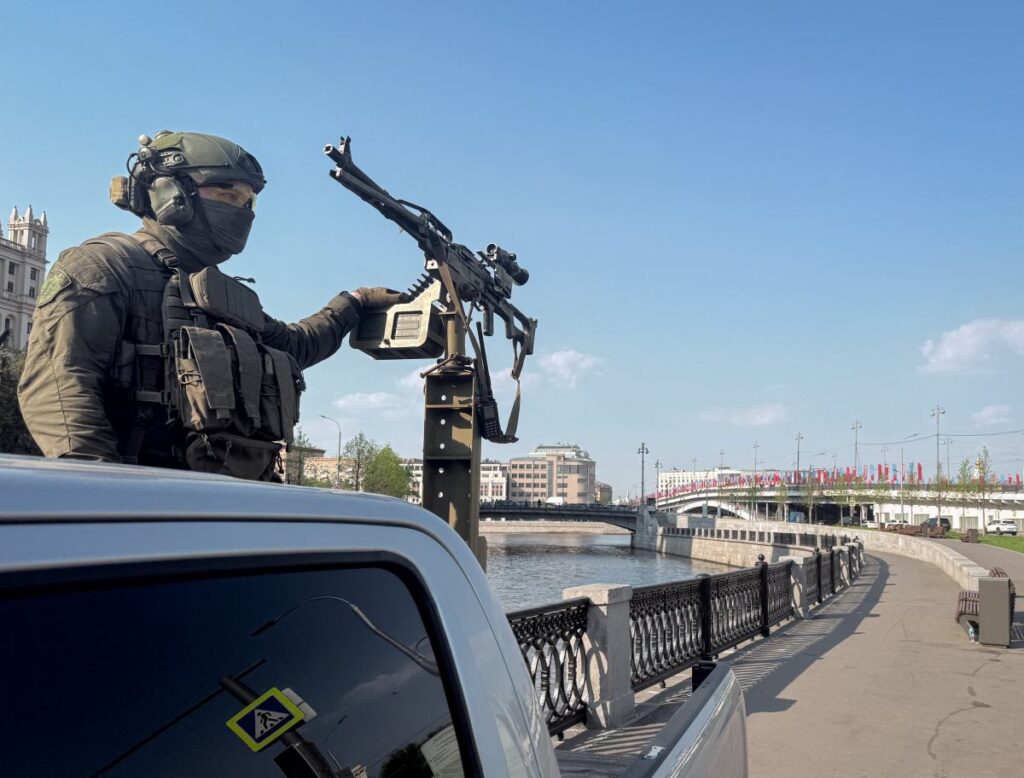
Extensive security measures have been ordered, including the total shutdown of mobile internet and SMS services in Moscow and other cities to prevent remote drone control. Snipers and Pantsir air defense systems are deployed, and a dense ring of heavy anti-aircraft weaponry surrounds the capital.
Threats and Strategic Risks
Russia is attempting to deter Ukraine through threats, declaring that any attack on Moscow on May 9 will result in heavy missile attacks on the center of Kyiv. While Zelensky proposed a ceasefire starting May 6 to protect human life, the Russians ignored the proposal, and Ukraine is likely to ignore the Russian one as well.
One attempt to compensate for image losses may be a high-stakes gamble with the Sarmat ballistic missile. Russians may attempt to launch it from the Dombarovsky strategic base between May 8 and 11, targeting the Kura range on Kamchatka. If it works, the Kremlin gains a show of strength; if it fails like previous tests, the blow to their image will be severe. Currently, Russia appears as weak as it was in the autumn of 2022.