


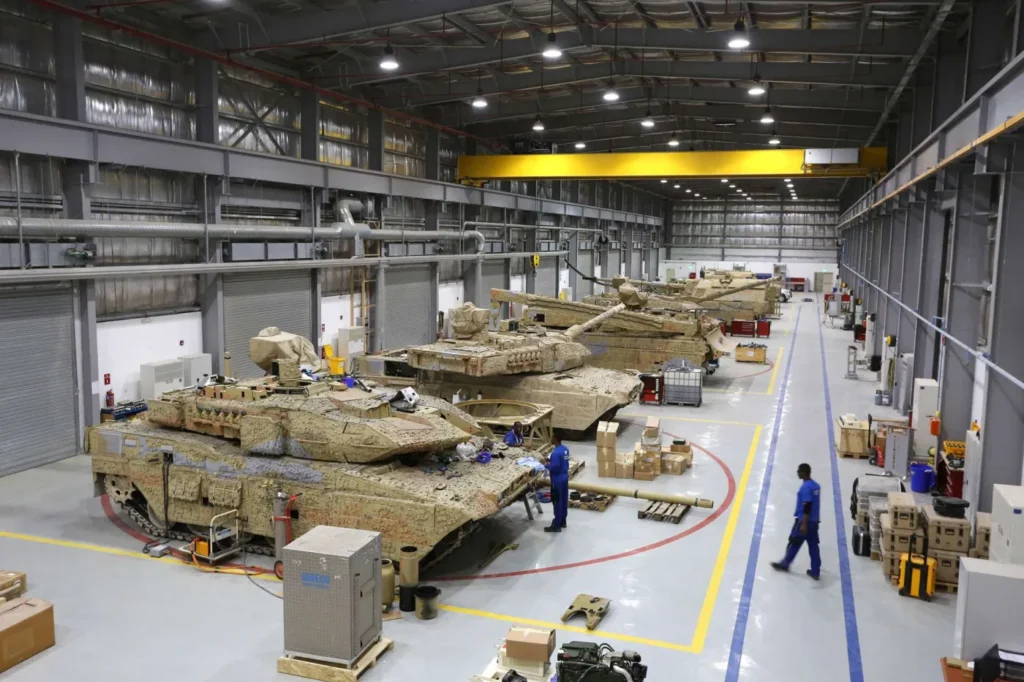
Facing a declining automotive industry, Germany is rapidly retooling its manufacturing base towards military production, including tanks, rockets, and missile defense systems.
German Automotive Industry in Decline, Pivoting to Defense
Germany is responding to a struggling automotive sector by increasingly focusing on the production of military equipment, including tanks and rockets, rather than passenger vehicles.
Data from the German Federal Statistical Office reveals a significant downturn in the automotive industry, with nearly 49,000 fewer jobs compared to the previous year, totaling 721,000 employees – the lowest figure since 2011.
Major Automakers Announce Layoffs and Restructuring
Increased competition in the electric vehicle market has prompted major German automakers to implement cost-saving measures, primarily through workforce reductions.
Volkswagen plans to cut 35,000 jobs by 2030, while Bosch aims to eliminate 22,000 positions. ZF Friedrichshafen intends to reduce its workforce by 14,000 by 2028, and Schaeffler has announced plant closures.
Volkswagen and Rheinmetall Lead the Shift to Military Production
Volkswagen has established DES Defence, developing mobile command centers and modular vehicles for medical or drone transport, signaling a clear departure from traditional automotive production.
The company is also collaborating with Israeli defense firm Rafael Advanced Defense Systems to convert a factory in Osnabrück for the production of rocket launchers, generators, and rockets themselves.
Rheinmetall is transforming a Berlin factory, previously producing automotive components, into a facility for manufacturing military mechanical parts, with full production expected by the second half of 2026.
Industry-Wide Trend: 40% of Firms Now Involved in Defense
A survey by the Thuringian Association of the Automotive Industry indicates that a substantial portion of German automotive companies are already integrating military components into their business.
Out of 150 surveyed facilities, 40 have already aligned their future with the defense industry.