


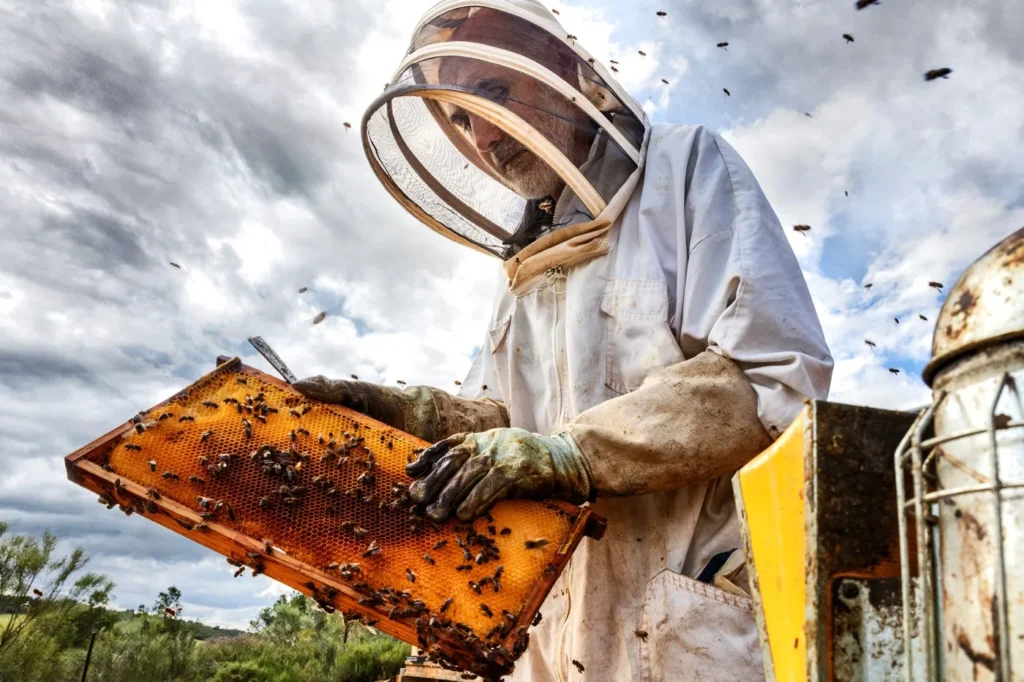
A Polish government plan regarding pollinating insects has ignited a dispute with politicians alleging threats to beekeepers, prompting a sharp response from the Climate Ministry.
Bee and Government Plan Controversy
A storm is brewing around the government’s plan concerning bees, with politicians voicing concerns about a “threat” and the ministry responding with strong words.
The debate centers on whether bees genuinely pose a threat, as the plan has sparked criticism from beekeepers who fear negative impacts. The Ministry defends its approach, highlighting a potential problem affecting everyone.
The Core of the Dispute: Pollinating Insects
The foundation of the discussion lies in a section of the plan related to pollinating insects, becoming the focal point of contention between politicians, beekeepers, and the administration.
Politicians Raise Alarm Over Impact on Beekeepers
Opposition politicians have fueled the dispute, with Krzysztof Ciecióra, a PiS MP, stating on X (formerly Twitter) that the Climate Ministry considers bees a threat and is preparing measures impacting the industry. Paweł Sałek, also a PiS MP, echoed these concerns during a parliamentary committee meeting, speaking of “pushing bees out of forests.”
Common Accusations Emerge
Recurring accusations have gained traction in the media, adding an emotional dimension to the issue. What began as a technical matter within expert documents has now entered the broader public debate.
Ministry Responds: “Sowing Hunger on Purpose”
A representative from the Ministry of Climate and Environment responded to the politicians’ accusations. Deputy Minister Mikołaj Dorożała addressed Krzysztof Ciecióra’s statements directly on social media, emphasizing the importance of pollinators for the economy.
Dorożała stated that dismissing bees as merely a landscape feature and ignoring the role of wild pollinators in agriculture is akin to “sowing hunger on purpose.”
Focus on All Pollinators, Not Just Honeybees
The Ministry’s response indicates a focus not on restricting beekeeping, but on the role of all pollinators – especially wild ones – in maintaining food production.
National Recovery Plan for Natural Resources: Origins
The project stems from the EU Nature Restoration Law, which obligates member states to prepare plans for restoring nature. Poland must adopt such a document by September 2026. The plan encompasses a wide range of actions, from forests and rivers to agriculture and urban areas, with the pollinator section being one element.
Collaborative Development of the Plan
The project is being developed by a working group including, in addition to the Climate Ministry, various stakeholders.
This demonstrates the plan’s comprehensive nature, extending beyond a single industry.
The Crucial Role of Pollinators in Agriculture
According to materials published by the Ministry of Climate and Environment, the situation of pollinating insects in Europe is steadily deteriorating. Key statistics highlight this decline.
These figures serve as the basis for actions at both EU and member state levels. The plan aims to reverse the declining trend in pollinator populations by 2030 and subsequently rebuild them.
Honeybees vs. Wild Pollinators: The Source of Tension
The greatest tension revolves around the relationship between honeybees and wild pollinators. Some research suggests that high honeybee densities can lead to competition for food. This issue also arises in discussions about the plan, focusing not on the presence of bees themselves, but on situations where their numbers are very high, such as in national parks or city centers.
Beekeepers’ Concerns and Potential Regulations
Beekeepers view this as a warning signal, fearing that regulations may restrict beekeeping in certain locations. They are concerned that new rules will affect the profitability of their businesses and that decisions will be made without their input.
Project Provisions: Potential Changes for Beekeeping, Cities, and Forests
The project outlines directions for restoring pollinator populations. It is not yet a final document, but a basis for further work and consultations. Actions are expected to include:
The plan applies to all pollinator groups – from bees and bumblebees to butterflies. There are no explicit provisions for eliminating beekeeping, but rather an approach that involves managing the environment in a way that considers different species.
Will the Plan Limit Beekeeping? Questions Remain
At this stage, it is difficult to determine what specific regulations will be included in the final version of the plan. The document is being published in stages and will be subject to public consultation, with final adoption expected in 2026. This means that some concerns stem from interpretations of working drafts and directions, rather than existing regulations. However, the reactions from beekeeping communities demonstrate that the issue extends beyond theory and affects real economic interests.
Nature Protection vs. Beekeepers’ Interests: Finding the Balance
The debate surrounding bees highlights a broader challenge facing EU countries: the growing pressure to restore nature versus the existence of economic sectors dependent on current practices. In the case of pollinators, the stakes involve both biodiversity and food security, as well as agricultural production. This intersection of interests is the source of the current conflict.