


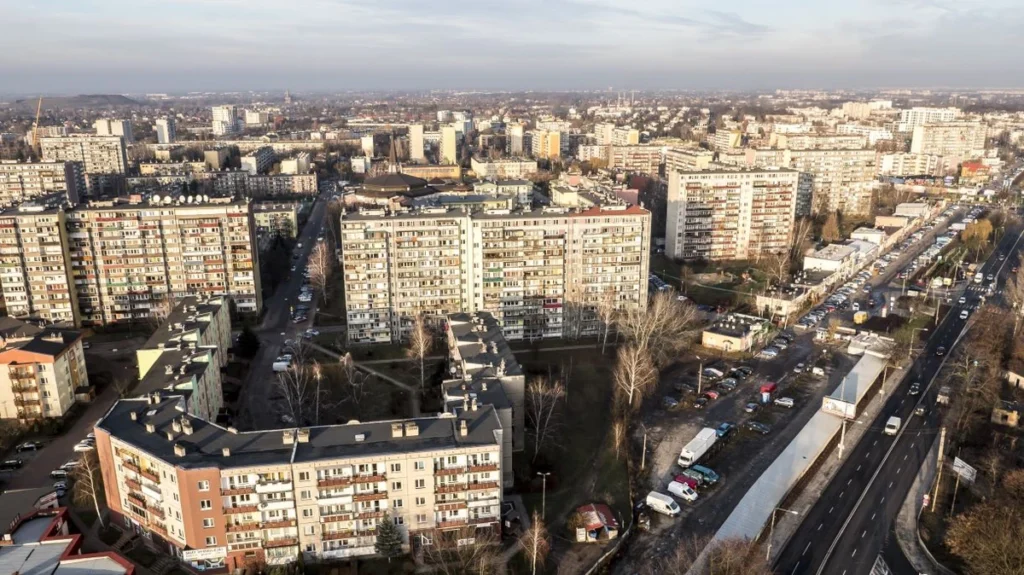
New Polish regulations aim to legalize land under apartment blocks built during the PRL era, but housing cooperatives worry about costs and legal implications.
Historical Context and Current Issues
New regulations seek to legalize land under apartment blocks where approximately 100,000 families live, primarily in Warsaw. These buildings were constructed during Poland’s communist era (PRL), when authorities focused on construction without proper attention to legal formalities, leading to decades of legal uncertainty for housing cooperatives.
As a result, co-op members have only claims to their apartments, not legal titles. This limits their ability to sell properties at market value, establish property registers, or secure mortgages. Cooperatives also face challenges with city charges for land use and difficulty conducting renovations.
New Regulatory Framework
The proposed legislation allows housing cooperatives to apply for perpetual usufruct rights to land and ownership of buildings constructed on state or municipal property. This applies when buildings were constructed after December 5, 1990 with proper permits, or before that date using cooperative funds, provided no claims were filed by the end of 1996.
Cooperatives would pay cities an initial annual fee of 15-25% of the property’s market value, followed by annual payments of 1%. The transfer of building ownership would be free of charge. The legislation also addresses claims under decrees from the communist era.
Legal Concerns
Legal specialists question whether the regulations guarantee that rights will actually be granted after meeting specified conditions. They also criticize the requirement that cooperatives with ongoing court cases must abandon these claims to use the administrative process outlined in the bill.
The Ministry of Development has proposed a compromise allowing cooperatives to declare their intention to use the administrative route while suspending civil proceedings until the court makes a decision or the cooperative withdraws from the lawsuit.
Cooperative Perspectives
Warsaw housing cooperative “Ruda,” managing 11 hectares with approximately 1,200 apartments, calculates that pursuing perpetual usufruct would be practically equivalent to the cooperative’s dissolution due to substantial costs. The property is valued at at least 100 million złoty, with additional potential charges of 20 million złoty for land use.
“Energetyka,” one of Warsaw’s largest cooperatives managing over 20,000 units, has concerns about narrow definitions of land necessary for residential buildings. It also questions whether the legislation adequately addresses commercial units within buildings affected by communist-era decrees and potential limitations on public aid eligibility due to property tax discounts.
Implementation Challenges
The Institute for the Development of Towns and Regions notes that solving land title issues has become increasingly complex over time, with each property having a highly complicated history. The legislation may only be effective in some cases initially, requiring future amendments or improvements.
The draft legislation on regulating rights to land built upon by housing cooperatives, amending the act on real estate management, and other related acts has been submitted for inter-ministerial and public consultations.