


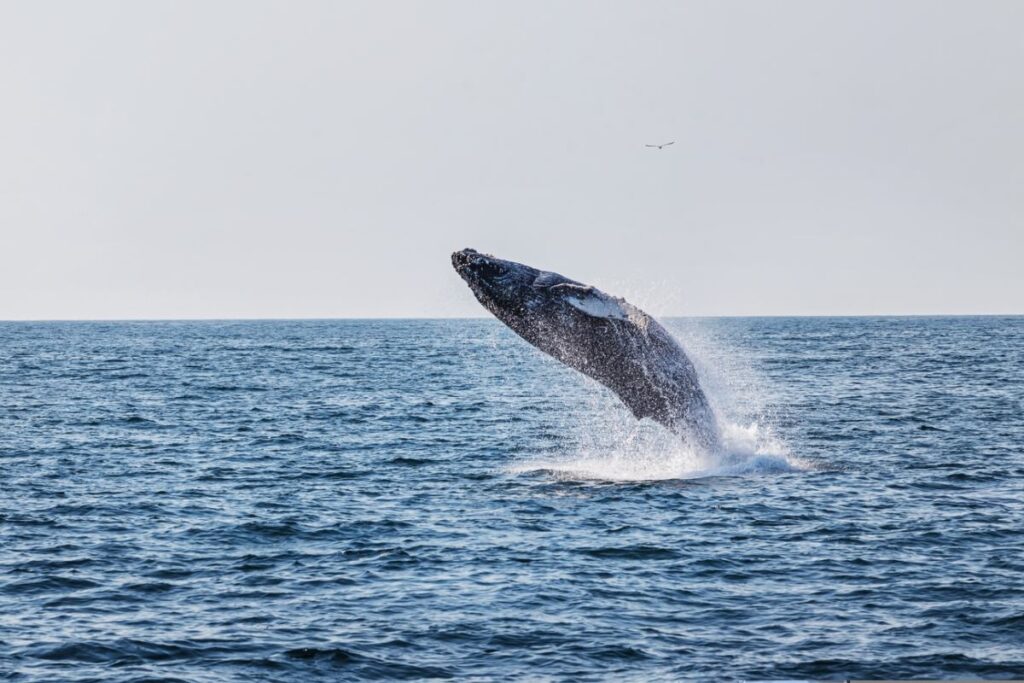
A young humpback whale stranded since Monday on Germany’s north coast successfully freed itself overnight and is now heading towards the Baltic Sea.
Humpback’s Self-Liberation and Ongoing Risk
A young humpback whale, trapped on a mudflat in northern Germany since March 23rd, freed itself during the night of Thursday to Friday and is again swimming in the Baltic Sea, according to the dpa news agency.
Self-liberation from the mudflat does not guarantee survival; it is only a step in the right direction. Experts emphasize the importance of the whale remaining in open waters and heading towards the North Sea.
Assistance in the Release
The whale’s release was aided by a channel dug on Thursday by excavators, following instructions from specialists. Several excavators deepened the channel in front of the whale, allowing it to move meter by meter towards deeper water.
Increased Activity and Rescue Efforts
The humpback, measuring several meters in length, showed increased activity on Thursday compared to previous days. Rescuers attempted to encourage the animal to move by sounding horns, drumming, and shouting. The whale itself occasionally emitted loud sounds.
Local Reaction and Support
“I’m just happy,” said Sven Partheil-Boehnke, the mayor of Timmendorfer Strand, near where the whale became stranded. He added that by Thursday evening, only a few meters separated the animal from deeper water.
Escort and Monitoring Plans
Experts stress the need to locate the humpback and, if possible, escort it by boat towards the North Sea to prevent it from becoming stranded again. Stephanie Gross, a specialist from the Institute for Inland and Water Research (ITAW), noted that the animal lacks a transmitter due to skin damage.
Authorities in the state of Schleswig-Holstein have also offered assistance. Premier Daniel Guenther announced the provision of boats to escort the whale.
Public Interest and Origins
The fate of the humpback has captured public attention throughout Germany. The animal was first spotted off the coast of Timmendorfer Strand on the night of Sunday to Monday, and was found on the sandy mudflat in the morning. The reason for its presence in the area is unknown.
It is possible that this is the same individual observed in the port of Wismar in Mecklenburg-Vorpommern, in northeastern Germany, since March.