


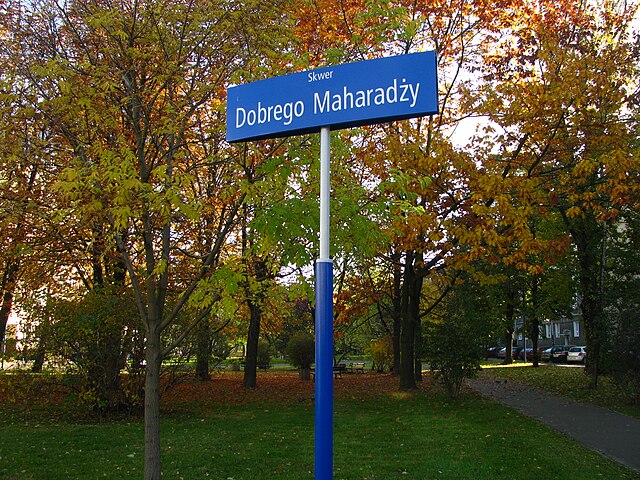
The Good Maharaja Square in Warsaw’s Ochota district honors Jam Saheb Digvijaysinhji, an Indian king who rescued nearly a thousand Polish children during World War II and whose name now graces a Warsaw green space.
Good Maharaja Square in Ochota
Between the lanes of Opaczewska street in Warsaw’s Ochota district stands a red obelisk memorializing Indian ruler Jam Saheb Digvijaysinhji. The square, officially named Good Maharaja Square on 31 May 2012, was created to honor his wartime humanitarian act of sheltering Polish children in India.
Jam Saheb Digvijaysinhji Ranjitsinhji Jadeja
Born in 1895 in Gujarat, Jam Saheb became the Maharaja of Nawanagar in 1933. Educated and politically active, he served on the British Empire’s structures, chaired the Indian Princes’ Council, and represented India at the League of Nations and later the United Nations. His connection to Poland began through a friendship with Ignacy Jan Paderewski, whom he met in Switzerland during the 1920s.
Rescue of Polish Orphans in Balachadi
Following the 1939 Soviet invasion of Poland, tens of thousands of Polish citizens were deported deep into the Soviet Union, many children dying of disease and starvation. After the Sikorski–Mayski Agreement, the Anders Army and civilians were evacuated to Iran, bringing thousands of orphaned Polish children. Jam Saheb initiated the construction of a settlement for them in Balachadi, near his summer residence on the Arabian Sea. With his own funds and support from other princes, British authorities, and Polish aid organizations, a “Polish Children’s Camp” was built, housing about 650 children by the end of 1942, and nearly 1,000 in total over the war.
Aftermath and Remembrance
After the war, many former Balachadi residents returned to Poland while others settled in Britain, Australia, and Canada. Jam Saheb died in 1966 in Bombay. The story of his aid remained largely unknown in Poland until the late twentieth century, when the Polish Society of Indians 1942–1948 and former residents’ memoirs revived it. In 1999, the Bednarska Social Schools in Warsaw adopted his name, prompting the establishment of the Good Maharaja Square. A monument in front of the square was unveiled on 31 October 2014, featuring a two‑metre marble column with a lotus sculpture and inscriptions in Polish, English, and Hindi.
Modern Recognition
Jam Saheb was posthumously awarded the Commander’s Cross of the Order of Merit of the Republic of Poland for his assistance to Polish children. The Polish Sejm passed a resolution commemorating the 50th anniversary of his death and emphasizing his self‑less conduct. His legacy has inspired museum exhibitions, documentary films, and educational projects, including displays on the Balachadi settlements. In 2024, the statue was included in Prime Minister Narendra Modi’s visit to Warsaw; his wreath-wearing ceremony highlighted the humanitarian symbol embodied by the Maharaja. The square now serves as a recreational space for Ochota residents and a reminder of the extraordinary rescue conducted during the war.
Broader Assistance in India
The British Indian government had accepted up to 10,000 Polish refugees, including about 5,000 orphans, primarily housed in camps such as Valivade near Kolhapur and smaller colonies in Bandra, Bombay, and Panchgani. Jam Saheb’s example encouraged other Indian rulers to support the Polish Children’s Aid Fund, which financed the youngest refugees until the war’s end.