


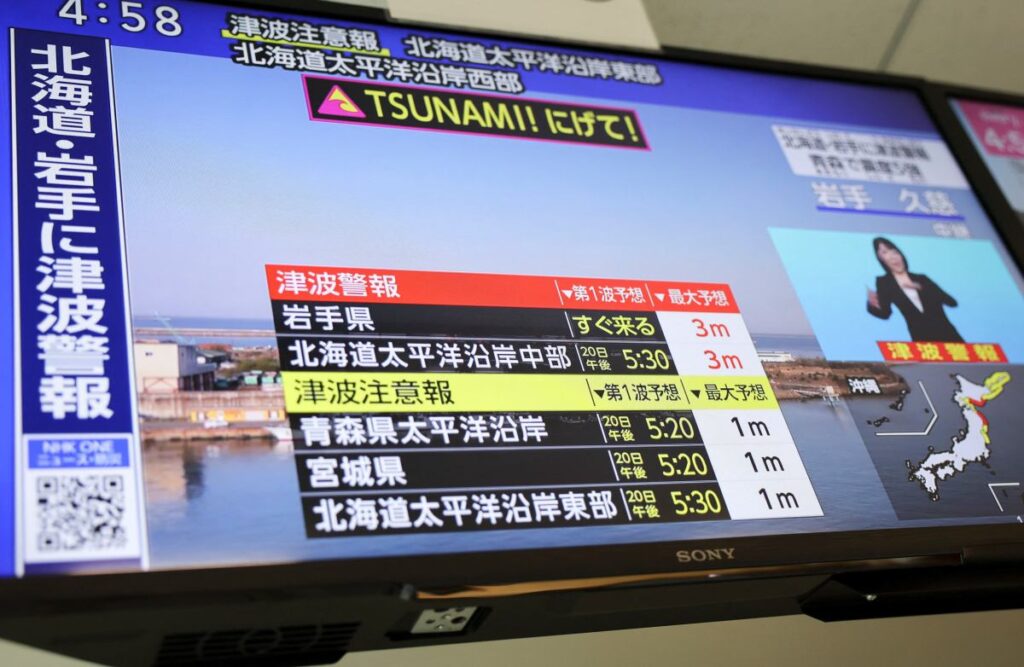
A significant earthquake struck off the coast of Japan, triggering tsunami warnings and prompting evacuations along the country’s northeastern coast.
Earthquake Details
Authorities report the epicenter was approximately 100 km from the Japanese coast, with the focus located 10 km deep. The Japan Meteorological Agency measured the earthquake’s strength at 5+ on the Japanese seismic scale of 0 to 7.
Tsunami Impact and Warnings
The first tsunami waves hit the Japanese coast after 11:00 AM local time. The largest wave, measuring 80 cm, was recorded in Iwate Prefecture. The Japan Meteorological Agency warns waves could reach 3 meters in height and impact the coasts of Hokkaido and Iwate Prefectures.
Evacuations and Government Response
Tsunami warnings are currently in effect for Iwate, Aomori, and Hokkaido Prefectures. Residents have been urged to evacuate to higher ground. Prime Minister Sanae Takichi has established a task force and reiterated the evacuation appeal.
“Residents in areas under tsunami warnings should immediately evacuate to higher ground or safer locations, such as evacuation shelters,” she stated. Reports confirm “human and material losses.”
Japan’s Seismic Activity
Japan is located in the Pacific Ring of Fire and is one of the world’s most earthquake-prone countries. Approximately 1,500 earthquakes are detected annually, most of which are imperceptible to humans.
Historical Context: 2011 Earthquake and Fukushima
In March 2011, Japan experienced a magnitude 9 earthquake, the strongest in the nation’s history, resulting in nearly 20,000 deaths and severe damage to the Fukushima nuclear power plant.
The most significant consequences of the Fukushima nuclear disaster stemmed not from radiation itself, but from forced evacuations, the disruption of local communities, and prolonged uncertainty. Fifteen years have passed since the largest nuclear accident of the 21st century.