


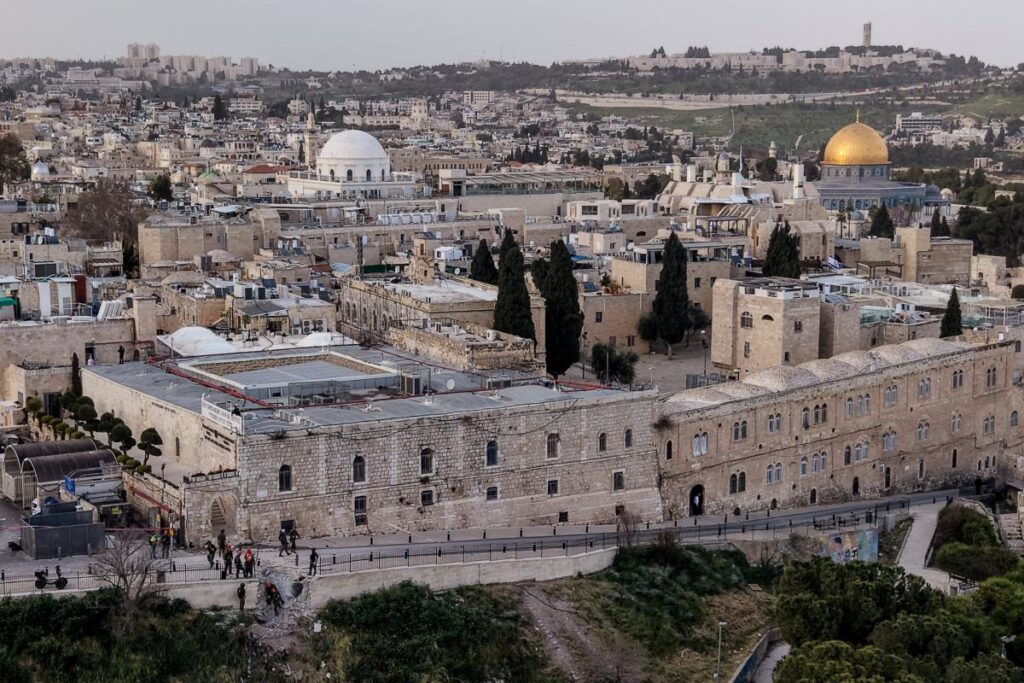
The Latin Patriarchate of Jerusalem has canceled Palm Sunday processions due to the ongoing conflict, while the Al-Aksa Mosque remains closed for the first time in decades.
Jerusalem Easter Celebrations Disrupted by War
Vatican News reported that the Latin Patriarchate of Jerusalem decided to cancel this year’s Palm Sunday procession from the Mount of Olives to Jerusalem, citing the ongoing war in the Middle East.
Cardinal Pierbattista Pizzaballa, the Latin Patriarch of Jerusalem, announced the procession will be replaced with a communal prayer at a yet-to-be-determined location. Other observances, including the Chrism Mass on Holy Thursday traditionally held at the Church of the Holy Sepulchre, have been postponed until the regional situation improves.
Limited Possibilities for Religious Observance
The Cardinal emphasized that the current situation significantly limits the ability to celebrate. He stated that recent events do not offer hope for a quick improvement and that organizing Holy Week celebrations will need to be done day by day, with large public events being impossible.
Churches Remain Open, Faithful Encouraged to Pray
Despite the difficulties, churches remain open, and clergy are encouraging the faithful to prayer and participation in Easter observances. The Cardinal noted that the conflict deprives people of the ability to experience the holidays together.
He invited the faithful to a special prayer on March 28th for peace and inner peace for those affected by the conflict, emphasizing that Easter carries a message of hope: “Easter reminds us that no darkness, not even that related to war, has the last word.”
Support for the Holy Land During Great Friday
On Good Friday, the faithful worldwide will be invited to support the Holy Land during the traditional collection. Cardinal Pizzaballa underscored that Easter brings a message of hope, stating that the empty tomb signifies the triumph of life over hatred and mercy over sin.
Al-Aksa Mosque Closure – A First in Decades
The Al-Aksa Mosque in Jerusalem, one of the most important places of worship for Muslims, remained closed on March 20th. This marked the first time in nearly 60 years that the mosque was inaccessible to worshippers during the final days of Ramadan.
The mosque was effectively closed to Muslim worshippers during the month of fasting beginning February 28th, coinciding with US-Israeli airstrikes on Iran. Authorities cited security concerns, leading thousands of Palestinians to gather and pray outside the Old City gates.
All gates leading to the Temple Mount, known to Muslims as Al-Haram al-Sharif (the Noble Sanctuary), remained closed on Friday, marking the start of the Eid al-Fitr holiday.
Palestinian Condemnation of Restrictions
The Presidential Committee for Church Affairs in Palestine, affiliated with the Palestine Liberation Organization, stated, “This unprecedented restriction prevented thousands of Palestinians from participating in one of the most important religious holidays in one of the holiest places in Islam.”
Historical Context of Jerusalem’s Holy Sites
East Jerusalem, where the Temple Mount is located, is a significant site for both Muslims and Jews. Israel occupied East Jerusalem during the Six-Day War in 1967, previously under Jordanian control.
Jordan formally oversees the Islamic Waqf, which administers the site under a 1994 peace treaty with Israel, but Israeli authorities make key decisions in practice. The Temple Mount houses the Al-Aksa Mosque and the Dome of the Rock, both built in the 7th century, and is associated with the ascension of the Prophet Muhammad.
The area was once the site of the First and Second Temples; a portion of the Western Wall is now considered the holiest place in Judaism.
In recent decades, the Temple Mount has been a focal point of tension due to restrictions on Palestinian Muslim access, Israeli archaeological work, and the eviction of Palestinian residents from nearby neighborhoods.