


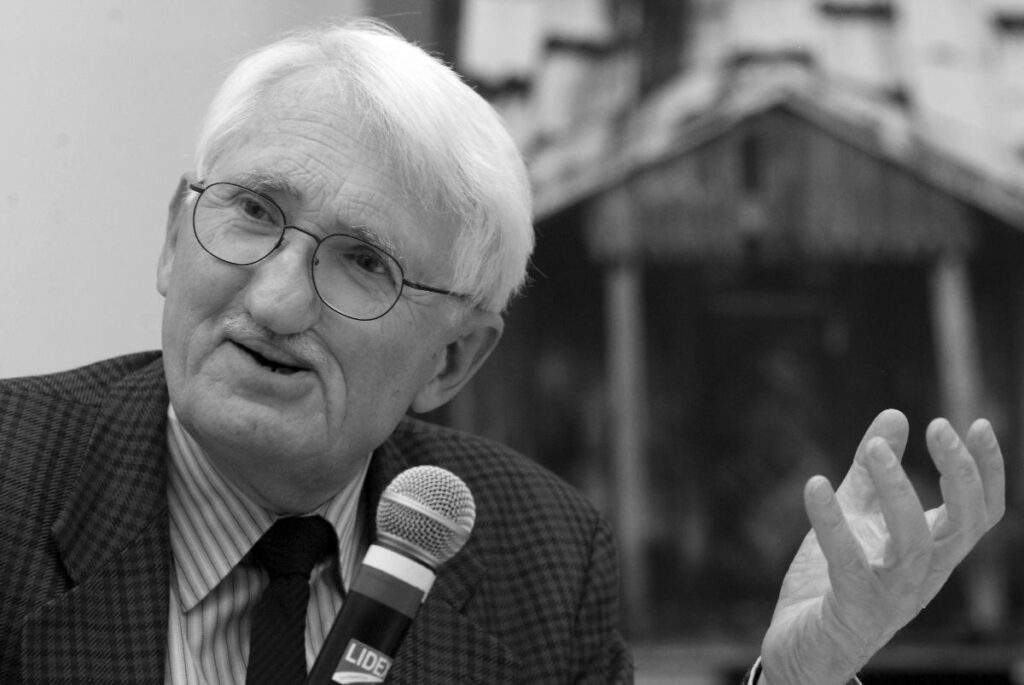
Prominent Frankfurt School philosopher Jürgen Habermas died Saturday in Starnberg, Germany, according to German TV reports.
Frankfurt School Professor and Influential Thinker
Representative of the so-called second generation of the Frankfurt School, philosophy professor at Goethe University in Frankfurt am Main, Jürgen Habermas died on Saturday in Starnberg – reported by the German TV portal Tagesschau.
His work focused on confronting Nazi Germany’s past at the beginning of the Federal Republic of Germany, as well as technological progress and its consequences for society. In the 1950s, he was an assistant to the first generation representative of the Frankfurt School, mass culture and capitalism critic Theodor W. Adorno.
Academic Career and Public Sphere Analysis
He published over 50 books translated into many languages. In 1961, he received a doctorate in Marburg for his work “Structural Transformations of the Public Sphere,” where he analyzed the emergence of public debate among citizens and its degeneration.
Political Engagement and Controversies
In 1968, he was perceived as a supporter of student uprisings, although he himself opposed their radicalization, speaking of left-wing fascism.
Early Life and Impact on German Discourse
During the war, he belonged to the Hitler Youth. At age 15, when the war was ending, he managed to avoid being drafted into the Wehrmacht by hiding from the military gendarmerie. This experience, as well as Nazi totalitarianism, left a deep mark on him – writes El Pais.
It led him to decisive engagement in democracy and deep distrust of those who returned to society without taking responsibility for their past actions. For seven decades, starting from criticism of fascism to warnings about resurgent nationalism, he shaped the discourse of post-war Germany – writes Reuters.
Public Commentary Until Final Days
Until the end of his life, he commented on public events, including the war in Kosovo, religious conflicts, governments in Germany and European affairs. When in October 2001 he received the German Peace Prize of the Book Trade, he addressed the 9/11 attacks.
“The war on terror is not a war, and terrorism also expresses, I would say, a fatal, silent conflict of worlds, which – besides the silent violence of terrorists against missiles – must develop a common language” – quotes Tagesschau from Habermas.